









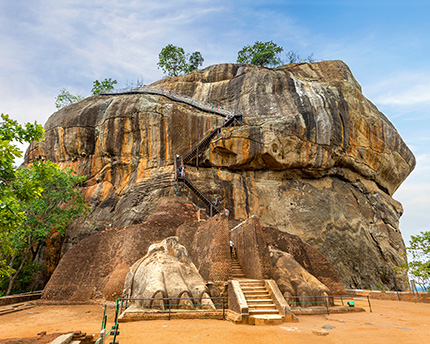
Also known as ‘the Lion Rock’, Sigiriya is considered to be the eighth wonder of the world and is one of Sri Lanka’s best-known tourist destinations. Some say that at the highest point of this site (the island’s great archaeological treasure) stood King Kasyapa’s palace, while others are convinced that there was an enormous Buddhist monastery here, which practised different rites and which must have been in existence centuries before and after the reign of Kasyapa (477-495). Whatever the truth is, this area is in Sri Lanka’s Central province, and was declared a World Heritage Site by UNESCO in 1982.
The enigmatic vertical rock of Sigiriya is the result of a magma eruption from an eroded volcano, and can be seen from kilometres away in all directions. The steep, flat-topped rock rises to a height of 200 metres. It should be noted that Sigiriya’s advanced hydraulic system comprises canals, lakes, reservoirs, bridges, fountains and underground water pumps, and still continues to provide water to the site’s rock gardens.
- Sigiriya: its history and interesting facts
- What you can see in Sigiriya
- How to get to Sigiriya
- Information and advice for visitors
- Where to stay in Sigiriya
Sigiriya: its history and interesting facts
It appears that Sigiriya (Sri Lanka) has been inhabited since prehistoric times. It was used as a monastery from the third century, with caverns prepared and donated by devout Buddhists. The garden and the palace were built by King Kasyapa, and after his death it continued as a monastic complex until the fourteenth century, when it was abandoned. Its ruins were discovered in 1831 by the British Army major Jonathan Forbes, and the site’s inscriptions were deciphered by the archaeologist Paranavithana, author of a ‘History of Sigiriya’. This site has spawned countless legends, including one claiming that King Kasyapa murdered his father in order to usurp his brother, Mogallana, who had a prior right to the throne, and that he committed suicide by falling on his sword after having been abandoned by his army.
What you can see in Sigiriya
There’s lots to see in Sigiriya. There are moats and fortified walls, superb gardens and a monastery, but the highlight is the 200-metre-tall granite rock that projects from among the ruins and is the great tourist magnet. On the top are the remains of a royal palace. We tell you what you can see in Sigiriya:
The Royal Gardens
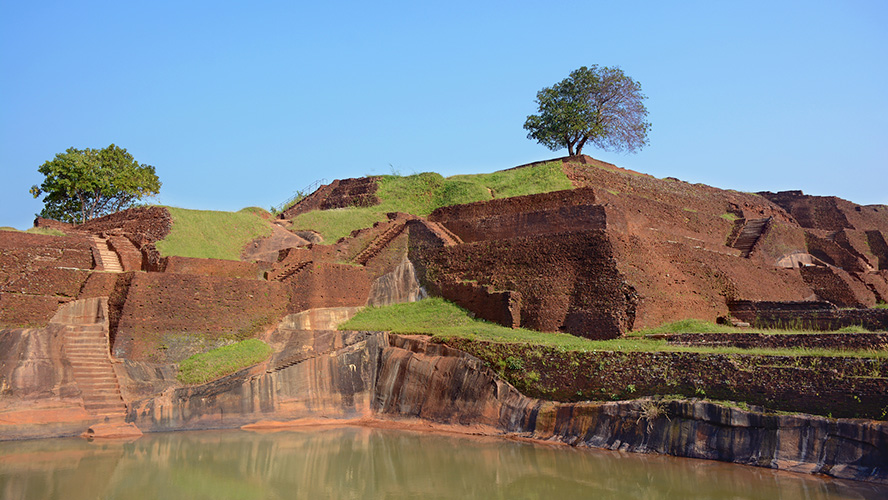
At the base of the Sigiriya rock is an area of symmetrical water gardens and natural crags that was once the site of Buddhist sanctuaries. There are also gardens designed using the stones that once formed part of the monastery buildings.
Frescoes
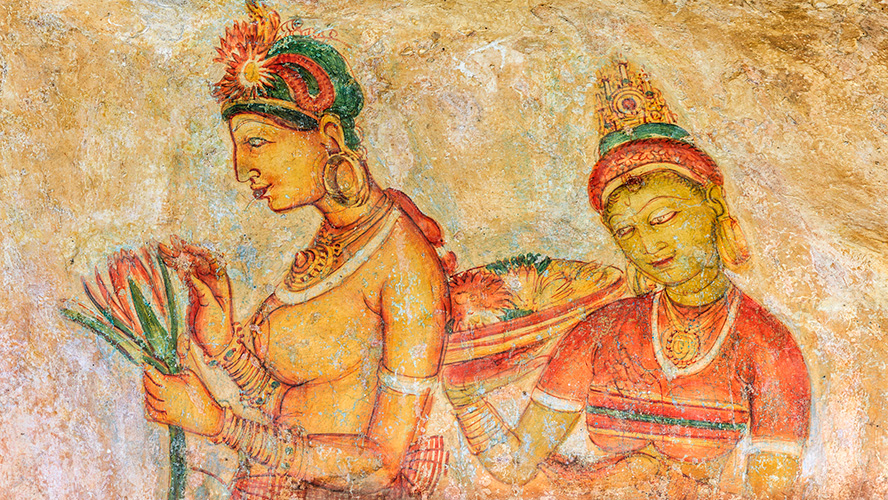
As visitors climb the 1,200 steps to the top of the rock, they will come across an open spiral staircase leading to a gallery around 140 metres in length, with pictures of voluptuous women representing celestial nymphs or concubines of the king. The frescoes are in a very good condition, but it is not known exactly when they were painted. Taking photographs is prohibited.
The Mirror Wall
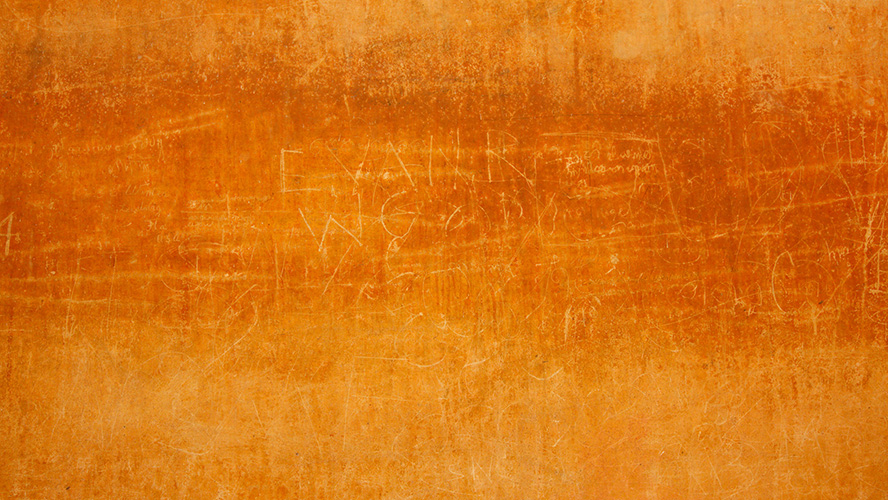
This is a wall of rock next to the gallery with the paintings of women, which bears inscriptions from the sixth to the fourteenth centuries with comments. This graffiti is of great interest to scholars, as it provides evidence on the development of the Singhalese language and script.
The lion’s paws
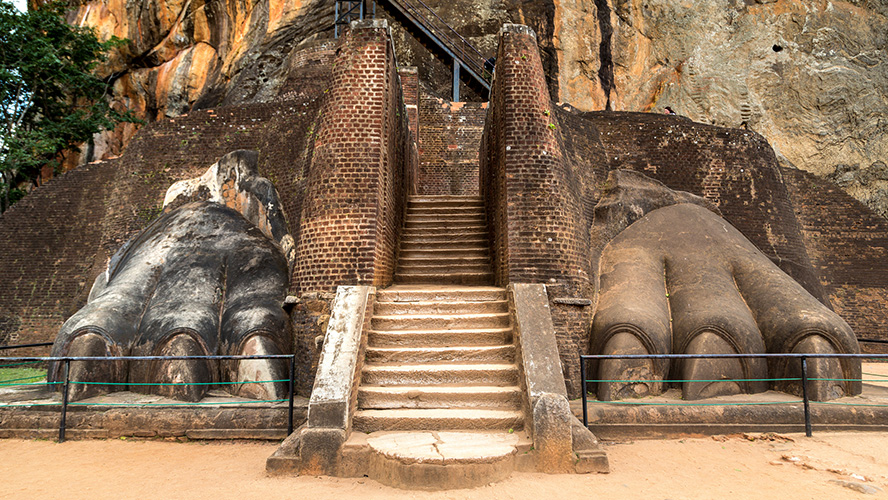
On the upper base of the rock, two enormous carved lion’s paws were discovered in 1898. It seems that originally, there was a massive lion at one end of the rock, and to climb up to the top, one had to begin at its paws and enter through its mouth. The lion reminds the faithful that the truths uttered by Buddha were as powerful as the roar of this lion. Of the original lion, only the lowest steps and the paws remain, although traces of the original steps can still be seen in the rock.
The Summit
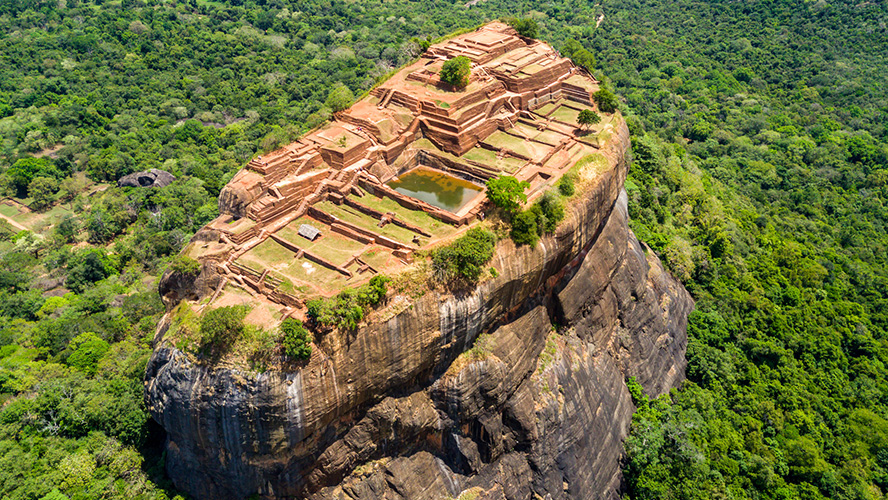
The highest point of Sigiriya is formed by terraces, and occupies a space of 1.6 hectares. Here (so it is said), King Ksyapa built his fortress, of which only the foundations now remain. The view from this spot, surrounded by emerald-coloured forests, is truly stunning.
The Cobra Hood Cave
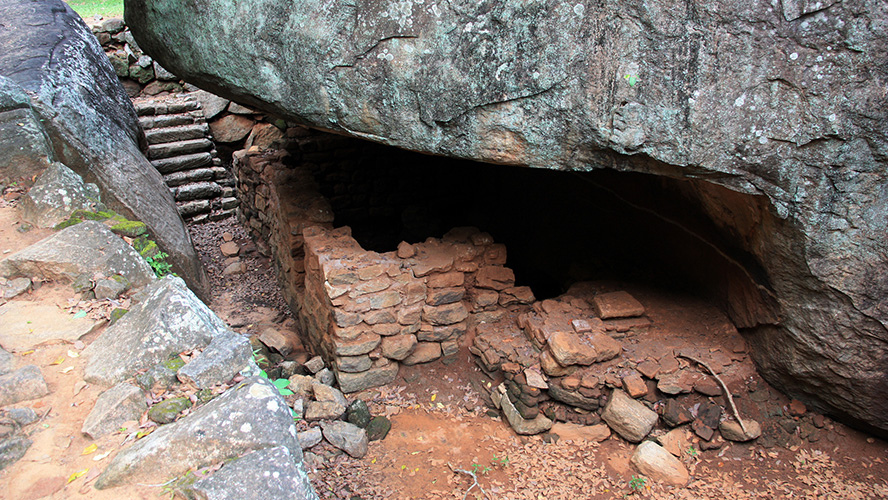
This is a mass of rock located in the rock garden, the shape of which resembles the open hood of a cobra. There were once paintings of flowers and animals inside the cave, but all that now remain are a few insignificant rough sketches.
Sigiriya Museum
This museum houses a huge scale model of the archaeological site, and enables visitors to appreciate the cultural significance of Sigiriya. The museum also explains the trading routes and the links between the site and the Persian Gulf, China, India, and the Roman Empire.
How to get to Sigiriya
Sigiriya is a three- to four-hour drive from Colombo. There are no direct buses, and the nearest railway station is in Habarana. So the best plan is to hire a private car or a taxi for the trip, and discover ‘in situ’ what Sigiriya has to offer.
Information and advice for visitors
The price of admission to the Sigiriya complex is 35 euros for adults and 16 euros for children. Children under 6 years are admitted free of charge. The site is open from 5.00 a.m. until 5.00 p.m., Monday – Sunday. As this is an archaeological site and not a sacred place, visitors to Sigiriya can dress in shorts and sleeveless tops. You need to bear in mind that the visit will last approximately half a day. It is advisable to arrive early in the morning in order to avoid the high temperatures and the crowds of visitors. It’s a good idea to begin your tour with the rock, and then to visit the gardens and the museum. As there is little shade at the highest part, it is worth bringing a hat and water. During the months of July and August, you need to beware of the wasps that nest in the rocks.
Where to stay in Sigiriya
If you’d like to visit Sigiriya and to stay in a hotel that guarantees comfort and relaxation, we recommend the Occidental Paradise Dambulla Hotel, which also offers excellent value for money. This is a very welcoming, four-star establishment set in the midst of nature. Without sacrificing the slightest luxury, you can have dinner among the trees, relax by the large pool, or enjoy your villa. The hotel enjoys excellent links, and boasts two restaurants where you can enjoy local and international cuisine. There are also two bars where you can spend a pleasant and memorable interlude. The hotel also offers a wonderful Ayu Balinese Spa and a complete Fitness Centre. There is a separate pool especially for children, and they can take part in activities designed specifically for them.
Another highly recommended hotel in Sri Lanka is the Occidental Eden Beruwala, a beach-front hotel with an interesting gastronomic offer. This really is paradise, because its 158 guest rooms offer a multitude of comforts, providing a refuge where you can unwind right by the Indian Ocean. The hotel also boasts an exclusive Ayurvedic spa, a hairdresser, a beauty centre and a gymnasium. This is definitely the five-star option for discerning travellers.