



































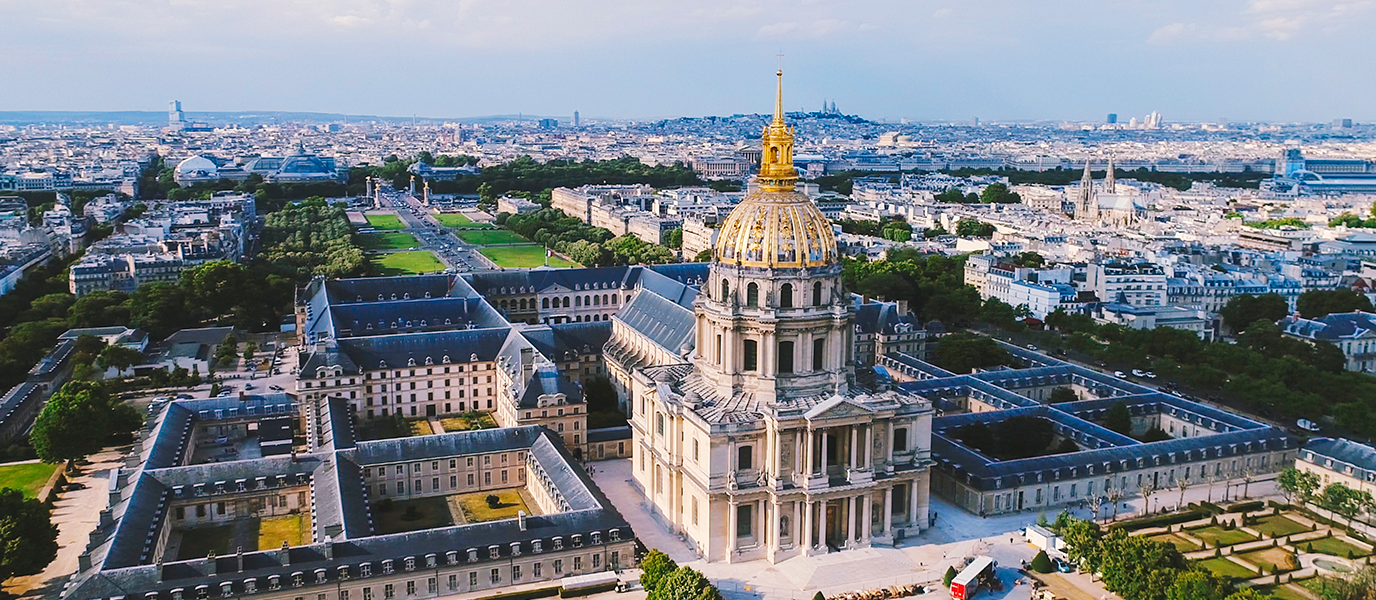
Les Invalides occupies a special place among the grand monuments of Paris. It is not just an imposing building with its golden dome that is visible from several areas in the city, it is also an ensemble that encapsulates centuries of French military history. Founded in the 17th century as a hospital and residence for war veterans, it is now a pantheon, museum and national symbol. It houses Napoleon Bonaparte’s remains under a lavish mausoleum, surrounded by collections that tell the story of battles, uniforms and weapons from different eras. Visiting it reveals the most solemn side of the French capital.
- History and significance of Les Invalides: from Louis XIV’s hospital to France’s military shrine
- The Dôme des Invalides: Napoleon’s tomb under the golden dome
- Museum highlights: collections of weapons, uniforms and memories of the great wars
- How to get there and information for visitors: opening hours, tickets and practical tips
- Highlights in the surrounding area: stroll through the most distinguished and elegant part of Paris
History and significance of Les Invalides: from Louis XIV’s hospital to France’s military shrine
The origins of Les Invalides date back to 1670, when Louis XIV, the so-called ‘Sun King’, commissioned a hospital and residence to accommodate the disabled soldiers (‘invalides’) after returning from war. The building was designed by the architect Libéral Bruant and completed by Jules Hardouin-Mansart, one of the key French Baroque names. The building had to be functional, but also reflect the monarch’s power and the army’s grandeur. Therefore, in addition to halls and dormitories for veterans, monumental courtyards and a royal church with majestic proportions were added.
The Hôtel des Invalides, as it is known in French, opened in 1676 and soon became a symbol of the state’s gratitude to its soldiers. Over 4,000 veterans came to live there in its heyday, supported by a system that included workshops for them and chapels for their religious services. In the following centuries, the ensemble took on a new role: not only as a military hospital, but also as a centre for historical memory. For example, during the French Revolution, it was stormed in 1789 by the Parisians, who seized thousands of weapons stored there in order to take the Bastille that same day.
In the 19th century, Les Invalides began to house the remains of great military figures: the first and most famous of all was Napoleon Bonaparte, transferred in 1840 from the island of Saint Helena. Since then, the site has established itself as a shrine to French military memory, with museums dedicated to the wars, uniforms and the history of France’s armies. Today, Les Invalides combines that dual legacy: it is still a military hospital, with administrative and medical functions, but it is also a museum and mausoleum open to visitors from all over the world.
The Dôme des Invalides: Napoleon’s tomb under the golden dome
The Dôme des Invalides, crowned by a golden dome that shines brightly in the sun, is the heart of the ensemble. It was built by the architect Jules Hardouin-Mansart, who designed it as a royal chapel for Louis XIV’s family. The building was completed in 1706 and was soon considered to be one of the finest examples of Baroque architecture in France.
Napoleon Bonaparte was entombed inside, under the majestic dome, in 1840. His remains were transferred from Saint Helena by order of Louis-Philippe I in what became known as the ‘retour des cendres’ (the return of the ashes). The imposing reddish sarcophagus is made of quartzite from Russia and rests on a pedestal of green granite from the Vosges. Around it, white marble reliefs depict the emperor’s major victories and achievements in a solemn setting designed to exalt his figure.
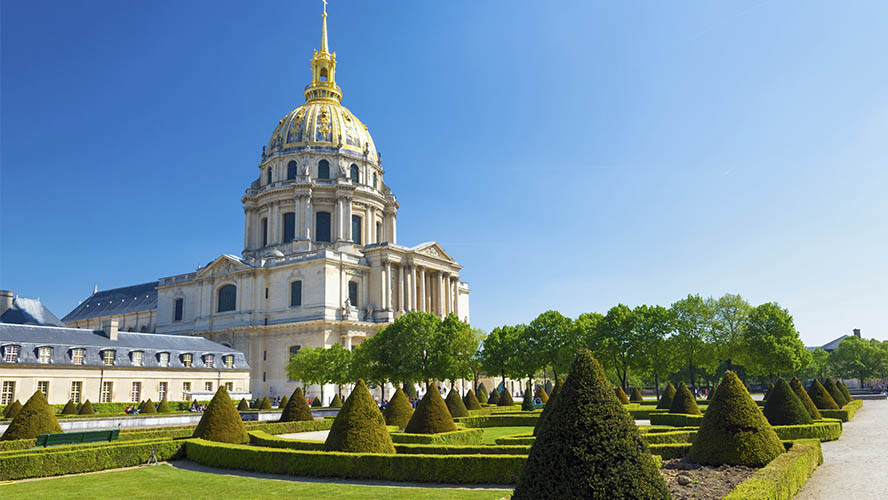
Nevertheless, Napoleon is not alone. In adjoining chapels lie other great names in French military history, including his son Napoleon II, Marshal Foch, who was Supreme Allied Commander during World War I, and Marshal Lyautey, a key figure in the colonial army. This pantheon of heroes makes the Dôme des Invalides a place full of symbolism, where every architectural and decorative detail is aimed at glorifying the memory of those who marked France’s history.
Museum highlights: collections of weapons, uniforms and memories of the great wars
In addition to the church and the pantheon, Les Invalides boasts one of the most complete military museums in the world: the Army Museum. Created in 1905, it brings together an impressive collection from the Middle Ages to the 20th century.
Visitors can explore rooms dedicated to medieval armour, firearms from the 16th and 17th centuries, uniforms from different periods, cannons, flags and personal objects from great military figures. One of the most visited sections is the one dedicated to the World Wars, where photographs, vehicles, soldiers’ letters and original pieces that transmit the human dimension of those terrible conflicts are on display. Equally interesting is the gallery dedicated to Napoleon, with his sword, decorations and other objects that give an insight into the emperor’s life.
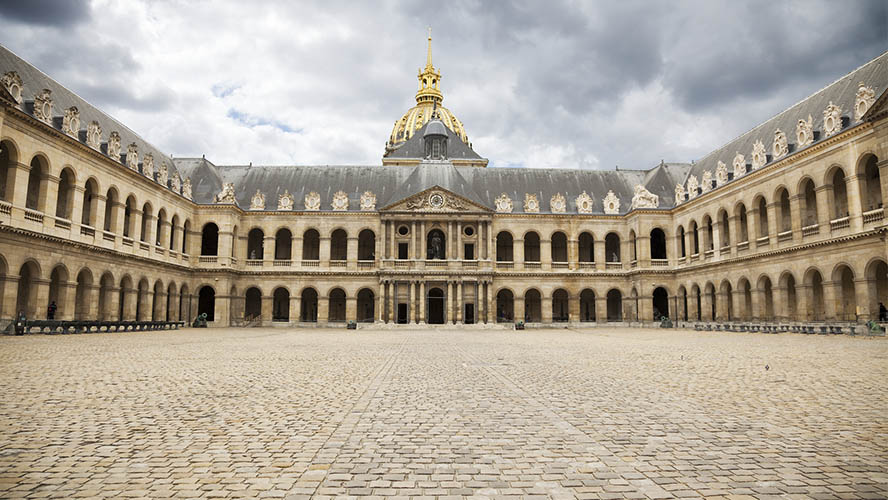
The museum is not just a succession of display cases: the museography is designed to help visitors understand how military history influenced the evolution of France. It shows the army’s role in building the state, in the colonial conquests and in the resistance against the Nazi occupation. All of this is provided in a monument setting that reinforces the solemn character of the place.
How to get there and information for visitors: opening hours, tickets and practical tips
Les Invalides is located in the 7th arrondissement of Paris, on the left bank of the Seine. Its golden dome can be seen in the distance, making it easy to find your way to the monument. The nearest metro station is Invalides (lines 8 and 13), but you can also get there from La Tour-Maubourg or Varenne.
The site is open every day, with opening hours varying according to the season: generally from 10:00 a.m. to 6:00 p.m., extending until 10:00 p.m. on the first Friday of each month. The general admission ticket, which costs 17 euros, includes access to the Dôme des Invalides, Napoleon’s tomb and the Army Museum. Reduced rates are available for young people, students and groups, and admission is usually free for EU residents aged under 18. The recommendation is to book in advance, especially during the peak season, to avoid queues.
To make the most of your visit, at least two hours is recommended, although military history buffs can easily spend half a day touring the galleries. The monument also has a souvenir shop, cafeteria and access for people with reduced mobility.
Highlights in the surrounding area: stroll through the most distinguished and elegant part of Paris
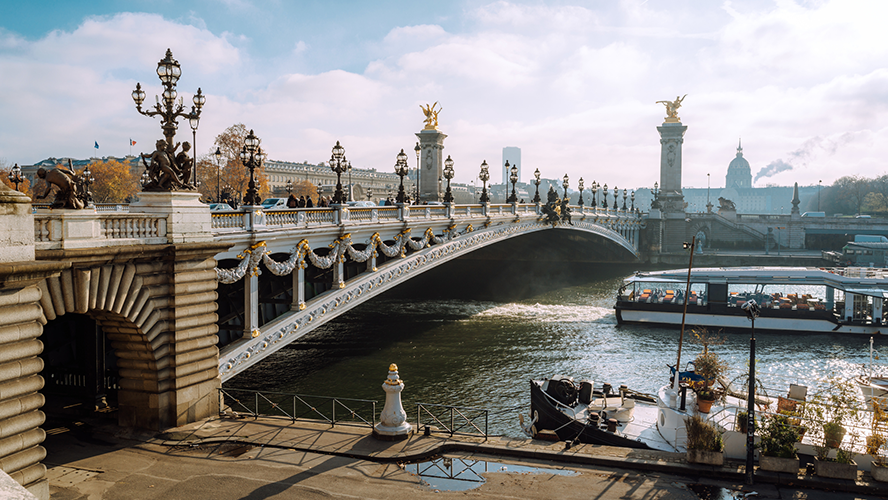
Visiting Les Invalides is also the perfect opportunity for strolling through one of the most elegant districts of Paris. A few metres away is Pont Alexandre III, considered to be the most beautiful bridge in the city, with its lampposts and golden sculptures that combine with the Dôme. To the west is the Invalides esplanade, a large green area that visually connects the ensemble with the Seine and is ideal for resting or admiring the building’s architectural façade.
Nearby are also other great Paris museums: the Rodin Museum, housed in a palace with gardens where sculptures such as The Thinker and The Burghers of Calais are exhibited; and the Orsay Museum, famous for its collection of Impressionist painters. All this makes a visit to Les Invalides an experience that is not limited to the monument itself, but is integrated into a first-rate cultural environment.