












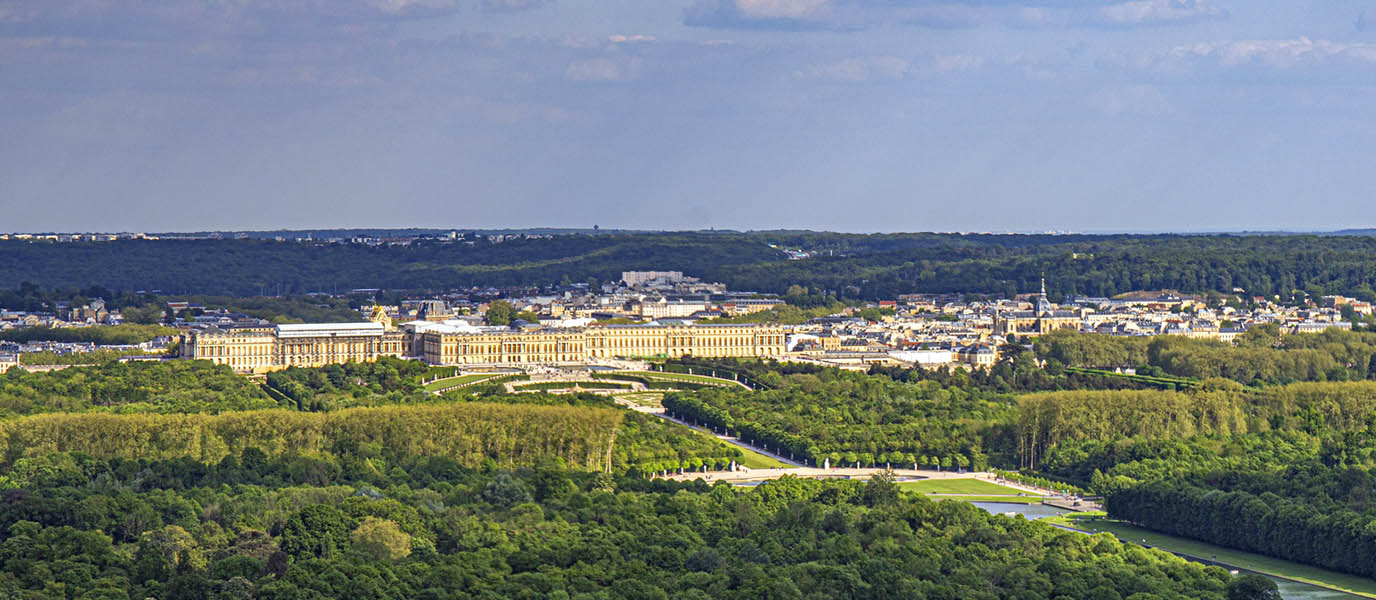
Versailles Palace is not only one of the most imposing buildings in Europe, but also a symbol of the absolute power of the French monarchy and the excessive luxury that defined the court of Louis XIV. Located some twenty kilometres from Paris, the palace is a universe in itself: more than 2,000 rooms, galleries and halls filled with frescoes, mirrors and marble, accompanied by gardens that seem to stretch to infinity, designed with mathematical precision to glorify a king who proclaimed himself to be the ‘Sun’. Today, touring Versailles is an experience that transports travellers directly into the heart of the Ancien Régime and the settings that forever changed the course of the history of both France and Europe.
- A brief history of Versailles Palace: from a former hunting lodge to the centre of royal power
- How to get to Versailles from Paris: routes and practical tips
- Highlights at Versailles: the endless halls, galleries and treasures of the Sun King
- Versailles Gardens: fountains, sculptures and paths that tell the story of a kingdom
- Information for visitors: opening times, prices and useful tips
A brief history of Versailles Palace: from a former hunting lodge to the centre of royal power
The history of Versailles Palace began in 1623, when Louis XIII ordered the construction of a small hunting lodge on a marshy piece of land on the outskirts of Paris. Nevertheless, it was his son, Louis XIV, who transformed it into the most lavish palace in Europe. The Sun King, who wished to get away from the bustle and intrigues of Paris, commissioned the architects Louis Le Vau and Jules Hardouin-Mansart, the painter Charles Le Brun and the landscape designer André Le Nôtre to turn that modest lodge into the most grandiose royal residence of the time.
The construction of Versailles went on for decades, in successive phases that extended its wings, halls and gardens. The famous Hall of Mirrors, with 357 mirrors facing 17 windows reflecting the gardens, became the ceremonial epicentre of the monarchy and the setting where major treaties were signed, such as the one that ended World War I in 1919. Throughout the 17th and 18th centuries, Versailles established itself as the political, artistic and diplomatic powerhouse of Europe.
In 1789, with the outbreak of the French Revolution, the royal family was forced to leave the palace and move to Paris. Versailles Palace then ceased to be a royal residence and has become a museum of French history, a function it retains to this day. Nevertheless, its walls are still steeped with the memory of the court festivities, masked balls and councils of ministers that shaped the destiny of a country.
How to get to Versailles from Paris: routes and practical tips
Versailles is located just 20 kilometres southwest of Paris, so getting there from the capital is quick and easy. One of the most convenient options is the RER suburban train line C, which connects several central stations such as Saint-Michel and Champ de Mars to Versailles Château-Rive Gauche station in about 45 minutes. From there it is only a 10-minute walk to the palace’s main entrance.
Alternatively, regional trains from Montparnasse and Saint-Lazare stations run to other Versailles stations such as Chantiers and Rive Droite. For those who prefer greater comfort, there are sightseeing buses that include admission to the palace and guided tours. It can even be reached by bicycle from Paris, following scenic routes along the Seine, which is an ideal experience for the more intrepid.
Plan your visit well: during the peak season, there are often long queues at Versailles Palace, so you should buy tickets in advance. You should also arrive early to make the most of the day, as visiting the interior and gardens can easily take six to eight hours.
Highlights at Versailles: the endless halls, galleries and treasures of the Sun King
Visiting Versailles Palace is entering into an unparalleled artistic display. Among its more than 2,000 rooms, there are some that are a must. The Hall of Mirrors is certainly the most famous, a 73-metre-long space that symbolises the grandeur of the French monarchy and has been the setting for coronations and historic treaties.
The King’s State Apartment, with the Hall of Apollo, the Hall of Diana and the Hall of Mars, shows how the monarch used each space not only for living, but also for displaying his power. Louis XIV’s bedroom, decorated with embroidered silk and gold brocade, reflects the daily ritual of the ‘lever’ and ‘coucher’ (getting up and going to bed), public ceremonies in which nobles and courtiers witnessed the monarch begin and end his day.
No less spectacular is the Queen’s Apartment, with Marie Antoinette’s bedroom, restored to show how it looked on the eve of the Revolution. Other notable rooms include the Royal Chapel, where solemn masses were celebrated, and the Royal Opera House, inaugurated in 1770 on the occasion of the marriage between Marie-Antoinette and the future Louis XVI, with a small theatre that dazzles with its acoustics and ornamentation.
Versailles Gardens: fountains, sculptures and paths that tell the story of a kingdom
If the palace is impressive on the inside, the gardens are even more spectacular. Designed by André Le Nôtre, they occupy some 800 hectares arranged with a perfect geometry symbolising the king’s control over nature. Strolling through its tree-lined avenues and flowerbeds, visitors will find more than 400 sculptures, ponds, fountains and artificial grottoes.
The fountains are true works of hydraulic art. The Fountain of Latona, representing the myth of Apollo’s mother, and the Fountain of Apollo, where the god emerges from the waters in a horse-drawn chariot, are a reminder of Louis XIV’s role as the Sun King. During the spring and summer weekends, the musical and night fountain shows revive the Baroque splendour with water and light choreographies.
Beyond the central axis are the Grand Trianon and the Petit Trianon, small palaces used by the royal family to escape the ceremonial rigidity of the court. Marie-Antoinette took refuge in the Petit Trianon and the Queen’s Hamlet, an idealised recreation of a rural village where she could enjoy a simpler life, but without sacrificing luxury.
Touring the gardens is an experience that requires time and energy. Many visitors rent bicycles or electric vehicles to get to the more out-of-the-way spots such as the Grand Canal, an artificial lake almost two kilometres long where regattas used to be organised in the past.
Information for visitors: opening times, prices and useful tips
Versailles Palace is open every day, except Mondays and 1 May. The usual opening hours are from 9:00 a.m. to 6:30 p.m. during the peak season (April to October) and until 5:30 p.m. during the off-peak season. On the other hand, the gardens are open from 8:00 a.m. to dusk.
General admission to Versailles Palace is €21, although there are different combined passes that include the Trianons and the Queen’s Hamlet. Children under 18 and EU citizens under 26 have free admission. An additional ticket is required for the fountain and garden shows.
In terms of time, you should spend at least a full day touring both the palace and the gardens. Those who have more time can divide their visit into two days: one devoted to the interior and the other to the gardens and annexes. You should wear comfortable shoes, carry water and take breaks since the distances are considerable.