


















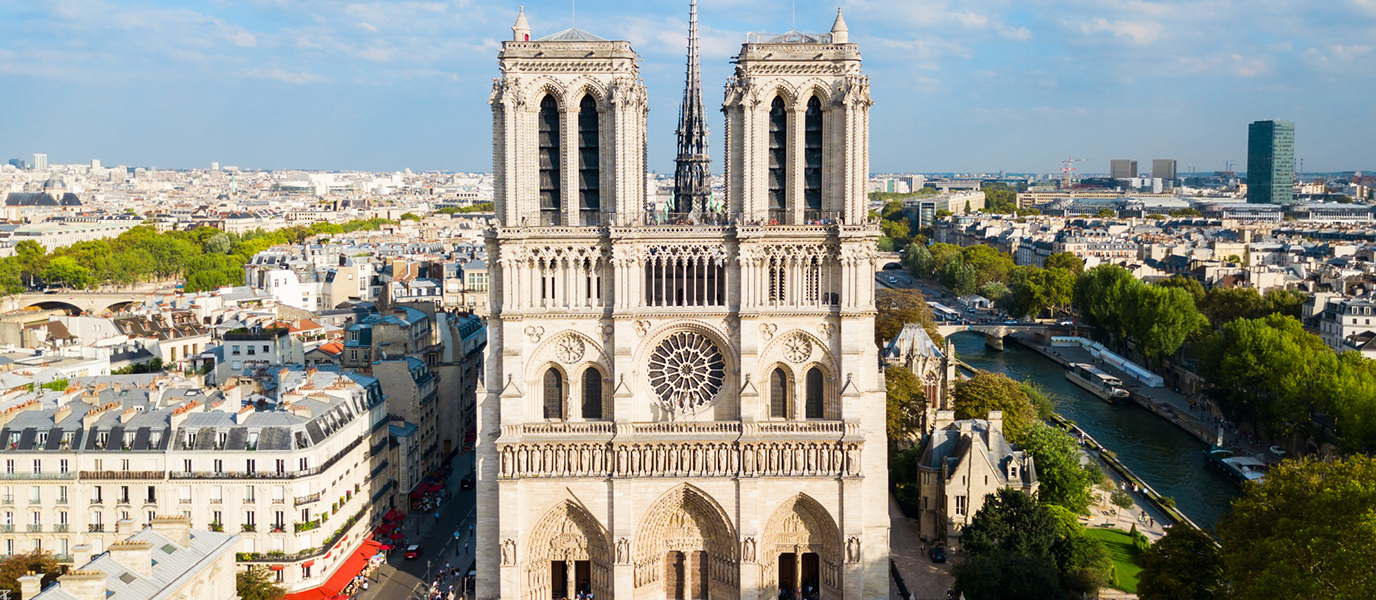
The whole world shuddered on the 15th of April 2019, when fire began to consume the towers of Notre-Dame Cathedral. This icon of Paris (a UNESCO World Heritage Site since 1991) was affected by a serious fire, the consequences of which fortunately were not fatal, as this Gothic church, one of the oldest in the world, has been restored in record time. Notre-Dame reopened on 7th December 2024 when the doors of this masterpiece of art were solemnly opened to the public.
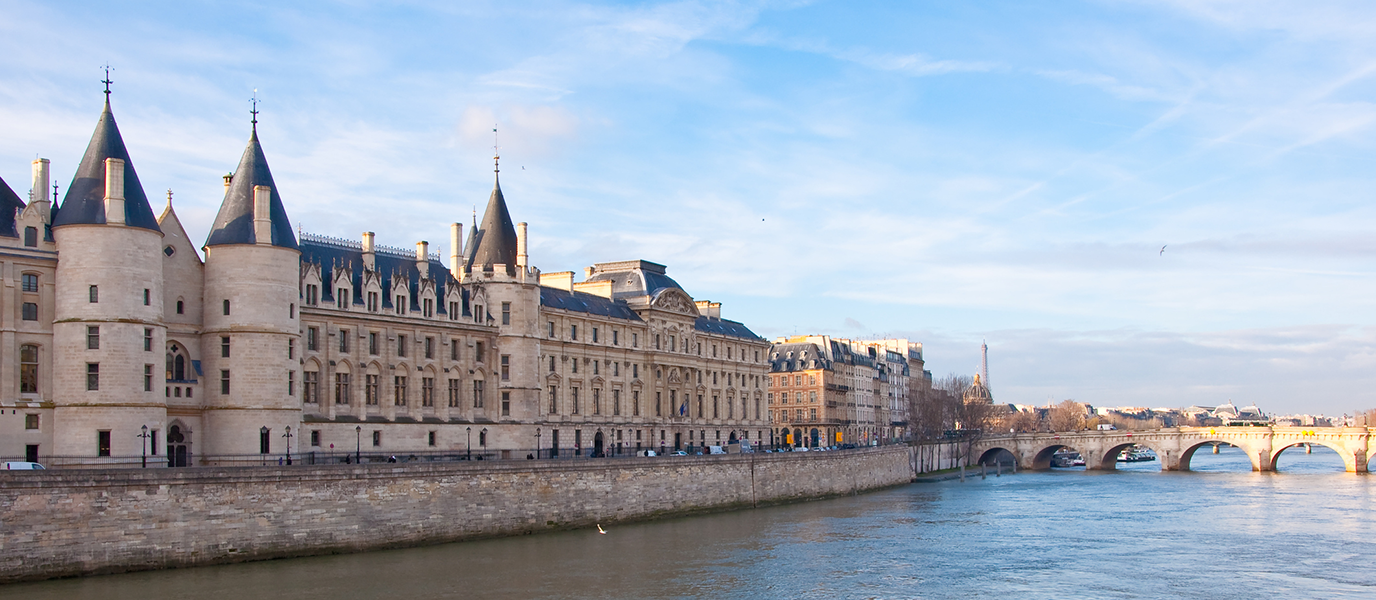
Located in the heart of Paris, at the end of the Île de la Cité, the Cathedral of Notre-Dame was built between the twelfth and fifteenth centuries, and stands very close to some of the city’s other architectural jewels, including the Sainte-Chapelle and the Conciergerie. And now, fortunately, travellers can visit Notre-Dame and once again admire its monumental rose windows, its newly restored stained-glass windows, its iconic towers, its fantastic gargoyles, and the archaeological crypt, as well as the treasure house, with its works of art and outstanding liturgical pieces.
- A history dating back over 800 years
- The exterior of the Cathedral of Notre-Dame
- What to see inside the cathedral
- How to go up Notre-Dame’s towers
- Notre-Dame Cathedral: opening hours, admission, worship…
A history dating back over 800 years
The Cathedral of Notre-Dame is possibly France’s most visited monument, along with the Eiffel Tower. Nowadays, no tourist on a trip to Paris forgets to visit this gem of Gothic art, and particularly after the fire that almost destroyed this great icon of architecture, with its history going back over 800 years. It receives over 15 million visitors every year.
It should be remembered that it was the Bishop of Paris, Maurice de Sully who, in 1160, decided to build a cathedral in the style of the age. He immediately secured the support of King Louis VII and that of several professional corporations, so work began only three years later — although it was not completed until 1272, a century later.
It seems that the Cathedral was built on a site that was already home to several religious buildings: a fourth-century, Early Christian basilica of the Merovingian period, a cathedral from the Carolingian period, and another, Romanesque cathedral.
The cathedral, immortalised by Victor Hugo in his novel ‘Notre Dame de Paris’, has witnessed key moments in the history of France. In fact, during the French Revolution in 1793, it became a Temple de la Raison [Temple of Reason]; it was here that the Emperor Napoleon was crowned in 1804, and this is where the liberation of Paris from the Nazis was celebrated in 1944, and attended by General Charles de Gaulle after he had walked down among the crowds from the Champs-Élysées.
The exterior of the Cathedral of Notre-Dame
The western façade is Notre-Dame’s main façade, and is therefore the most impressive architecturally. It has three horizontal and three vertical sections, in addition to two towers and three entrances. The central entrance, also known as the Portal of the Last Judgment, dates from the early thirteenth century. The top section depicts the figure of Christ, along with two angels, the Virgin, and Saint John the Apostle. The central section portrays Saint Michael and the demons, and on the lowest part is a scene of the dead at the moment of resurrection. On the lower plinth can be seen the ‘Vices’ and the ‘Virtues’, together with the calendars and the signs of the zodiac.
Over the façade entrances is the Gallery of Kings, a collection of 28 statues representing the kings of Judea and Israel; most of these were destroyed during the French Revolution because people thought they represented kings of France, so the statues we see today are replicas of the originals, some of which can be seen in the Musée de Cluny.
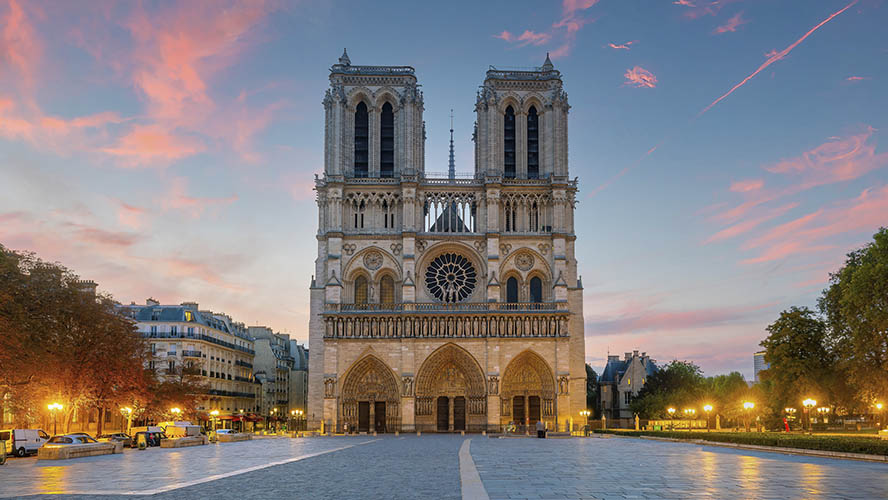
The cathedral’s towers are 69 metres tall. It is worth remembering that inside the south tower is the famous bell, Emmanuel, weighing 13 tonnes and with a 500 kilo clapper. It is only rung at great celebrations and on auspicious occasions.
What to see inside the cathedral
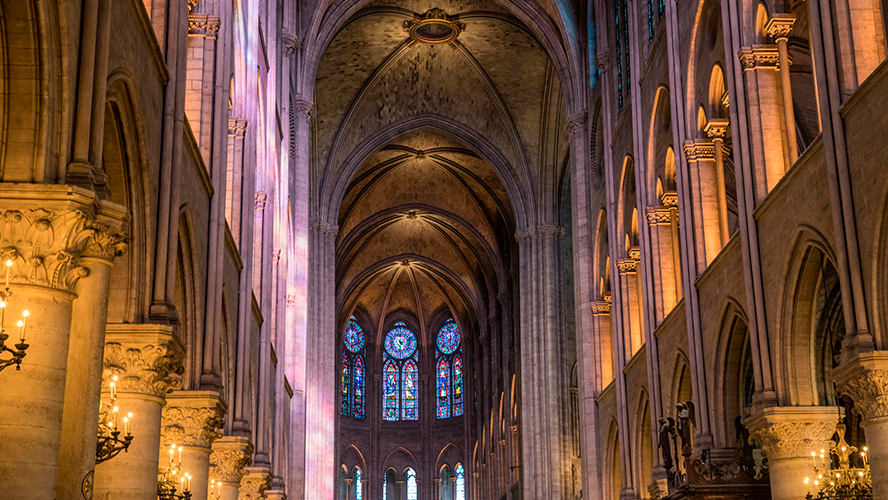
Inside, Notre Dame cathedral is striking for its luminosity, thanks to the large windows in its apse and its aisles. The sculptured decorations on the capitals and other areas, mainly depictions of plant life, are in character with its Cistercian simplicity. In the apse, the outstanding feature is the Pietà, a monumental sculpture by Nicolas Coustou (eighteenth century), which is flanked by effigies of Kings Louis XIII and Louis XIV, who appear kneeling in supplication and surrounded by angels. The choir retains part of its eighteenth-century wooden seating, with Baroque embellishments. The majority of the stained glass windows were installed during successive restorations undertaken from the nineteenth century onwards. And the case of the cathedral’s organ is decorated with automatons.
The cathedral’s treasure house is home to items linked to the Passion of Christ, including the crown of thorns, a fragment of the True Cross, and one of the nails used for the Crucifixion, relics apparently acquired by King Louis IX from the Emperor of Constantinople.
How to go up Notre-Dame’s towers
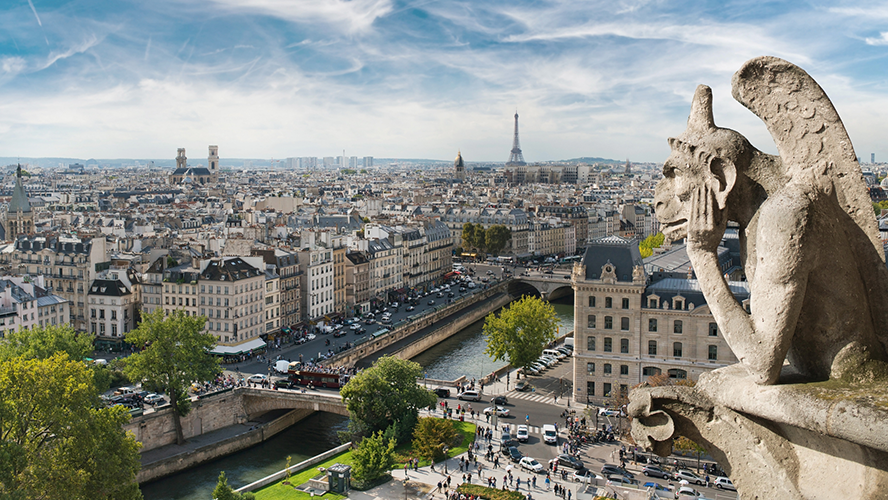
If you like ‘high architecture’, you must go up to the cathedral’s towers, in one of which lived the ‘hunchback of Notre-Dame’, created by the imagination of Victor Hugo. As from 25th September 2025, it will be possible to enjoy this jewel of Gothic art from the heights for the first time since the 2019 fire. Visitors have to climb 424 steps up a spectacular oak double staircase, to be rewarded with an outstanding 360-degree panorama from the south tower with beautiful views over Paris and its surroundings, as well as enjoying a view of the gargoyles and the cathedral spire. Afterwards, you go past the famous ‘bumblebees’ and the courtyard of cisterns, before going down the North Tower.
Notre-Dame Cathedral: opening hours, admission, worship…
Notre-Dame Cathedral’s visiting times are 7.45 a.m. until 7.00 p.m.
To go up the South Tower, visitors need to be physically fit. The climb involves 424 steps and you have to go through some narrow stretches (45 centimetres) and low sections where you have to crouch down. There is no lift, no toilets, and no offices where you can leave bulky items.
Where is Notre-Dame? The cathedral is in the Ile de la Cité, in the heart of Paris. The cathedral is easily reached from the Cité or Saint-Michel metro stations. Or you could travel by bus routes 21, 24, 27, 38, 81, 85 or 96.
What about admission to Notre-Dame? Entry to the cathedral is free, but if you want to go up the towers, there is a charge that has to be paid on line.
Every Sunday there is a mass at 11.30 a.m., and on working days there are three services: at 8.00 a.m. (8.30 a.m. on Saturdays), 12.00 noon and 6.00 p.m.
The Notre-Dame Whispers mobile app provides an audio tour of the cathedral, a free experience that reveals secrets and stories related to this sacred place.