






























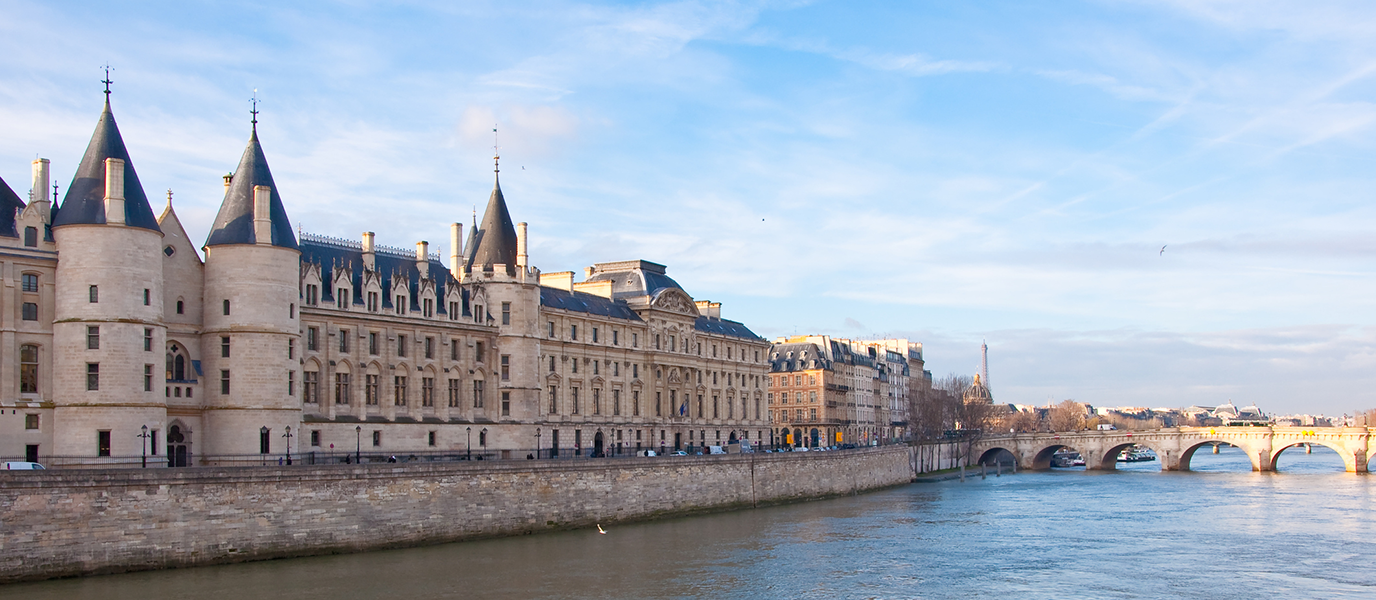
Sainte-Chapelle de Paris is one of the architectural jewels of the ‘City of Light’.This church was built in the thirteenth century on the orders of Louis IX to house one of history’s greatest and most famous relics: Jesus Christ’s Crown of Thorns, which has been kept in the Cathedral of Notre Dame since 1806.The French King also acquired other relics of the Passion of Christ, one of the most important being a fragment of the Cross.
Anyone entering Sainte-Chapelle (located within the vicinity of the Palace of Justice in the Île de la Cité) is left awestruck by the beauty of the stained-glass windows which depict 1,113 scenes from the Old and New Testaments up until the arrival of the relics in Paris in the thirteenth century.
This is one of the essential sights of the French capital, and one for which it is well worth setting aside the best part of a morning or afternoon.
- The history of Sainte-Chapelle
- The architecture and exterior of Sainte-Chapelle
- What you can see inside
- The location of Sainte-Chapelle and how to get to it
- Practical advice for your visit: opening times and prices
The history of Sainte-Chapelle
During the Middle Ages, there was a fervour for worshipping and collecting Christian relics. So much so that in 1239 Louis IX bought Jesus’s Crown of Thorns from Baldwin II of Courtenay, the last Roman Emperor of the Byzantine kingdom in Constantinople, for an amount estimated to equate to half the annual income of the kingdom of France. Two years later, the King acquired another 21 relics, which included a fragment of the so-called True Cross.
He ordered the building of a chapel, the Sainte-Chapelle, to house this treasure. The edifice was also intended as a demonstration of authority and prestige to emphasise the power of his rule. With this church, where the relics of Christ’s Passion were kept and venerated, Paris was considered by many to be the ‘new Jerusalem of the West’.
It is not known who designed the building which was consecrated in 1248, but it was conceived as a Palatine chapel set within the residence of the Capetian dynasty or the ‘house of France’ in the Île de la Cité (the heart of the oldest part of Paris). On the upper floor, there was a chapel where the relics were worshipped in a gilded silver-and-copper reliquary, and which was for the exclusive use of the monarch and his guests. The lower chapel was for the use of the palace staff. The two floors were linked by a gallery.
During the French Revolution (1789-1799), most of the relics disappeared and the chapel was used to store flour, but the Crown of Thorns survived; after being kept for some years in the French National Library, the sacred relic became part of the treasure of Notre-Dame cathedral in 1806.
After serving as an archive of the Palace of Justice between 1803 and 1838, Sainte-Chapelle remains conserved much as it was when it was first built, thanks mainly to a restoration project undertaken between 1840 and 1863. Today, after centuries of being neither a place of worship nor a great reliquary for Christianity, it is one of the world’s most beautiful and impressive Gothic edifices.
The architecture and exterior of Sainte-Chapelle
Considered a masterpiece of what is known as the Rayonnant Gothic style, thanks to the rays of light that radiate through the windows, Sainte-Chapelle was built within seven years (1242-1248) — a record for the completion of a finished edifice.
Its design, as a work of precious metal with few walls — the pillars merely form a stone skeleton: the rest is glass — is remarkable for the dominant presence of windows that filter the light into the interior through the coloured stained-glass windows.
These ‘walls of light’ were designed to glorify the French monarchy of the time, as the light inside the building gives a sense of immateriality. In total, there are 15 stained-glass windows, each measuring 15 metres tall, with the dominant colours being red, blue and yellow.
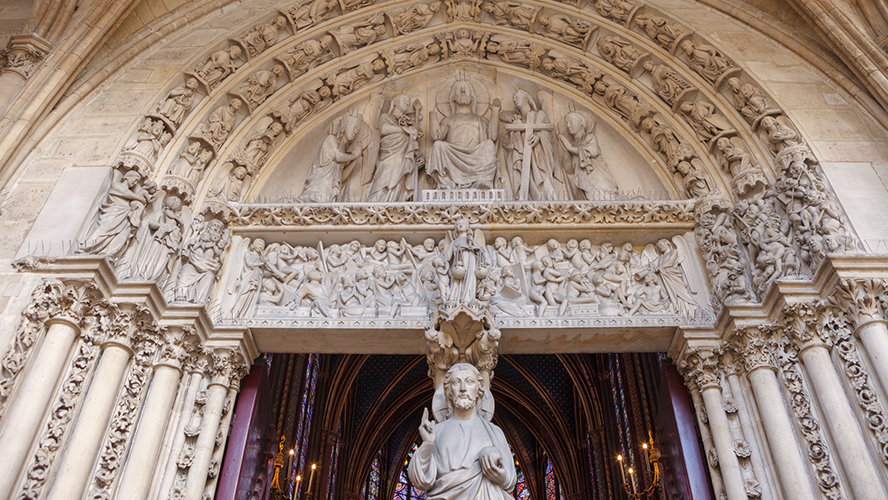
The building stands in a small courtyard of the present Palace of Justice and former Palace of the city of the kings. The external architecture of Sainte-Chapelle is more sober than that of the cathedrals built during the French late Gothic era, which were characterised by flying buttresses and ostentatious ornamentation.
The pinnacles, the balustrade, the gargoyles and the rear of the building are in the style of a great reliquary, reflecting the chapel’s original purpose. Statues of saints, angels and other religious figures set around the edges of the roof demonstrate the level of craftsmanship of the time.
At 75 metres tall, the spire (built during the nineteenth century, and the fifth spire since the building was originally completed) is outstanding, in cedar wood coated with lead to survive adverse weather conditions.
This holy chapel was built on two levels to reflect the social hierarchy. The upper floor was for royalty, and the lower floor was intended for the ordinary people. The upper chapel was adorned with blue domes with gilded lilies and the lower chapel, built to support the upper floor, has three naves.
What you can see inside
If you visit Sainte-Chapelle early in the morning or in the evening, you will be able to see the spectacular interior of the upper chapel at its most glorious, thanks to the light that streams in through its 670 square metres of stained-glass windows. The colour of the domes heightens the almost divine sense of the interior.
The upper chapel consists of a single nave in four sections that ends in a seven-sided chancel. Although it is not especially wide or particularly tall, it gives an impression of verticality. It is of double height, and extends as far a the Palace of Justice.
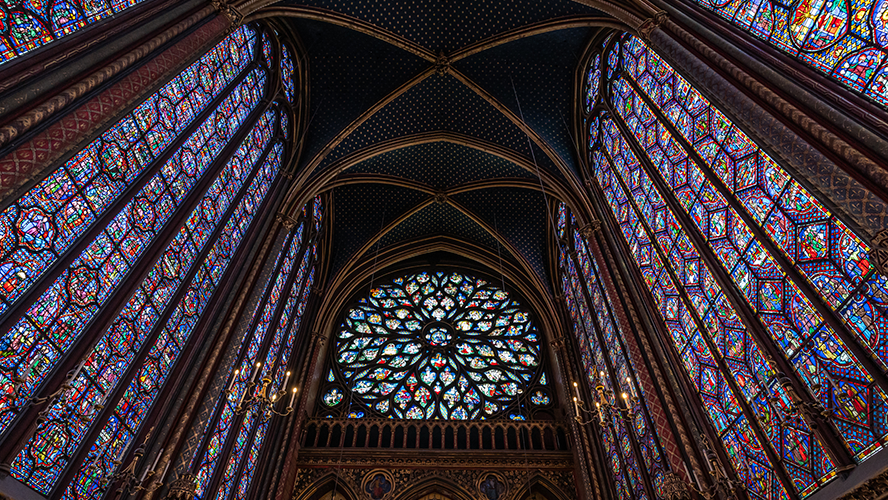
Visitors will surely take the opportunity to admire some of the 1,000-plus detailed scenes on the stained-glass windows — two thirds of which date back to the Middle Ages. On the western side of the upper chapel is the rose window known as the ‘Rose of the Apocalypse’. Reconstructed towards 1485 by Charles VIII in a Flamboyant style, it is full of symbols related to the Apocalypse.
The lower chapel is dedicated to the Virgin Mary. It can be accessed from the courtyard, and its ceiling supports the weight of the upper chapel, i.e. the weight of the whole building. Also outstanding is the colourful decoration on its domes and columns. The columns are blue, decorated with lilies (a symbol of the French style) and red, decorated with castles in gold (Louis IX was the son of Blanche of Castille). A statue of Louis IX gazes out at visitors, giving them the impression of entering a kind of grotto.
The location of Sainte-Chapelle and how to get to it
Sainte-Chapelle is located in the Île de la Cité in the vicinity of the Palace of Justice (10, Boulevard du Palais), a stone’s throw from one of the banks of the Seine.
If you want to travel to it by Metro, the stop is Cité. If you are travelling by bus, the stops are: Palais de Justice (21,38,58, 70 and 96) and Pont Saint-Michell (line 27). And if you take the RER, the stop is Saint-Michel Notre-Dame.
Practical advice for your visit: opening times and prices
D
From 1 October until 31 March, the opening hours for this jewel of the French Gothic is from 9.00 a.m. until 5.00 p.m. From 1 April until 30 September, it is open 9.00 a.m. until 7.00 p.m. Sainte-Chapelle is closed on 1 January, 1 May and 25 December.
Between 1 October 2025 and 31 March 2026, a single ticket costs 13 euros. The price increases from June onwards. Admission is free for youngsters under the age of 18, for those between the ages of 18 and 25 who were born in the European Union and non-European residents in France — excluding groups — and groups such as teachers, applicants for jobs in France and those with a disability, among other groups.
Admission is free on the first Sunday of each month (between 1 January and 31 March, and between 1 November and 31 December). Finally, prices for groups and organisations are attached.