












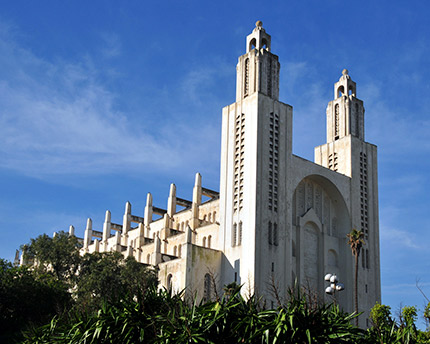
Although officially, Morocco is an Islamic country (Islam is the official state religion), we can nevertheless catch glimpses of other religions in monuments such as Casablanca Cathedral, a Christian place of worship, built in the twentieth century, in a most interesting architectural style. Read on to find out more.
While Islam is the country’s official religion, the Constitution of Morocco ‘guarantees everyone the exercise of religious freedom’. An estimated 1% of Morocco’s population is Christian. However, in the country’s major cities, we can find churches, cathedrals and Catholic diocese that date from a specific period in the history of Morocco.
Cathedrals like the one in Casablanca are a legacy of the years of rule by the French and Spanish over the Alawi kingdom, a vestige of the country’s colonial period.
- History of the Cathedral of Casablanca
- Architectural style
- Visiting the Cathedral
- What to see in the area around
History of the Cathedral of Casablanca
The correct name of the Cathedral of Casablanca is the Old Church of the Sacred Heart. The building is now deconsecrated, and never was a cathedral, as Casablanca is not the seat of a bishopric, and therefore could not be the site of this type of church. It was thanks to its monumental appearance that it became known as the Cathedral of Casablanca.
The history of this mis-named church dates back to the time of the Protectorate. At that time, there was a sizeable Catholic community here of around 40,000 faithful. Construction of the Church of the Sacred Heart began in 1930, on the north-west corner of what is now the Arab League Park.
The church was completed in 1953. Three years later, in 1956, Morocco declared independence, something that prompted a decline in the Catholic population of the country, and the building ceased to be a church during the 1970s. Today, the Cathedral of Casablanca has been deconsecrated and functions as a cultural centre.
Architectural style
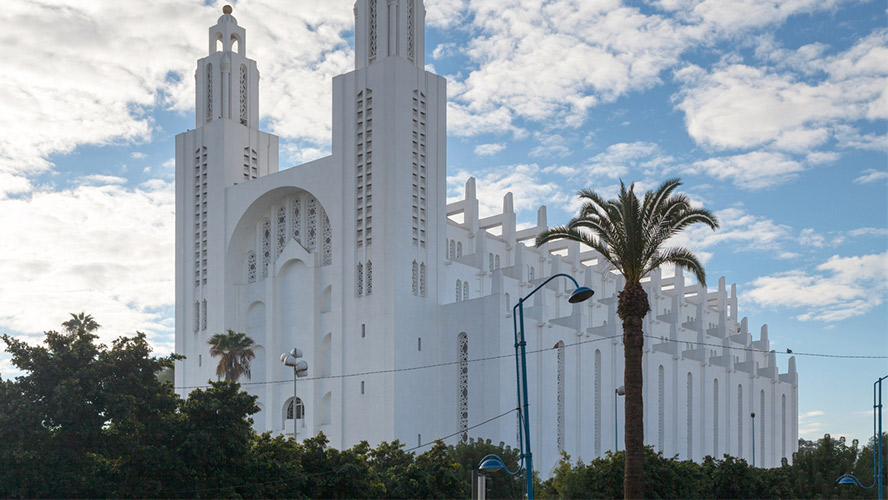
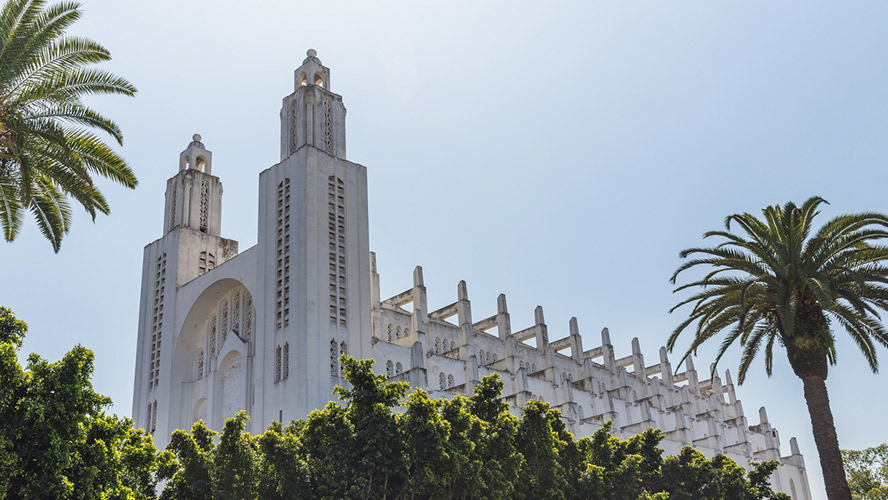
The Church of the Sacred Heart (or Cathedral of Casablanca) was designed by the French architect Paul Tournon. Its style was inspired by the great Gothic European cathedrals, with a monumental aesthetic. Outstanding features are the nave, the buttresses and the two rectangular towers on the main façade. The church combines an Art Déco style with a degree of austerity and sobriety in its white concrete external design.
The nave, with a barrel vault, has 11 spans of archways on two levels, enormous rectangular stained-glass windows with a Modernist design and an apse at the end, with no ambulatory. The stained-glass windows are what mark the departure from austerity, bringing light and colour to the church’s interior. They are the work of Florence Tournon-Branly, Jean Mamez and Louis Barillet.
The church is 75 metres long and the towers are 33 metres tall, reminiscent of the minarets of a mosque.
Visiting the Cathedral
The Old Church of the Sacred Heart is no longer a place of worship, but has been converted into a cultural and exhibition centre. It is a venue for all kinds of events and exhibitions, so if you want to visit the building, you will need to be aware of the programme of events.
You can also go up the towers to enjoy good views of Casablanca.
What to see in the area around
Casablanca Cathedral is located in the heart of the city, in the modern part. Its central location means that it can be visited at the same time as many other monuments and points of interest in the city.
The first of these is the Arab League Park, which lies next to the church. This park is one of Casablanca’s main green spaces, a genuine oasis where you can enjoy a break from the noise and frenetic activity of the big city.
A little further north, barely a ten-minute walk from the Cathedral, is United Nations Square, one of Casablanca’s main traffic hubs. This square is a crossroads between the entrance to the Medina and the elegant boulevards of the twentieth-century city.
The Medina is only slightly further away from the cathedral. A walk of no more than 15 minutes will bring you to this fabulous area that symbolises the city’s past, the pre-colonial era, and here you will find a hive of business activity.