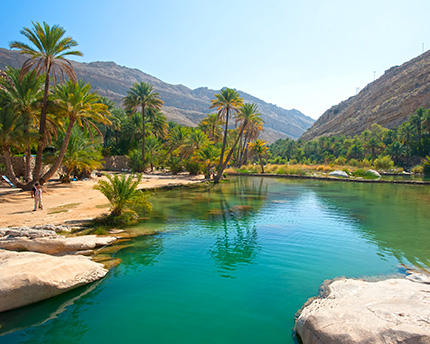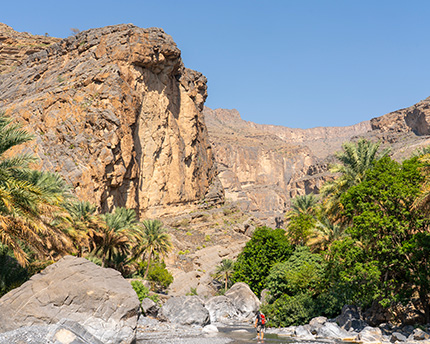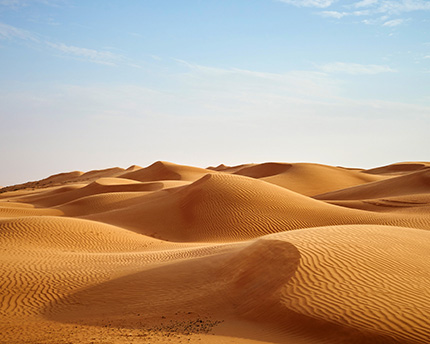





















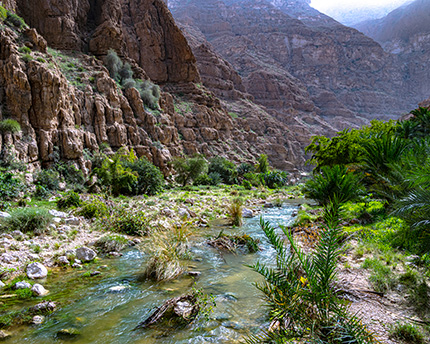
‘Wadi’ is an Arabic word meaning an extremely dry riverbed or canyon which floods at regular intervals, especially after heavy rain. They can be in desert or semidesert areas where there are lots of hills and plateaux. Thanks to its particular terrain, Oman has a large number of wadis, although the most famous is the Wadi Bani Khalid, located among the Eastern Hajar Mountains just a few kilometres north of Al-Kamil. They are very distinctive formations, bounded by ravines with lots of curves, and landscapes dominated by ochre and reddish colours. In these breathtaking surroundings, there may be hamlets, cultivated fields, and sources of thermal waters.
What is a wadi?
A wadi is an Arab term that means something similar to a watercourse, although in the Arab countries, it is also used to describe gorges, mountain waterfalls, and even valleys and riverbeds. It is interesting to note that in Spain, the names of many rivers begin with ‘Guad-’, because they were renamed during the time of Moorish rule. In any case, the word is used for dry riverbeds or seasonally dry riverbeds, springs and waterfalls in hot, arid regions. The riverbeds can be up to 100 metres wide and they are only supplied with water during periods of heavy rain. They are often surrounded by trees in front of steep mountainsides, and many of them form natural swimming pools, ponds or oases.
The best wadis in Oman
As a semidesert country, Oman has many wadis that form spectacular scenes and are well worth seeking out. They are definitely a sight worth seeing. The country’s best wadis are in the province of Ash Sharquiyah, and the following are the most famous:
Wadi Bani Khalid
This is possibly the most popular of all Oman’s wadis, as it has water all year round. Hordes of travellers come on day trips here to discover the fountains and the natural swimming pools. Around the Moqal cave, you can also have a picnic and go for a dip. Having said that, you need to remember that the area becomes very crowded, especially at weekends. This wadi is located 260 kilometres from Muscat, and has natural swimming pools with translucent water. The landscape is dotted with palm trees, waterfalls, caves and mountains.
Wadi Shab
This is said to be one of Oman’s most beautiful wadis. It is situated about 150 kilometres from Muscat, and is quite easily reached by car. There is a path that leads you through a canyon with high walls of rock that over time have formed the riverbed. In the area around, you will find palm trees and cultivated fields, as well as pools with turquoise water where it is sometimes possible to bathe.
Wadi Al Arbeieen
Access to this wadi is rather more difficult, as you need an all-terrain vehicle to reach the car park and the wadi. It is about 130 kilometres from Muscat, and normally has water almost throughout the year. This wadi is an ancient canyon scattered with pools, rocks, palm trees and lemon trees. You will also come across waterfalls and lakes.
Wadi Darbat
Although not as wall known as the others, Wadi Darbat has a waterfall about 30 metres high, which usually forms between July and September. It too is a sight well worth seeing.