















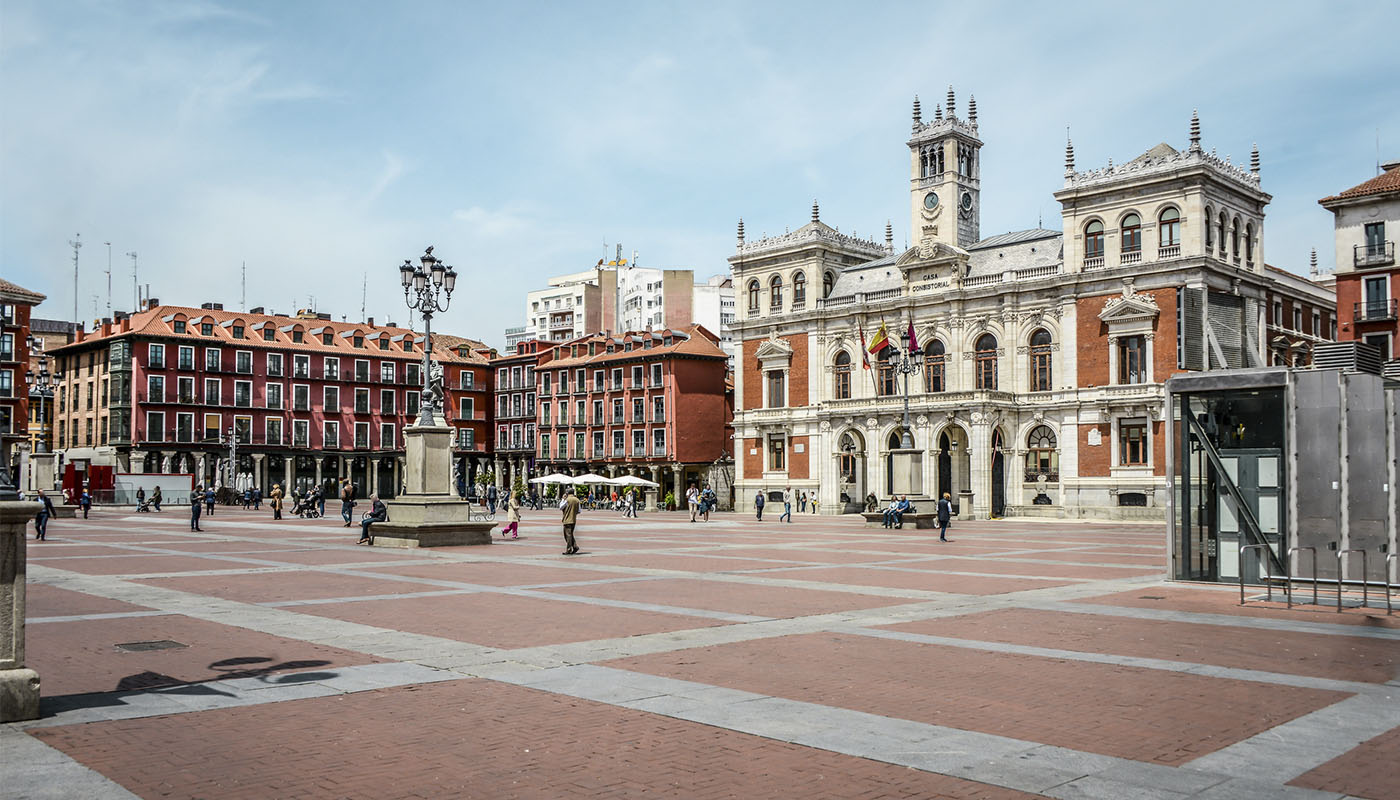



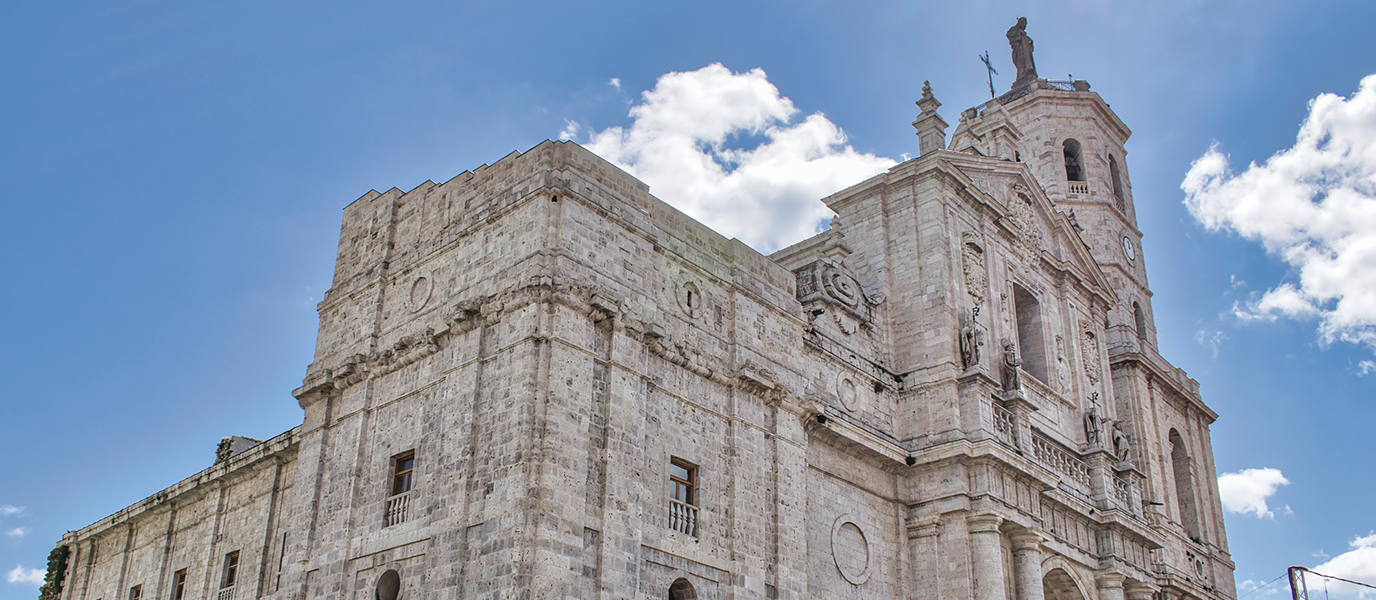
From a distance, the Cathedral of Nuestra Señora de la Asunción de Valladolid is an imposing sight, thanks to its austere-looking bulk and to its unfinished appearance. This edifice does not seek to please with ornamentation, nor to dazzle with Gothic filigree carvings: its power lies in its scale, in its geometry, and in the appearance it has had for centuries as an unfinished work. To visit the cathedral is to confront one of the great paradoxes of Spanish heritage: a cathedral which was conceived to rival the greatest churches of Europe (but was never completed), and because of this reveals so clearly the political, religious and civic ambitions of the age. Set in the historic heart of Valladolid, a stone’s throw away from the Plaza Mayor [Main Square], the cathedral cannot be understood in isolation. It formed part of an ambitious urban planning programme linked to the period in which the city aspired to become the Spanish Monarchy’s permanent capital.
- The history of Valladolid Cathedral
- The architecture and exterior of the church
- Inside the Cathedral
- Advice for your visit, opening times and prices
The history of Valladolid Cathedral: why it is unfinished — the capital that never was
The history of Valladolid Cathedral is closely tied to the city’s political heyday in the sixteenth century. In 1595, Valladolid was a named episcopal seat, separate from the diocese of Palencia. This was also a period of great prosperity for the city, which had become the habitual residence of the royal court and an administrative centre of the first order. In this context, the idea arose of building a new cathedral to replace the old collegiate church, which was considered to be inadequate for the status that Valladolid aspired to attain.
The person in charge of the project was Juan de Herrera, the royal architect responsible for the Escorial. His involvement went some way towards defining the character of the edifice. Herrera planned a grand, monumental cathedral, with pure lines and mathematical proportions, in line with the principles of the late Renaissance and Herreran classicism. The original project was vast: one of the biggest cathedrals in Europe, with a tower at each of the corners and a floor plan with capacity for thousands of worshippers.
However, the city’s destiny underwent a sudden change. In 1606, the royal court was permanently transferred to Madrid — an economic and political blow from which Valladolid never fully recovered. The financing of the cathedral at first slowed — and then stopped. Throughout the seventeenth and eighteenth centuries, the works progressed intermittently, adapting to ever decreasing resources, and with steps being taken to simplify the original design.
The result is the partially constructed cathedral, with only one tower — which was also rebuilt after being demolished during the nineteenth century — and a nave which barely reaches half the size of the project envisaged by Herrera. The cathedral, however, is far from being an architectural failure, as its condition makes it an exceptional historical document: an edifice that allows one to study, stone by stone, the collision between political ambition and economic reality.
The architecture and exterior of the church: Herreran geometry, Castilian austerity and a scale appropriate to its urban setting
The exterior of the Cathedral of Valladolid is characterised by a sober form. The main façade, facing towards Calle Cascajares, is a forbidding structure, dominated by vast, sparsely-decorated stretches of limestone wall. The gigantic columns, classic frontages and a monumental style directly reference the architectural language of Juan de Herrera, in which proportion supersedes ornamentation as the main resource for expression.
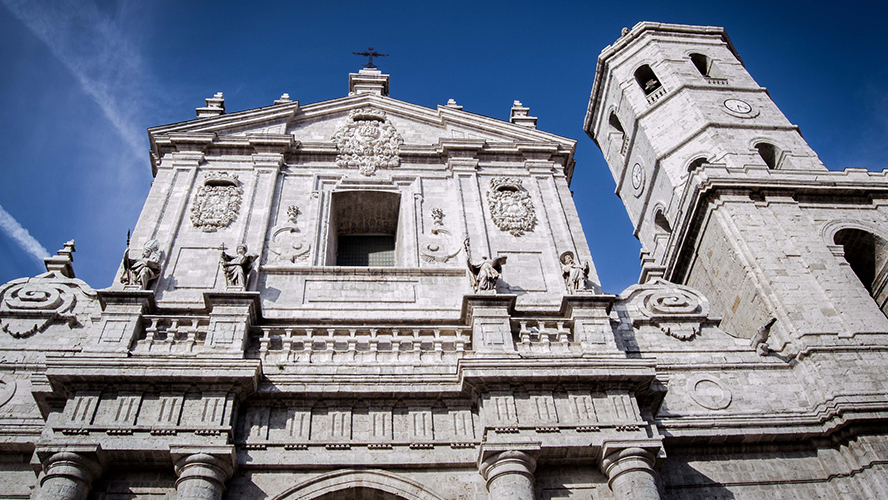
The tower, positioned at one end of the façade, reaches a height of 70 metres and has become one of the outstanding features of Valladolid’s urban profile. Although it does not form part of the original design (which envisaged four towers), its presence allows us to imagine what an imposing monument the edifice would have been. From outside, one can clearly see the unfinished state of the building: blank walls, incomplete structures and the feeling of a work paused abruptly while in full swing.
The positioning of the cathedral is no accident. It is woven into the historic fabric of the city as a dominant element, in a dialogue with the urban fabric handed down from the Middle Ages and with the later Renaissance renovations. Its scale contrasts with the relatively narrow streets that surround it, reinforcing the impression of grandiosity and emphasising its symbolic, rather than functional, role.
Inside the Cathedral: the altarpiece by Juan de Juni, the tower viewing point and other treasures of ‘La Inconclusa’
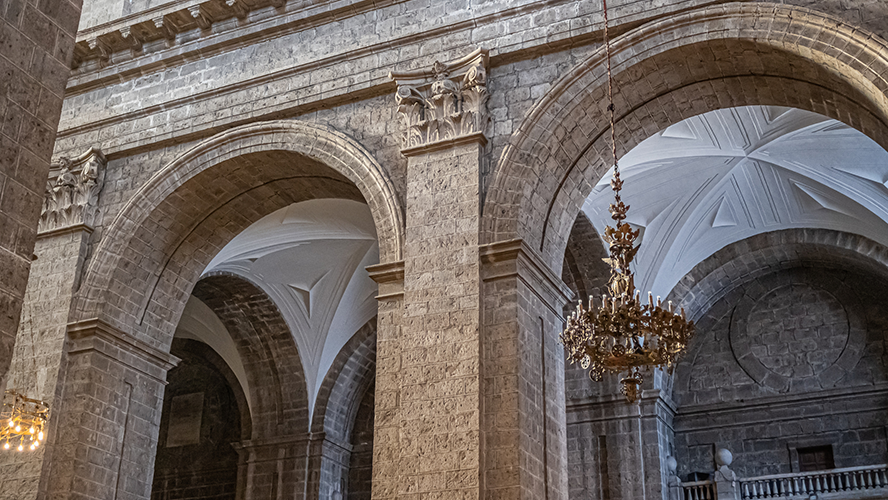
The interior of Valladolid Cathedral impresses visitors with its spaciousness and the special clarity of its light. The enormous main nave is covered by barrel vaults with small windows that ensure the lighting is uniform and controlled. The impression is one of order and balance, very different from the vertical drama of the Gothic style. Here, everything obeys a rational logic, in which the architecture has no need for excessive ornamentation.
One of the cathedral’s outstanding highlights is its main altarpiece, the work of Juan de Juni, one of the great sculptors of the Spanish Renaissance. It presence introduces an expressive counterpoint in a space dominated by architectural sobriety. The highly dramatic altar figures bring humanity and feeling to a church founded on geometry and logic.
The cathedral is also home to the Cathedral and Diocesan Museum, which occupies annexes. The Museum houses pieces of enormous artistic value, including paintings, sculptures and liturgical objects brought here from the parishes of the diocese. A tour of the Museum complements the architectural tour, and allows visitors to contextualise the cathedral’s religious and cultural role in Valladolid’s history.
Another of the cathedral’s great attractions is the opportunity to visit its tower. From the top, there spreads one of the finest panoramic views of the city, with a clear view of the historic centre, the Plaza Mayor, and the urban fabric that developed from the sixteenth century onwards. This experience helps us to appreciate the real scale of the cathedral project and its relationship with the city that dreamed of becoming a capital, but was stopped in its tracks.
Advice for your visit, opening times and prices: how to organise your tour
Valladolid Cathedral is easily accessible on foot from any point in the historic quarter. You can visit independently, but there are also guided tours that offer a deeper insight into the edifice’s historic and architectural aspects — these are particularly recommended for anyone wishing to understand the original project and the changes it went through.
Visiting hours vary depending on the time of year and the timing of religious services. In general, access for tourists is organised in time slots that do not interfere with religious worship. Admission is €3, which includes access to the Cathedral and Diocesan Museum. Admission to the tower viewing point costs €12. The recommended time for a full visit is between an hour and an hour and a half, especially if you go up into the tower.