















The church, which once belonged to San Pablo’s convent, was originally founded through the efforts of two medieval queens: Violante de Aragón and María de Molina. However, it was the Duke of Lerma who, as its patron, endowed the institution with most of its art works during the seventeenth-century. Nowadays, the church is one of Valladolid’s most iconic monuments, thanks particularly to its main façade.
- History of the Church of San San Pablo el Real, a Valladolid icon
- The architecture and exterior of a church with an impressive façade
- What you can see inside: a church filled with works of art
- The Church of San Pablo and the Spanish Monarchs: a close relationship
- Information on opening hours and advice for visitors to this Dominican church
- Practical advice for a respectful visit to San Pablo
History of the Church of San San Pablo el Real, a Valladolid icon
Located in what is now Plaza de San Pablo, this convent was founded in the year 1276 when Violante de Aragón, the wife of Alfonso X El Sabio [Alfonso The Wise], donated land for its construction, always intending that the church would be dedicated to San Pablo.
Towards the end of the thirteenth century, it was another queen (María de Molina, the wife of Sancho IV) who advocated for it to be rebuilt, and who extended the church to accommodate the tomb of her son, the Infante don Alfonso.
The final design, built of stone in an Isabelline Gothic style, was decided by Cardinal Juan de Torquemada (uncle of the famous inquisitor) who, between 1445 and 1468, funded the construction of the church we see today with its single nave and its chapels between the buttresses.
It was the Duke of Lerma, however, who took on the patronage of the convent and filled it with valuable works of art after Felipe III transferred the capital of the kingdom to Valladolid in 1601.
The architecture and exterior of a church with an impressive façade
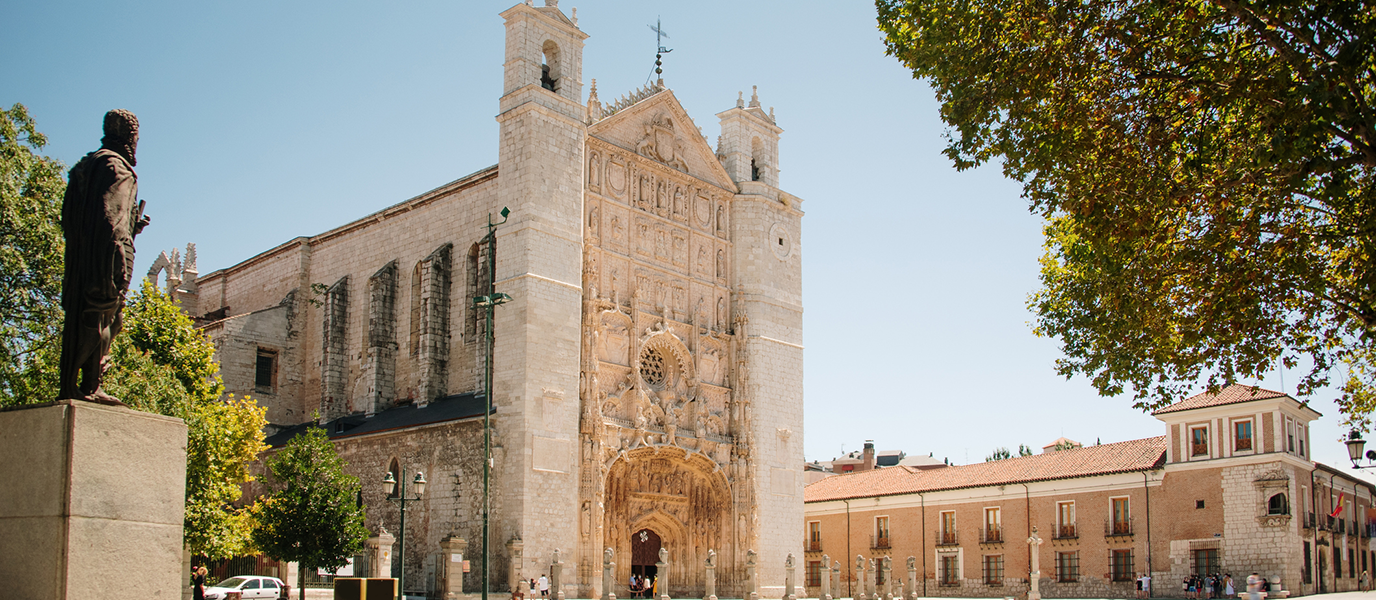
The church is considered to be one of the finest examples of Isabelline Gothic architecture in Valladolid, and to represent a highlight of any tour of the city, especially because of its monumental façade, the work of Simón de Colonia which was completed in 1500.
The façade is in the style of an altarpiece, divided into several carved sections with a large central rose window.
The church has a single, very wide nave, with a marked transept and a polygonal apse. It also has several chapels positioned between the buttresses and a complex ornamentation consisting of pinnacles and tracery.
There are also Flemish and German influences, with Mudejar elements and Renaissance details, along with a few more classicist pieces.
Thanks to the patronage of the Duke of Lerma, the Sandoval and Rojas coats of arms were added, along with the two towers that stand on either side of the main façade.
What you can see inside: a church filled with works of art
Inside, the church is very austere, but it does have a few artistic and architectural treasures, such as its ribbed vaults with star motifs, while a sixteenth-century masterpiece, the great carving of the Crucified Christ by Juan de Juni, can be seen in the high chapel.
Buried in this chapel are the first Duke of Lerma, Francisco y Rojas, along with his wife — although their bronze funerary sculptures are now exhibited in the National Museum of Sculpture.
Other sculptural gems include the Cristo Yacente [Dead Christ] by Gregorio Fernández, one of Valladolid’s best-known Holy Week figures; a painted Christ on the Cross and a Santo Domingo de Guzmán.
There also rococo and neo-Classical altarpieces as well as two canvases by Bartolomé de Cárdenas.
No visitor should leave without visiting the sacristy, which dates from the mid-sixteenth century and was sponsored by Cardinal Loaysa. This is one of the church’s most interesting spots from an architectural point of view.
The Church of San Pablo and the Spanish Monarchs: a close relationship
The Church of San Pablo stands close to the Royal Palace and the Palace of Pimentel, royal sites in Valladolid that were the residences of the Catholic Monarchs, of their son Carlos I and of Felipe II when they stopped by the city.
The church has occupied part of the private history of the Spanish royal family, and particularly the House of Austria: Felipe II and Felipe IV were both christened here. In fact, it is said that the son of Carlos I was taken out through the window of the Palace of Pimentel, where a chain now hangs, so that he could be baptised in this church and not in the Church of San Martín, which he should have been according to jurisdiction.
In addition, the Church of San Pablo was the setting for the swearing-in and proclamation of Carlos I as the new king in 1518, and he was always regarded with great affection here.
On the transfer of the capital to Valladolid in 1601 with Felipe III, the Church of San Pablo was the church normally attended by the King whose favourite, the Duke of Lerma, encouraged its different refurbishments and the construction of the two towers.
Information on opening hours and advice for visitors to this Dominican church
The Church of San Pablo is still an active place of worship, so opening hours for visitors are closely linked to the celebration of religious services. There are no organised or guided tours.
The best time to visit is during the hours when Mass is celebrated. From Monday to Saturday, the church is normally open for religious worship from early morning, and on Sundays until approximately 1.00 p.m.
In the evening, religious services are normally held at 7.30 p.m., although in summer they may take place until 8.30 p.m.
Practical advice for a respectful visit to San Pablo
Visitors should bear in mind that the church is open for religious worship, so it is best to visit either just before or just after Mass, and to always remain silent and respectful.
It is best to avoid the use of flash photography so as not to interrupt the worshippers, and to remember to allow time to appreciate the façade.