













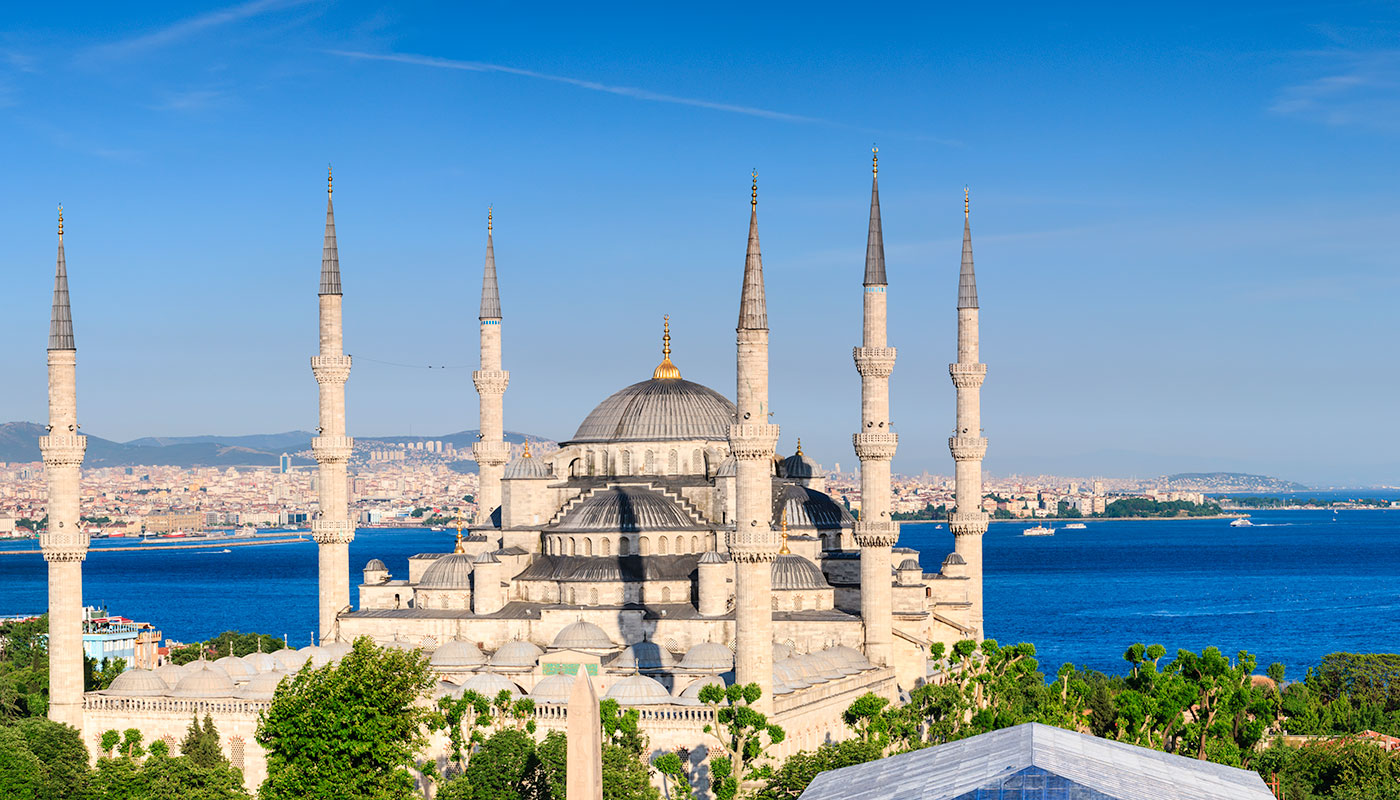
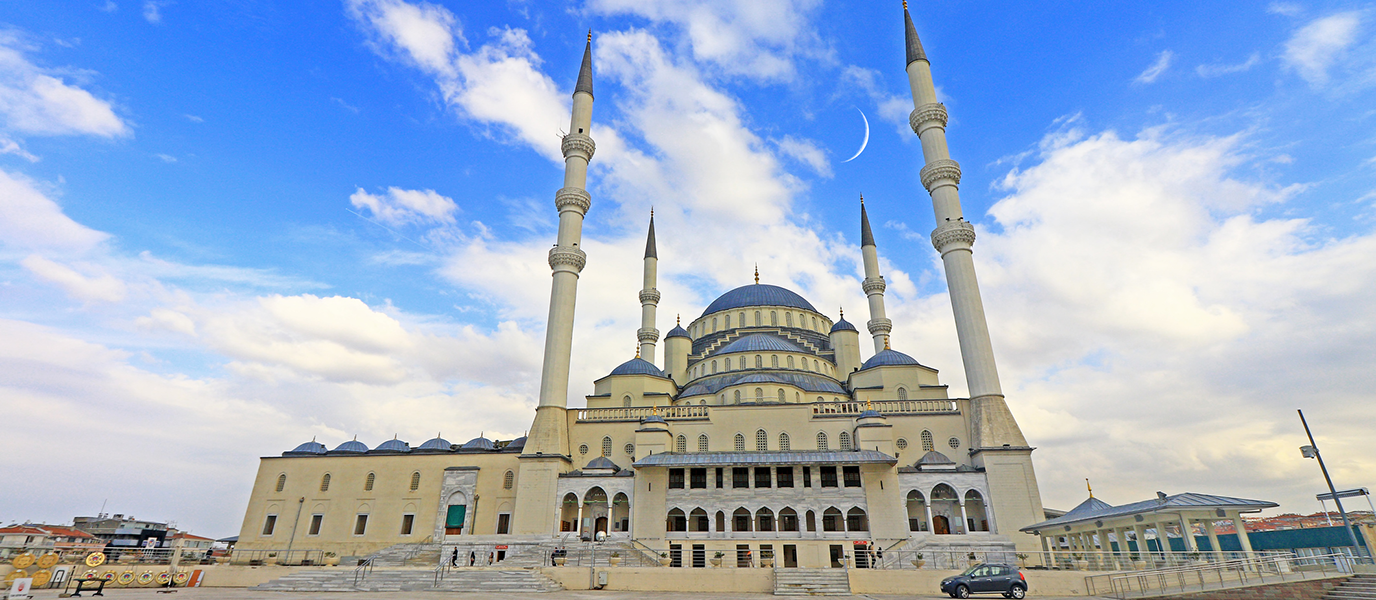
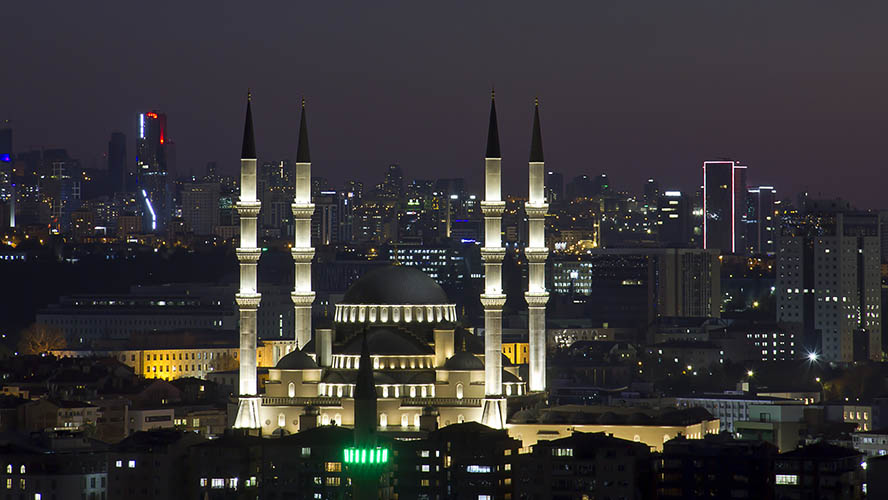
Standing tall in the heart of Ankara, the Kocatepe Mosque dominates the skyline with its four slender minarets, each rising 88 metres, and its majestic central dome, visible from all across the city. Inaugurated in 1987 after two decades of construction and a long-running debate over its design, the mosque blends Ottoman tradition with modern elements, making it the spiritual hub of the capital. Its architecture evokes the great mosques of Istanbul, such as Süleymaniye and the Blue Mosque, but with a distinct identity that makes it one of Turkey’s most striking places of worship. For visitors eager to experience Ankara’s culture and history, Kocatepe offers an unforgettable journey into the heart of Islamic art and devotion.
- History of the Mosque: a dream nearly half a century in the making, marked by failed projects
- Visitor information: plan your spiritual journey
- What you’ll see inside: a journey through devotion and design
- Other religious monuments in Ankara: from medieval mosques to Roman temples
History of the Mosque: a dream nearly half a century in the making, marked by failed projects
The idea of building the Kocatepe Mosque dates back to the 1940s, when the need for a major place of worship in Ankara was first raised. In 1944, Ahmet Hamdi Akseki, then Deputy Minister of Religious Affairs, along with 72 founding members, established the Society to Build a Mosque in Yenişehir, Ankara. Despite their efforts, the initial plans submitted in 1947 were rejected, delaying construction.
In 1956, backed by Prime Minister Adnan Menderes, land was allocated and a new design competition was launched the following year. Out of 36 entries, the winning design by Vedat Dalokay and Nejat Tekelioğlu proposed a bold, modern structure designed to break away from Islamic architectural traditions. However, the avant-garde style was met with resistance from conservative quarters, and construction was halted after only the foundations were laid.
In 1967, a third architectural competition led to the selection of a more traditional design by Hüsrev Tayla and M. Fatin Uluengin. This version, in the Ottoman neoclassical style, drew inspiration from iconic mosques such as Selim Mosque in Edirne and the Şehzade and Blue Mosques in Istanbul. After two decades of planning and building, the mosque was finally completed and opened in 1987, becoming the largest in Ankara and a lasting symbol of classical Islamic architecture.
Visitor information: plan your spiritual journey
The Kocatepe Mosque is located in the Kocatepe neighbourhood, in the bustling Kızılay district, one of the most central and busiest areas of Ankara. Its strategic position makes it a prominent landmark, easy to spot from various parts of the city. To get there, visitors can take advantage of Ankara’s efficient public transport system, including buses and the metro, simply get off at Kızılay station and walk a few minutes to the mosque.
Entry is free and open to people of all faiths, reflecting the welcoming spirit of Turkish culture. It’s best to visit outside of prayer times to avoid interrupting worship and to enjoy the space in a more peaceful setting. Prayer times in Turkey vary depending on the position of the sun, so it’s worth checking the day’s schedule in advance.
Before entering, visitors are asked to remove their shoes as a sign of respect, so it’s a good idea to wear some socks to ensure comfort. It’s also important to keep a quiet and respectful manner, and to avoid using devices that might disturb the serene atmosphere.
What you’ll see inside: a journey through devotion and design
Stepping inside the Kocatepe Mosque, visitors enter an immense space that can hold up to 24,000 worshippers, a true reflection of its grandeur and importance in religious life in Ankara. The design, rooted in classical Ottoman architecture, pays homage to iconic mosques such as the Süleymaniye Mosque and the Blue Mosque in Istanbul, although with a modern twist that makes it unique.
The main prayer hall is a sight to behold. The central dome, 48 metres high, towers over the prayer hall, supported by four massive pillars and surrounded by semi-domes that enhance feeling of spaciousness. A colossal chandelier made of thousands of bulbs hangs from the dome, casting a warm glow over carpets in tones of burgundy and blue, especially designed for the mosque.
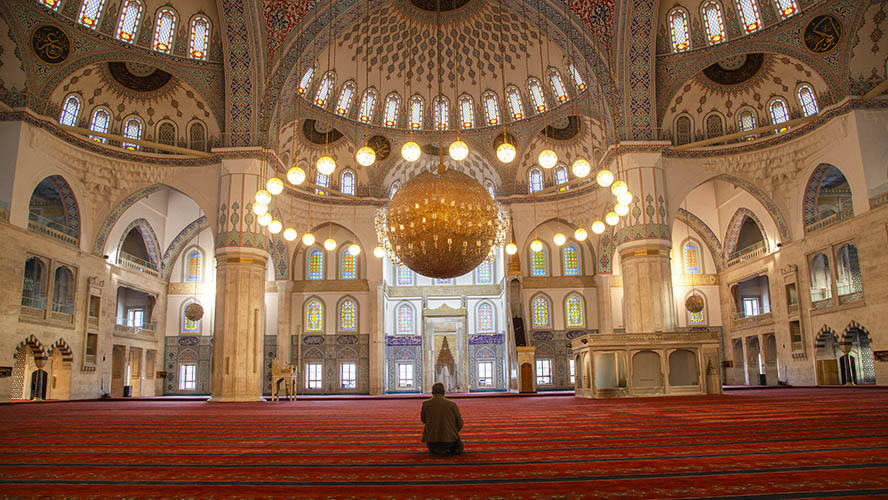
The walls and ceilings are covered in delicate geometric and floral motifs, while golden Arabic calligraphy features verses from the Quran. Natural light pours through stained-glass windows decorated with Islamic patterns, casting colourful reflections on the marble interiors.
At the front, the mihrab, which indicates the direction of Mecca, is carved from white marble with gold accents and surrounded by Iznik tiles with floral designs. Next to it is the minbar, the pulpit from which sermons are delivered, built from finely carved walnut wood with arabesque designs and gilded finishes.
On either side of the main hall, upper galleries are reserved for female worshippers, offering sweeping views of the dome and the prayer hall. In the corners, marble ablution fountains serve as a reminder of the importance of purification before prayer.
The four minarets, each 88 metres tall, not only shape Ankara’s skyline but also house speakers that broadcast the call to prayer five times a day, a sound that echoes across the city, marking the rhythm of daily life.
Other religious monuments in Ankara: from medieval mosques to Roman temples
In addition to the Kocatepe Mosque, Ankara is home to a rich variety of religious monuments that reflect its diverse heritage. One such site is the Hacı Bayram Mosque, built in the 15th century in honour of the poet and mystic Hacı Bayram Veli. Blending Seljuk and Ottoman architectural styles, it stands beside the Temple of Augustus and Rome, a Roman-era ruin that adds a fascinating historical layer.
Another highlight is the Aslanhane Mosque, one of the oldest in the city, dating back to the 13th century. Its interior features a finely carved wooden minbar and a mihrab decorated with turquoise tiles, which are examples of the splendour of medieval Islamic art. Also worth visiting is the Maltepe Mosque, an elegant, Ottoman-inspired building which, though smaller than Kocatepe, is just as majestic and spiritual.