










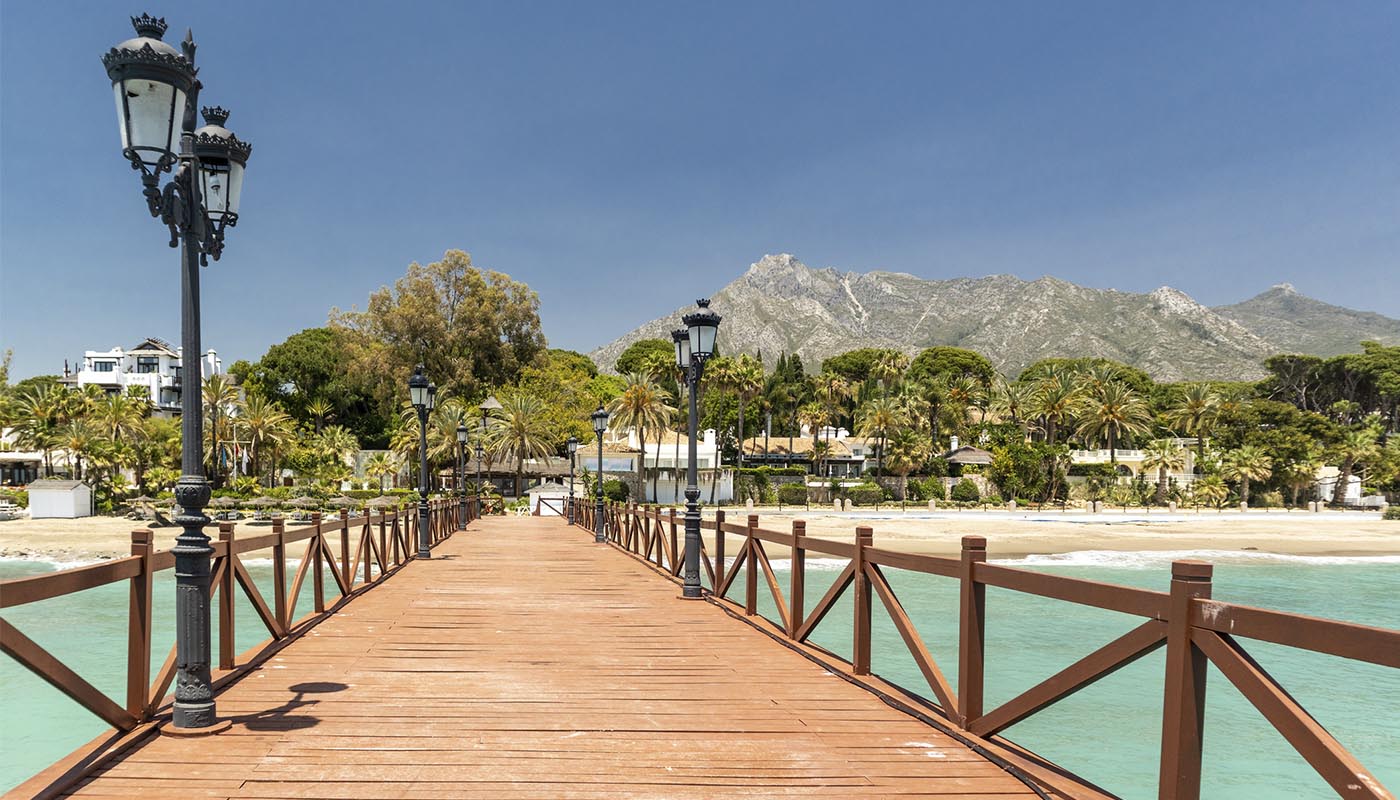




Situated between the buzz of Puerto Banús and the calm of the old town, right in the heart of the Golden Mile, the Ralli Museum in Marbella stands out like a shining beacon. Far removed from ostentatious luxury and Andalusian folklore, this museum, which is free to enter, brings together one of Europe’s most remarkable collections of contemporary Latin American art. Its white, understated architecture is not designed to dazzle but to provide space for the vibrant colours, dreamlike forms and expressive force of artists such as Wilfredo Lam, Roberto Matta and Leonora Carrington. An unexpected experience in the heart of a city more familiar with yachts than canvases.
- History of the museum: the quiet legacy of Harry Recanati
- What you can see on your visit. Outstanding works in dialogue from both sides of the pond
- Useful information: opening hours, access and practical tips
- Other museums in Marbella: exploring printmaking and local archaeology
History of the museum: the quiet legacy of Harry Recanati
The Ralli Museum in Marbella opened in 2000, thanks to the Harry Recanati Foundation, a non-profit organisation that came about thanks to the personal enthusiasm of this Swiss-Israeli banker and philanthropist. Recanati was a dedicated collector of contemporary Latin American art, and his vision was both simple and radical: to offer free public access to works that had previously only been shown in private galleries or major institutions across the Atlantic.
The museum in Marbella is one of five Ralli museums around the world. The others are in Punta del Este (Uruguay), Santiago de Chile, Caesarea (Israel) and, since 2010, a second location in Zefat, also in Israel. They all share the same philosophy: to offer elegant but unpretentious exhibition spaces where artworks are given room to breathe and interact without interference.
The decision to locate the museum in Marbella was no accident. Recanati knew the Costa del Sol well, having spent time in the city, and saw its potential as an international meeting point. Far from the mass tourism and nightclubs of Puerto Banús, he sought to create a calm, open cultural space surrounded by gardens and close to the sea. And so the museum was born, on a quiet plot by the main road, with discreet access and a deeply inclusive spirit.
Since opening, the Ralli Museum has remained independent and free to enter. It has grown with temporary exhibitions and new acquisitions, while maintaining its core mission: to champion the expressive and symbolic power of 20th-century Latin American art and connect it with the great European movements. Its galleries are home to magical realism, surrealism, political critique, indigenous spirituality and the vivid colourful vitality of the Americas.
What you can see on your visit. Outstanding works in dialogue from both sides of the pond
The museum’s single-storey building is arranged around interior courtyards and wide corridors. Visitors can move through the rooms quietly, unhurried and undisturbed, allowing their gaze to explore a collection that remains rare in Europe. The museum houses over 200 works, including paintings and sculptures, mostly by artists from Argentina, Peru, Chile, Mexico and Uruguay.
One of the most prominent names is the Argentinian Antonio Seguí, whose vibrant and ironic work addresses urban and existential themes. Other notable artists include Mario Toral, Oswaldo Guyasamín, Armando Morales and Roberto Matta, one of the leading figures of Latin American surrealism. Each gallery offers a mix of artists and styles, helping visitors understand the diversity of the continent without resorting to stereotypes or narrow interpretations.
In addition to Latin American art, a significant section is dedicated to European artists such as Dalí, Miró, Chagall and Giorgio de Chirico. These works are not merely anecdotal: they open up meaningful exchanges between the continents, revealing influences, tensions and aesthetic echoes. Some temporary exhibitions have also explored themes such as the relationship between art and politics, indigenous spirituality and the role of women in 20th-century art.
Several outdoor sculptures are on display in the garden, which acts almost as a prelude to the museum. Some are cast in patinated bronze or carved in white marble, depicting human figures in reflective or conversational poses. It is a serene space, shaded and equipped with benches, that extends the artistic experience beyond the walls of the museum.
Useful information: opening hours, access and practical tips
The Ralli Museum is located on Avenida Bulevar Príncipe Alfonso de Hohenlohe, known as Marbella’s Golden Mile, around four kilometres from the old town. You can easily get there by car, and free parking is available on site. Alternatively, you can head there on foot from the Nagüeles area, along a lovely route through gardens and residential villas.
Admission is entirely free, making it a highly recommended cultural option for both residents and visitors. The museum is open Tuesday to Friday from 10 a.m. to 5 p.m., closing one hour earlier on Saturdays. It is closed on Sundays, Mondays and public holidays, so it’s worth planning your visit in advance. Information leaflets are available, and guided tours can be booked in advance.
There’s no café or shop, reinforcing the museum’s focus on art without distractions. It is not heavily signposted in the city, which helps it retain the air of a well-kept secret. For that very reason, those who find it often describe it as a surprising and rewarding discovery.
Other museums in Marbella: exploring printmaking and local archaeology
Although Marbella is not widely known for its museum offering, it does feature several interesting cultural spaces. Among them is the Museum of Contemporary Spanish Printmaking, located in the old town in a former 16th-century Renaissance hospital. This institution houses a remarkable collection of prints by artists such as Picasso, Miró, Chillida and Tàpies, with an educational focus and a busy programme of temporary exhibitions.
Another worthwhile visit is the Cortijo Miraflores Cultural Centre, a traditional building that contains archaeological remains from the area, models, historical photographs and a small gallery for temporary exhibits. It’s an ideal space for learning about the urban and social evolution of Marbella from the early modern period to the 20th century.
Lastly, private exhibition spaces and galleries in Puerto Banús and the Golden Mile complete the cultural offering for art lovers. But among them all, the Ralli Museum stands out for its uniqueness, not only for its focus but for the quality of its collection and the calm it offers in contrast to the city’s hustle and bustle.