



















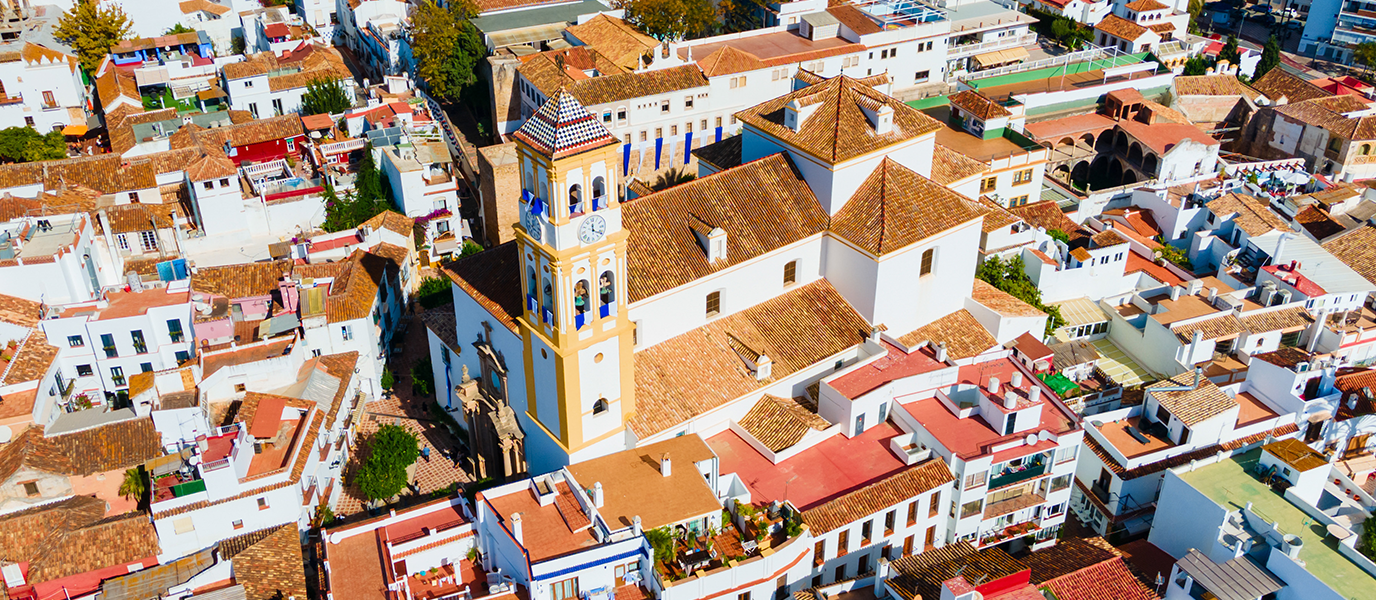
Beneath Marbella’s brilliant sunshine, in the labyrinth of narrow streets that make up the old town, the Church of Santa María de la Encarnación stands as the city’s main principal place of worship. Its history dates back to 1485, when the Catholic Monarchs ordered a former mosque to be converted into a Christian church. It was during the seventeenth century, however, that construction of the present church commenced; it would be an edifice on an unusually grand scale for this region. Its Baroque façade, dominated by an imposing doorway built in red stone from El Torcal, is just a foretaste of the artistic splendour to be found inside. From its monumental organ, considered to be one of the finest in Andalusia, to its carved and gilded high altar, this church is a living testament to the historic and cultural development of Marbella.
- The history of the Church: from important mosque to majestic Christian church
- How to visit the church: essential information for travellers
- What you can see inside: Andalusian Baroque art and one of Spain’s finest organs
The history of the Church: from important mosque to majestic Christian church
The history of the Church of Santa María de la Encarnación is inextricably linked to the religious and cultural transformation of Marbella. After the Reconquest of the city by King Fernando el Católico on 11 June 1485, there began a process that was common for the age: the conversion of mosques into Christian churches. The church was probably built on the site of Marbella’s main mosque, to symbolise the transition from Muslim to Christian dominance. The dedication of the church to the Incarnation is a demonstration of the Catholic Monarchs’ devotion to this Christian doctrine.
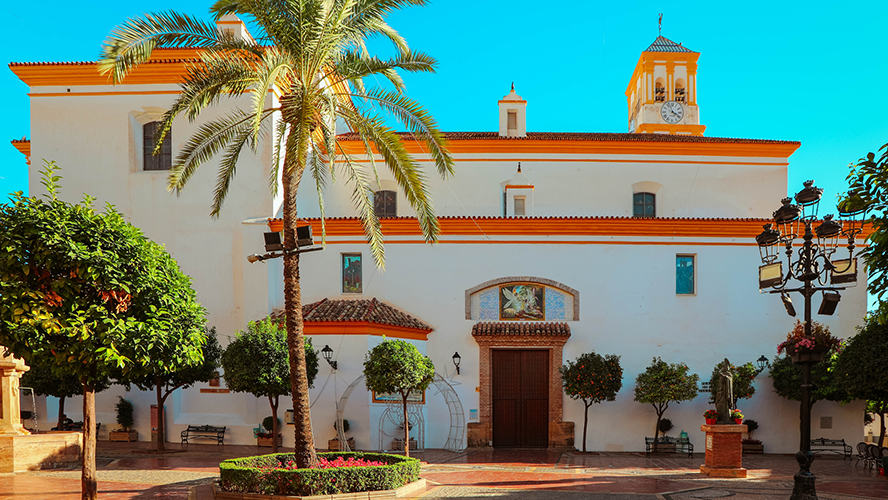
Over the centuries, the church underwent various refurbishments. In 1505, it was canonically established by the Archbishop of Seville, Diego Deza, and in 1510 it became the seat of the episcopal vicariate. During the seventeenth century, under Bishop Luis Fernández de Córdoba, the bell-tower was constructed, in 1618, according to a commemorative plaque on the façade. The church’s condition was deteriorating, and more space was needed, so between 1750 and 1755, work began on a new edifice, which finally opened in 1767. The church’s main entrance, the Puerta del Sol, dates from this period. Rococo in style, and carved in ochre-coloured stone, it dates from the second half of the eighteenth century.
The twentieth century brought with it major challenges. During the Spanish Civil War, in 1936, the artistic heritage and the parish archives were destroyed. Reconstruction began in 1937, with the support of many Marbella residents. In 1972, the Sol Mayor Organ was installed. With 5,000 pipes made of pewter, copper and wood, it was built by master organ builders Gabriel Blancafort and Juan Capella. The organ is acknowledged as one of the most impressive in Andalusia.
How to visit the church: essential information for travellers
The Church of Santa María de la Encarnación stands in the Plaza de la Iglesia, in Marbella’s old town, so it is easily accessed by visitors sightseeing in the historic quarter. The church is open to the public every day from 8.00 a.m. till 1.00 p.m. and from 6.00 p.m. till 7.00 p.m., for both tourist visits and spiritual contemplation.
Mass is sung daily from Monday to Saturday at 8.30 a.m. and 7.00 p.m., with a slight change of timing on Sundays. It is advisable to consult the specific schedules for masses and other liturgical events on the official website so that you can plan your visit. It is important to bear in mind that during liturgical services, tourist access may be restricted. Therefore, it is suggested that you plan your visit for times that do not coincide with masses, so that you are free to fully appreciate the church’s architecture and art.
What you can see inside: Andalusian Baroque art and one of Spain’s finest organs
As they step into the Church of Santa María de la Encarnación de Marbella, visitors enter a space of breathtaking splendour. The edifice has three large naves, which emphasise the height of its domes and the central cupola, elements that lend the church a majestic atmosphere.
A striking feature of the spacious and light interior is the basilical floor plan, with three naves separated by Tuscan-style columns. Although it was reconstructed after the Civil War, the high altarpiece is nevertheless a magnificent example of Baroque sacred art. At its centre is the image of San Bernabé [Saint Barnabas], the city’s patron saint, set among rich ornamentation that reflects the devotion and artistry of the age.
One of the church’s most notable treasures is the Sol Mayor Organ, which was installed in 1975. This instrument, with its 5,000 pipes, is considered to be one of the most important organs built in Spain during the last century, and its sound has enriched countless ceremonies and concerts.
The side chapels contain various images and sculptures of great artistic and religious value, reflecting the profound spirituality of the Marbella community. The stained glass windows depicting biblical scenes, allow the sunlight to filter through, creating an atmosphere that is warm, welcoming and conducive to meditation. Every corner of this church has a story to tell, from the baptismal fonts to the confessionals, encouraging visitors to immerse themselves in centuries of tradition and faith.