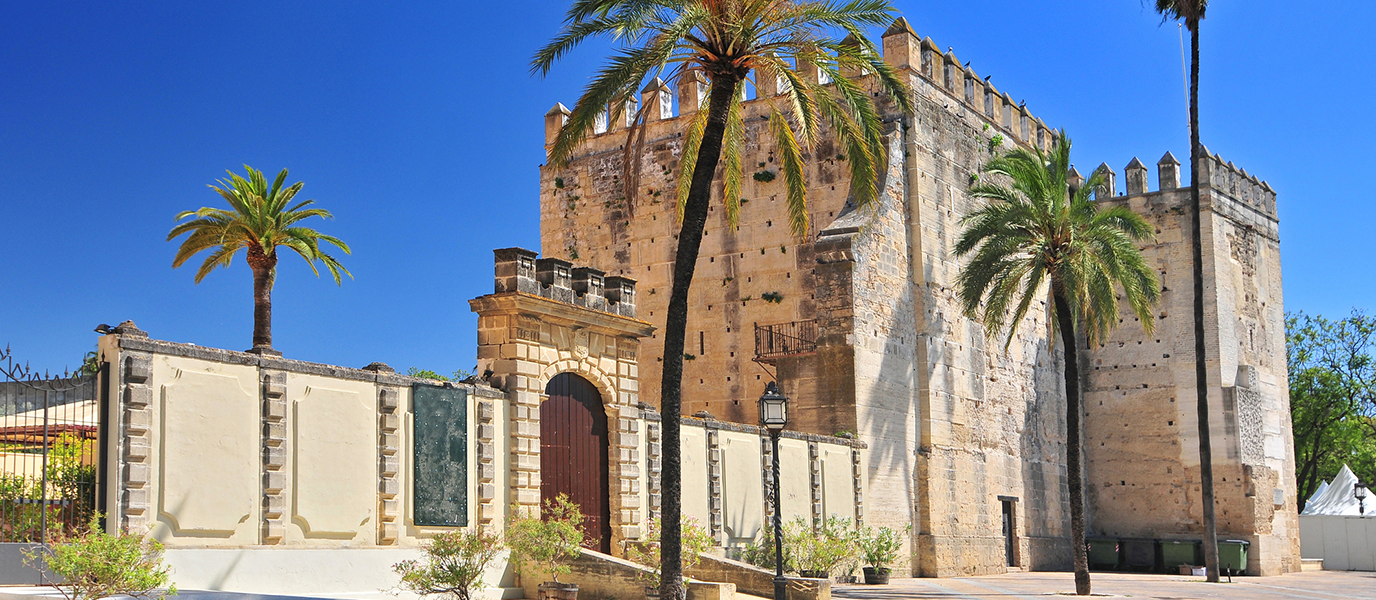
















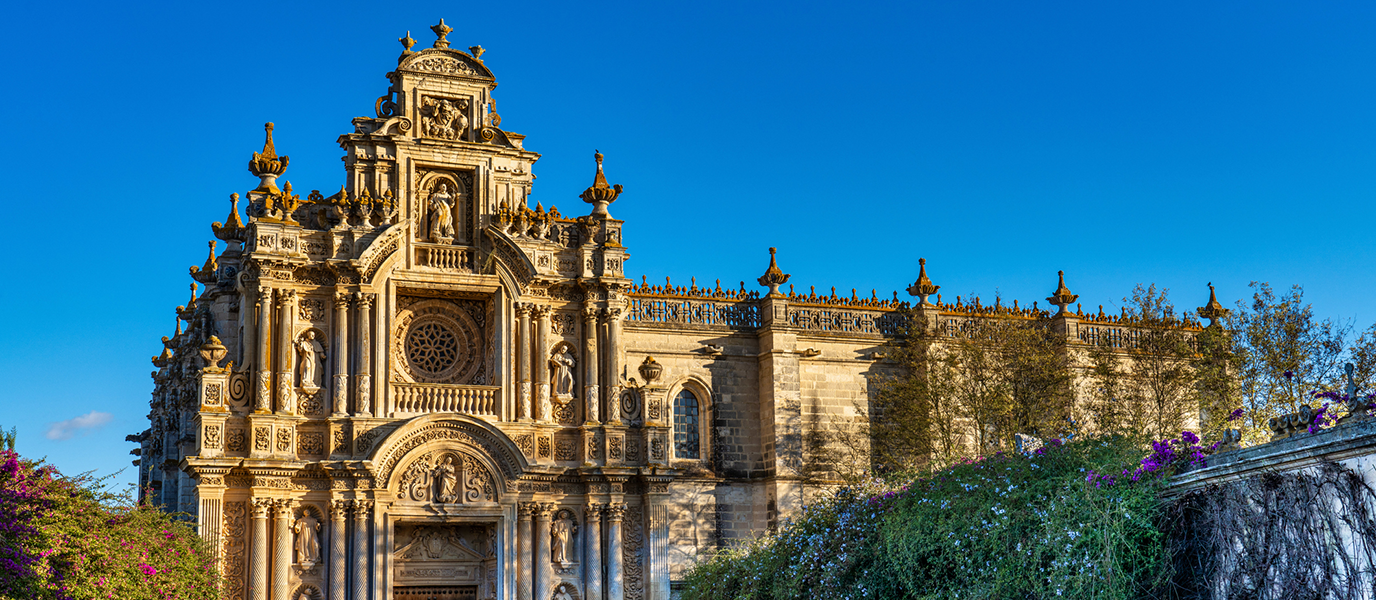
Located in the south of Jerez de la Frontera, about 5 kilometres from the centre of this attractive city in Cádiz, on a hill on the right-hand bank of the river Guadelete, La Cartuja de Santa María de la Defensión is a great monument that is well worth a visit on any sightseeing tour. It has, quite possibly, the greatest artistic value of all the monuments in the province of Cádiz. Its long history dates back to the year 1369, when this was the site of an important battle: the Battle of Salado, between the Christians and Muslims. It is said that victory fell to the Christian side thanks to the intervention of the Virgin Mary. So, in her honour, a small refuge was built, which more or less corresponds to the Capilla de Caminantes [Wayfarers’ Chapel] that we see today in the atrium of La Cartuja. Its initial architectural style, from the fifteenth century, is late Gothic.
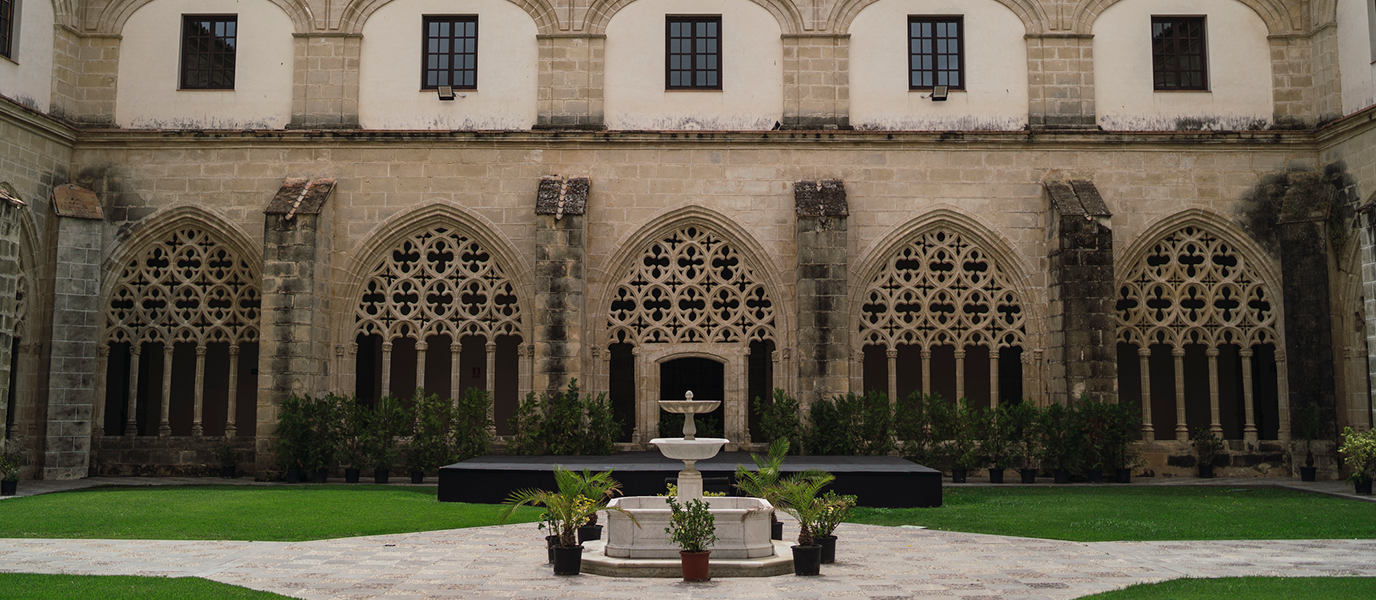
Its impressive Renaissance entrance (as well as the Chapel of Santa María) is the work of Andrés de Ribera. Also notable are the seating in the choir and the main altarpiece, by Juan de Oviedo de la Bandera (1565-1625). He actually made it for the Church of the Merced in Sanlúcar de Barrameda, from where it was brought in 1960. Another impressive feature is the small Gothic cloister, designed by Martínez Montañés. A few important paintings that once belonged to La Cartuja (among them one by Zurbarán) are now in the Museum of Cádiz.
- The history of La Cartuja de Santa María de la Defensión
- Visiting La Cartuja de Jerez
- Useful information: opening times, admission, worship…
The history of La Cartuja de Santa María de la Defensión
Although the notion of La Cartuja de Santa María de la Defensión dates from 1369, it was not until 1474 that Álvaro Oberto de Valeto, a Jerez nobleman of Genovese descent, offered a significant financial contribution to the building of it. And just two years later, in 1476, the first Carthusian monks arrived from Seville.
In 1810, with the French invasion, the monks had to abandon the monastery and take refuge in Cádiz. The monument was used as accommodation for the troops, and suffered significant damage. In 1835, ownership passed to the State during a country-wide process of disentailment. There was serious pillaging, which also destroyed the ancient Orchard de la Cartuja, the olive oil mill, and the river viewing point.
In 1948, the Carthusians returned to Jerez at the request of the Archbishop of Seville, Don Pedro Segura y Sáenz, and they remained there until their permanent departure in 2001.
Who then occupied the monastery of La Cartuja, Jerez? The Hermanas de Belén [Sisters of Bethlehem], a female order dedicated to contemplation, remained at the monument until March 2024.
Visiting La Cartuja de Jerez
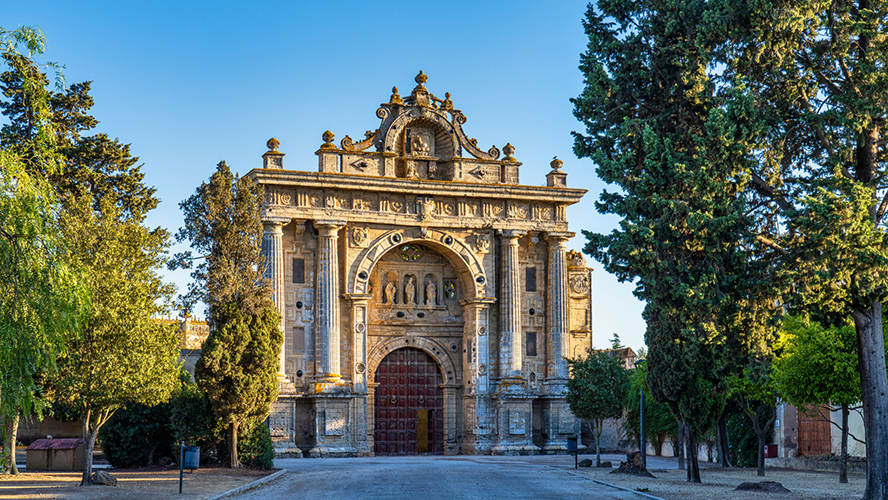
Thanks to its great beauty and wealth, La Cartuja de Jerez was the first historic building in Cádiz to be declared a Monument of Artistic and Historical Interest.
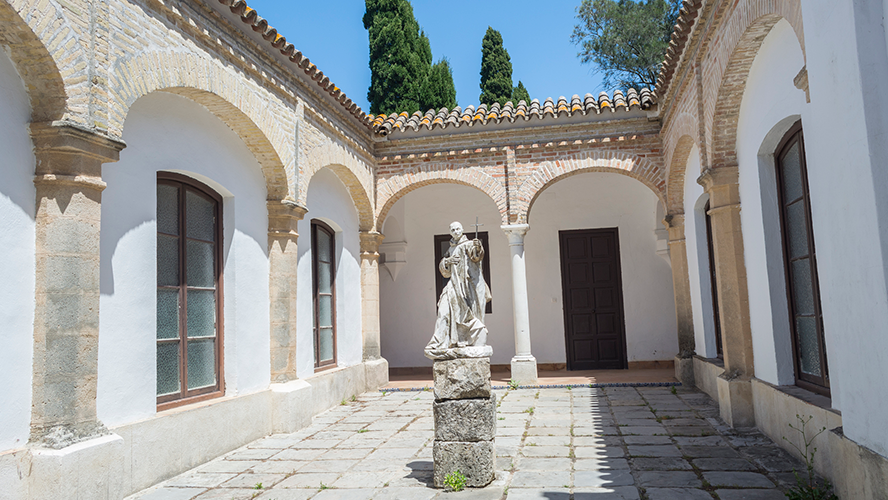
Throughout its history, its various rooms were designed to fulfil certain functions in the lives of its occupants, the Carthusian monks. One outstanding feature is the cloister, the Claustro de Padres, which is overlooked by the monks’ cells. The Carthusians lived a solitary life, and each cell contained what they required for their spiritual and bodily needs: a small refectory, a bedroom, a small study and an oratory. Inside the Church, the monks recited the office of the Hours in the choir, and celebrated the Eucharist. The Church area is divided into three: the inner part was intended for the Carthusian Fathers, the middle section for the lay brothers, and the outer section for the faithful who wished to accompany the Fathers during the celebration of the Eucharist. The building’s Baroque façade was designed by Brother Pedro del Piñar, and the images in the niches are the work of Francisco de Gálvez. The lay brothers’ role was to serve the Carthusian Fathers so that the latter could devote their time and energies to their spiritual life. The lay brothers’ cells open out on to the Claustro de Legos [Lay Cloister]. The Claustrillo [Small Cloister] provides access to La Cartuja’s larger spaces, and in its galleries we can find rooms with communal facilities including the Capítulo de Padres [Fathers’ Chapter], the Capítulo de Legos [Lay Chapter], and the Communal Refectory.
La Cartuja has other communal areas: orchards, workshops, stables, lodgings for pilgrims, and so on.
Useful information: opening times, admission, worship…
Very close to the monastery there is now the Guadalete Interpretation Centre. It should be remembered that, in 2019, Roman remains were discovered in the river next to the monastery.
The easiest way to get to La Cartuja de Jerez is to follow the Jerez-Algeciras road as far as the 5 kilometre sign. The monastery can also be reached via the AP-4, the motorway that links Seville with Cádiz, and which joins the Jerez-Algeciras road.
The general admission charge for a guided tour of La Cartuja de Jerez is 15 euros. This is the only way of visiting, and you can only see this group of monuments on Fridays and Saturdays, with two tours taking place on each morning. Throughout most of the area, photography without the use of flash is permitted.
On Sundays at 12.30 p.m., you can follow the celebration of the Holy Mass in the Monastery of La Cartuja de Santa María de la Defensión.