
















































Wine in Jerez is more than just an industry: Jerez smells of wine, and that’s no cliché. As you wander through its historic centre, the aroma of those generous wines seeps through the thick walls of wineries like Tío Pepe.
In this setting, the Tío Pepe wineries have become one of the top tourist attractions in Jerez. And for good reason: this is no ordinary winery. Some of its vast buildings, where wine is aged using the solera system over many years, were once part of the city’s street map.
In fact, this is where you’ll find what’s considered one of the most beautiful streets in Spain: the Callejón de los Ciegos, completely shaded by a vine-covered trellis and paved with stunning geometric stonework.
- Historical context and location
- How to get there and other helpful information
- What to expect from your visit to the winery
- Other wineries in Jerez
Historical context and location
Of all the wineries in Jerez, Tío Pepe’s location is second to none. At the heart of the city’s historic centre, its 370,000-plus square metres lie between the Alcazaba complex and the Cathedral. It’s also just steps from the Viceroy Laserna Palace and the city’s main square, Plaza del Arenal, which leads onto the pedestrianised Calle Lancería.
It was here that the company’s founder, Manuel María González Ángel, bought his first winery in 1835. Soon after, he added the La Constancia winery, and over the decades expanded by acquiring nearby buildings, gradually creating the huge complex we see today.
The winery is named after the founder’s uncle, José María Ángel y Vargas, whom he always called “my Uncle [Tío] Pepe”. He supported and advised Manuel María in the early days of the business. As a gesture of affection and gratitude, the name Tío Pepe was given to one of the first fino wines the winery produced.
The business took off and gained international prestige after González Ángel partnered with British importer Robert Blake Byass in the mid-19th century. And so the González Byass company was born, now owners of Tío Pepe and eight other wineries throughout Spain. Today, it’s run by the family’s fifth generation.
How to get there and other helpful information
As mentioned, the Tío Pepe wineries are right in the centre of Jerez. That means they’re just a short walk from the city’s main attractions. If you’re coming by car, there’s a large (paid) car park right by the winery.
The standard tour takes around two hours and includes tastings of several wines and tapas, depending on the ticket chosen. There are usually three guided visits per day, every day except Monday, two in the morning and one in the afternoon. Prices range from 24 to 48 euros per person.
Tours are available in Spanish, English and German, and if you’re planning to make your own way around, it’s best to book and pay for your ticket on the winery’s website: tiopepe.com. Especially during peak season (summer and public holidays).
What to expect from your visit to the winery
The tour begins at the visitor reception centre, where each group is assigned a guide in their chosen language. Then you hop on a little train that winds through the historic gardens of Villa Victoria, filled with exotic plants. From the train, you’ll see the only vineyard located in the city centre of Jerez, known as San Manuel.
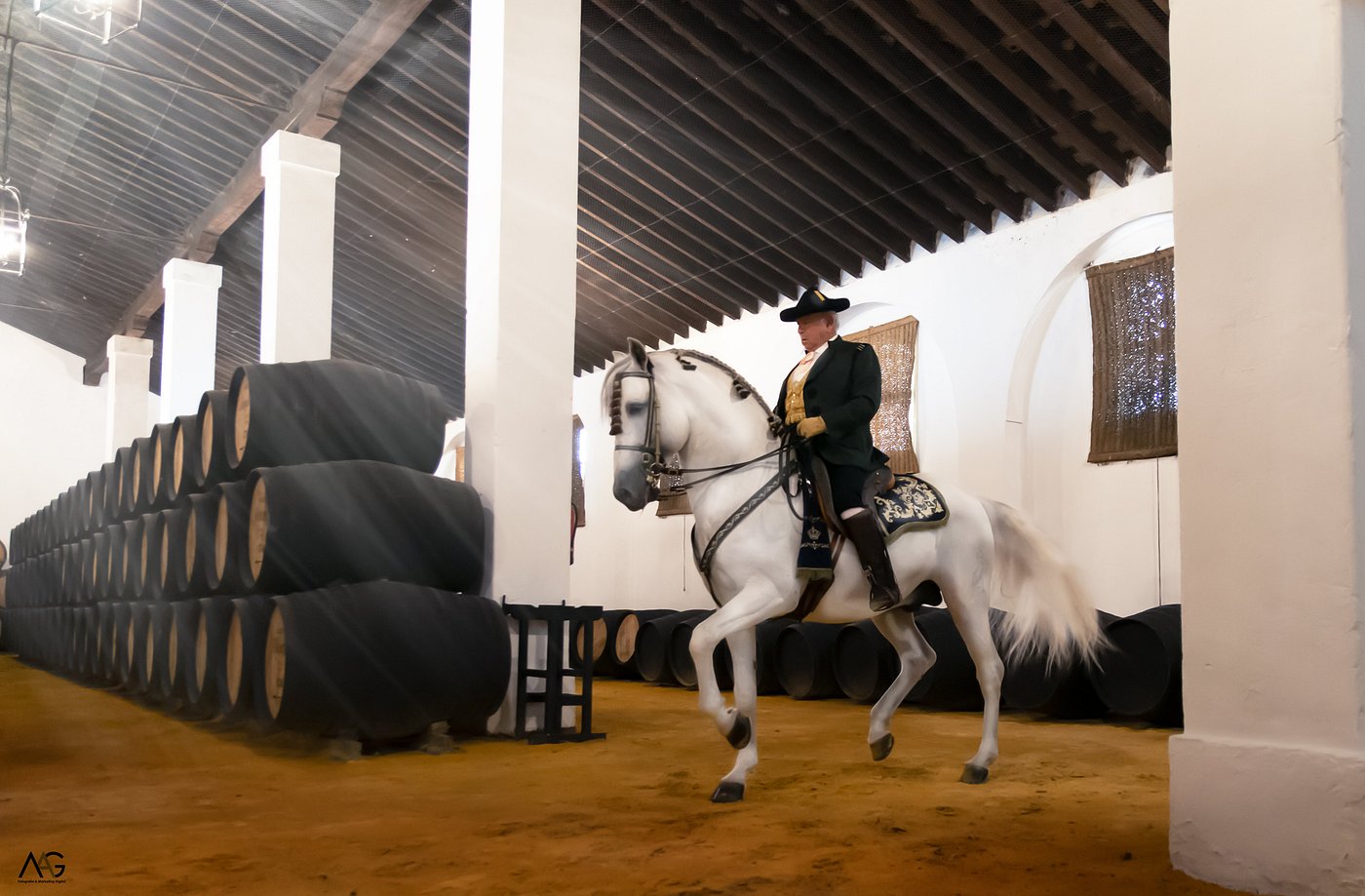
It’s also the name of one of the first wineries you’ll visit in the complex, where they produce Lepanto brandy. From there, the tour continues through the so-called “wine cathedrals” where the different types of sherry are aged: La Cuadrada, Los Apóstoles (which holds casks with over 12,000 litres), La Constancia and Los Reyes.
In the latter, you’ll find barrels signed in chalk by some of the most famous names in the arts, politics and science, both in Spain and globally.
Between La Constancia and Los Apóstoles lies the Callejón de los Ciegos, undoubtedly the most photographed (and shared) spot in the whole complex.
The visit ends with a wine tasting, held in one of the unused wineries. In the same space, you’ll also find various art installations inspired by the brand’s logo.
Other wineries in Jerez
There are plenty of other wineries in Jerez and the surrounding municipal area that are also well worth a visit. In fact, there are more than 40 registered with the Jerez-Xérès-Sherry regulatory council.
One of the most prestigious and impressive is Lustau, founded in 1896. Though it’s a traditional winery, it also embraces innovation; just try its acclaimed vermouth and you’ll see. One of Lustau’s main attractions is the sheer variety of wines and drinks it offers.
A visit to Bodegas Tradición is also a dive into the art world, both in terms of sherry production and fine art. One of its old solera ageing facilities has been turned into an art gallery, showcasing the family’s collection built up over more than a century. The Rivero Art Gallery includes paintings by Velázquez, El Greco, Murillo, Goya, Valdés Leal and Carlos de Haes, among others.
Bodegas Fundador is something a little different, specialising in brandy, though it also produces fortified wines. It’s one of the oldest in the city, dating back to 1730. Its La Mezquita winery is said to be one of the biggest in the world. A visit to its brand-new museum, opened in 2024, is also a must.
Also worth mentioning are the Álvaro Domecq Wineries, founded in 1850. It takes its name from the famed horseback bullfighter who bought it in the late 20th century. That explains the winery’s strong link to horses and bullfighting.
Besides these, there are other notable wineries in Jerez worth visiting. Among them are Sandeman; Williams & Humbert, where the famous sweet wine Canasta is made; Faustino González, which focuses on high-end wines; and Luis Pérez, located outside the city in a vineyard of palomino fino grapes, the base variety for sherry.