













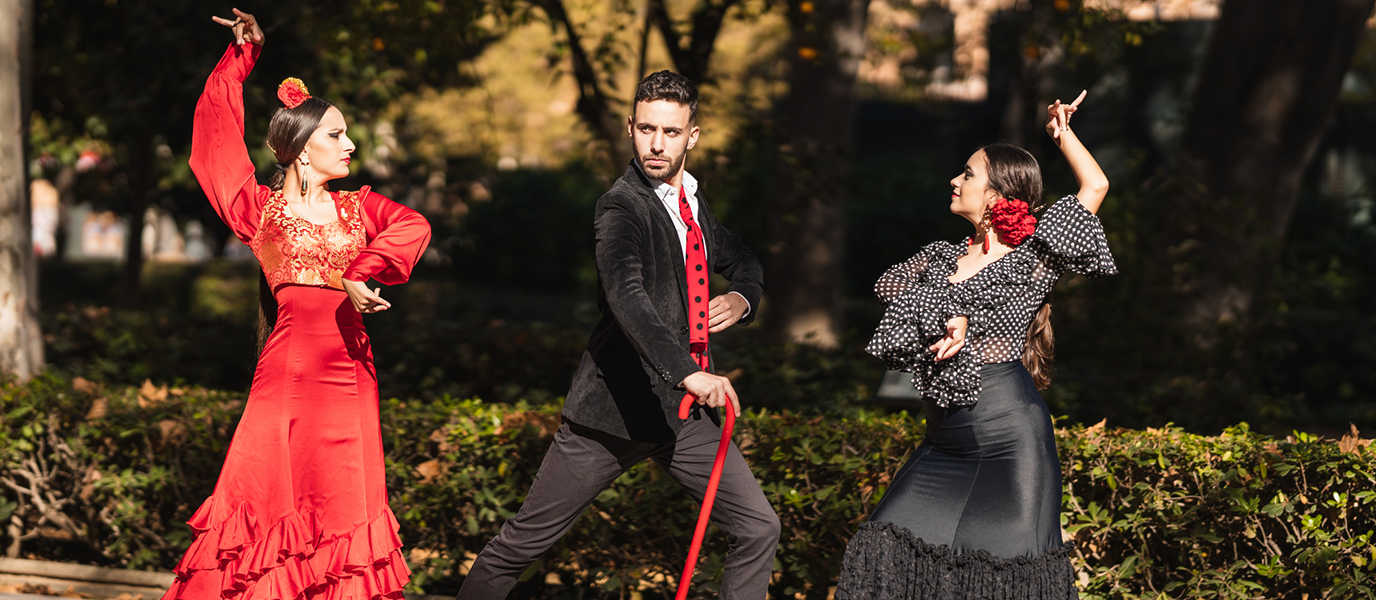
Flamenco is one of the great passions of Andalusia and, of course, of Jerez de la Frontera, the part of Cádiz that claims to be the cradle of the art of flamenco. Since 2010, this form of artistic expression has generated an endless range of flamenco styles and emotions, and has been added to the UNESCO Intangible Cultural Heritage list. Flamenco is incorporated as an essential element in Jerez’s religious ceremonies, in its public festivals, in private parties, in the life of its gypsy community and in the life of its working-class neighbourhoods, and from there to the University and to the world’s great stages via families, dynasties, social groupings and Jerez flamenco peñas.
Jerez’s links with flamenco are ancient, to the point where the city has produced its own, genuine, palos [flamenco styles], such as the Bulería, and has been home to great exponents of the art, such as Lola Flores, José Mercé, and the Moraíto family, who have taken flamenco all over the world.
The context and history of flamenco in Jerez
As we have already noted, flamenco is an intrinsic aspect of daily life in Jerez. At any time of the year, you can attend flamenco peñas and tablaos, and throughout the year, festivals and cycles of performances are held to celebrate this art. Not to mention the spontaneous singing and dancing that start as if by magic, and which are improvised in the city’s bars, streets and squares, particularly in the districts of San Miguel, Santiago and San Mateo.
The year begins with the Jerez Flamenco Festival, and ends with the flamenco rhythms of the area’s traditional carols. In between, there are highlights such as the Ciclo Caló Flamenco. And in summer, there is the Fiesta de la Bulería, the Noches de Bohemia [Bohemian Nights] and Viernes Flamencos [Flamenco Fridays].
Jerez’s great flamenco performers have travelled the world with their art. They include: Tío Borrico, Don Antonio Chacón, Terremoto, Juan Moneo el Torta, La Paquera and Fernando de la Morena. As a testament to all of them, and to the history of flamenco in Jerez, stands the Centro Andaluz de Flamenco, located in the city’s historic quarter, and worth visiting if you would like to learn more about this universal art.
The best flamenco tablaos
Many visitors to Jerez de la Frontera are drawn by its heritage and also by the art of flamenco. For this reason, there are lots of tablaos and peñas where you can enjoy a flamenco show. Here are a few:
Tablao Flamenco Puro Arte
In the centre of Jerez, near the bullring, this venue offers quality shows every day with renowned dancers, singers and guitarists. You can also enjoy the show with a glass of local wine, or even with a traditional Andalusian dinner. It is said to be the finest flamenco tablao in Jerez de la Frontera.
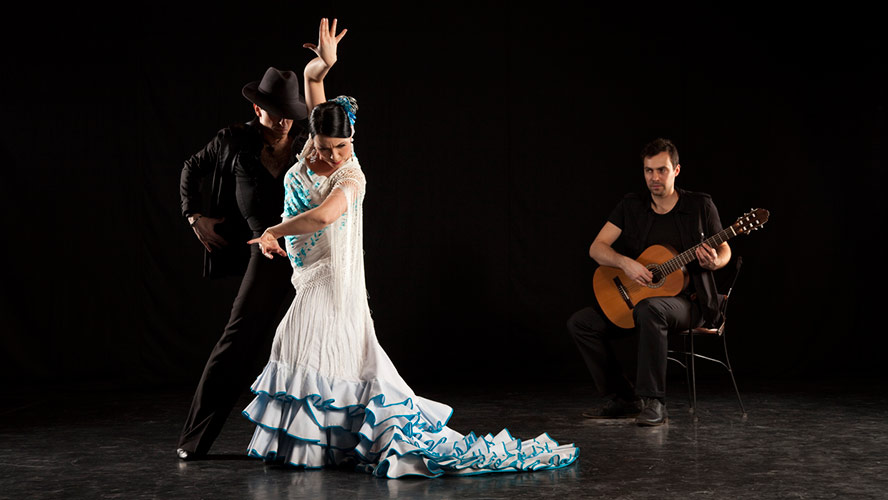
La Guarida del Ángel
This is another famous Jerez establishment. Here, in an intimate atmosphere, you can watch live performances by revered artists and other outstanding figures. La Guarida del Ángel is next to the Plaza de las Angustias.
El Pasaje
Founded exactly a century ago, in 1925, this Jerez flamenco tablao is one of the city’s classics. It offers daily performances with a wide variety of wines and tapas.
El Lagá
This tablao is in a former nineteenth-century bodega, and always puts on a Jerez flamenco show with a typical Andalusian dinner.
There are other venues in this neighbourhood offering live flamenco performances, such as La Cava, located in an eighteenth century bodega, La Bailaora Flamenco, which is in a gastrobar, and A la Feria, a small tablao which also serves a great selection of local wines.
The Jerez Flamenco Festival
Every year, the Jerez Flamenco Festival is held, and is a great success. The next one will run from 20 February until 7 March 2026, and during this period the city invites the whole world to allow itself to be seduced and impressed by the art of flamenco and Spanish dance. During the festival, the city opens the doors of its palaces, bodegas, peñas, tablaos and the Villamarta Theatre to welcome the public and fans of the art of flamenco.
Participants in the last festival included Eduardo Guerrero, the Antonio Gades Company, Karime Amaya, Ballet Flamenco de Cádiz, the Marco Flores Company and the María del Mar Moreno Company.
This is also a good time to join one of the many courses on offer, run by important figures in the world of flamenco. Would you like to learn to dance bulerías or alegrías? Or how to perform with the long-tailed dress and fan? Or would you prefer to learn the dance techniques of martinetes or tientos? There are also courses for beginners in the tangos of Triana, in siguiriyas and in baile por caña.
To give an idea of the level of this festival, we need only say that some of the teachers of these courses and workshops are of the calibre of Eva Yerbabuena, Andrés Peña, Antonio Najarro, El Truco, David el Gamba, Niño de la Fragua and José Ignacio Franco.