










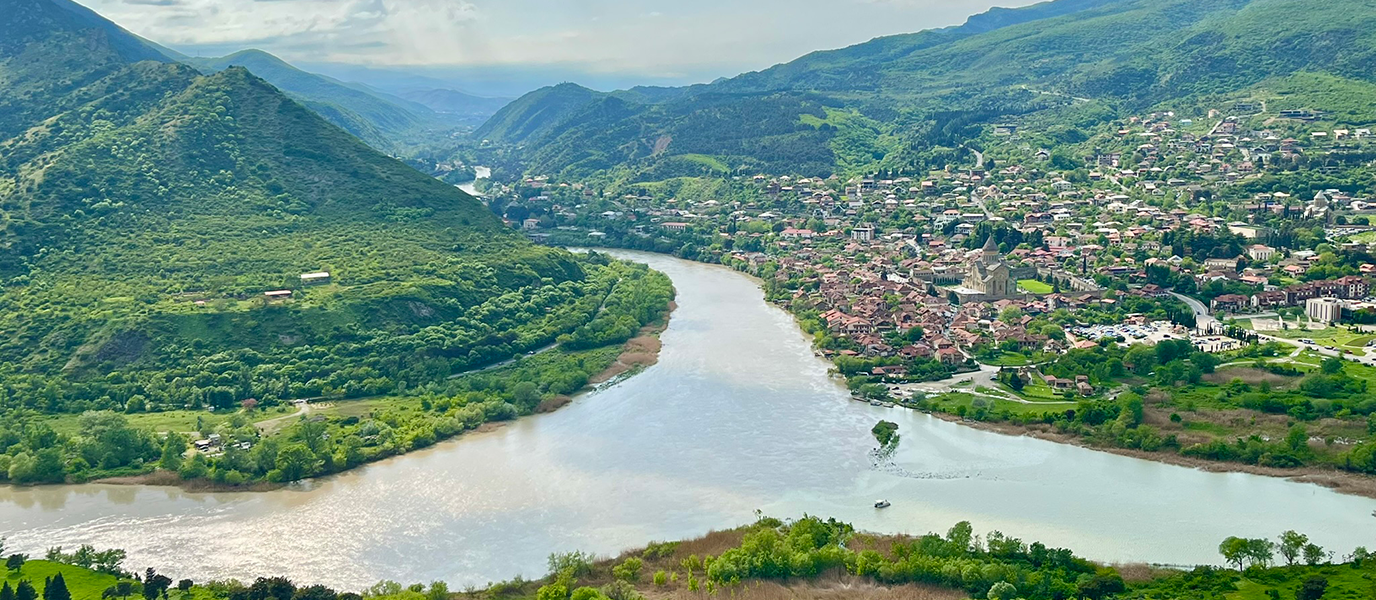
Mtskheta doesn’t impress through its size or hustle and bustle, but through the weight of its past. Situated where the Aragvi and Kura rivers meet, in a fertile valley surrounded by gentle hills, it was the political and religious heart of the ancient Kingdom of Iberia for centuries, the forerunner of the Georgian state. Today it has just over 10,000 inhabitants, but its historic centre and monuments encompass some of the most decisive chapters in the nation’s history. It was here that the official conversion to Christianity took place in the 4th century and its main churches have been declared World Heritage Sites.
- History of Mtskheta, the ancient capital of Georgia
- How to get there: 20 kilometres from Tbilisi by car, taxi or “marshrutka”
- What you’ll see on your visit: three churches that tell the story of a nation
- Where to eat: traditional restaurants between Svetitskhoveli Cathedral and the Aragvi River
- What to see in the surrounding area: from medieval fortresses to the Georgian Military Road
History of Mtskheta, the ancient capital of Georgia: from the Kingdom of Iberia to the nation’s spiritual capital
The history of Mtskheta dates back to the first millennium BC, when it became established as the centre of the Kingdom of Iberia, Kartli in Georgian, a political entity that played a key role in the Caucasus. Thanks to its location on routes connecting Anatolia, Persia and the Black Sea, the city prospered as a commercial and strategic hub. Archaeological remains found in the surrounding area confirm the existence of fortified settlements and necropolises, revealing a complex and hierarchical society.
The event that definitively shaped its identity took place in the year 337, when King Mirian III adopted Christianity as the official religion, influenced by the preaching of Saint Nino. This event turned Mtskheta into the spiritual epicentre of the country. Tradition holds that the city safeguards Christ’s tunic, a relic said to have arrived from Jerusalem which, according to legend, was buried beneath the future main cathedral.
During the Middle Ages, Mtskheta retained its religious importance, even though the political capital moved to Tbilisi. The churches and monasteries in Mtskheta became centres of cultural and artistic production, where a distinctive type of architecture emerged, characterised by the balance of its proportions and its sober decoration. Persian, Arab and Mongol invasions left marks of destruction and reconstruction, but the city maintained its symbolic status.
In the 20th century, under Soviet rule, Mtskheta lost administrative prominence, but its historical value was recognised and preserved. After gaining independence, Georgia consolidated its role as a spiritual reference point. Today, although small, the city remains the setting for religious celebrations and official visits, and for many Georgians it represents the very origin of their national identity.
How to get there: 20 kilometres from Tbilisi by car, taxi or “marshrutka”
Mtskheta is located about 20 kilometres to the north-west of Tbilisi, making it one of the most accessible day trips from the capital. Getting there by road is direct and quick: by car or taxi, the journey usually takes between 20 and 30 minutes, depending on traffic. The motorway heading north makes access easy even for those who aren’t used to driving in the country.
Another common option is to use “marshrutkas”, shared minibuses that operate as intercity transport. They depart frequently from Didube station in Tbilisi and allow you to reach Mtskheta at low cost. Many travellers also choose to book organised trips that combine the visit with other nearby places of interest, such as fortresses or monasteries situated on nearby hills.
Once in the city, the historic centre is easy to explore on foot. The recently restored cobbled streets are lined with souvenir shops, small cafés and provide direct access to the main monuments.
What you’ll see on your visit: three churches that tell the story of a nation
Mtskheta brings together several of Georgia’s most important religious monuments. Although the urban centre is quite compact, the main points of interest are scattered between the centre and the nearby hills, which means combining urban walks with short journeys by vehicle or taxi.
The visit is usually organised around three major sites: Jvari Monastery, Svetitskhoveli Cathedral and Samtavro Convent. Each one offers a different perspective on Georgian history and architecture, and together they form a coherent route that makes it possible to understand how the country has developed spiritually and artistically.
Jvari Monastery: the cross on the hill where two rivers meet
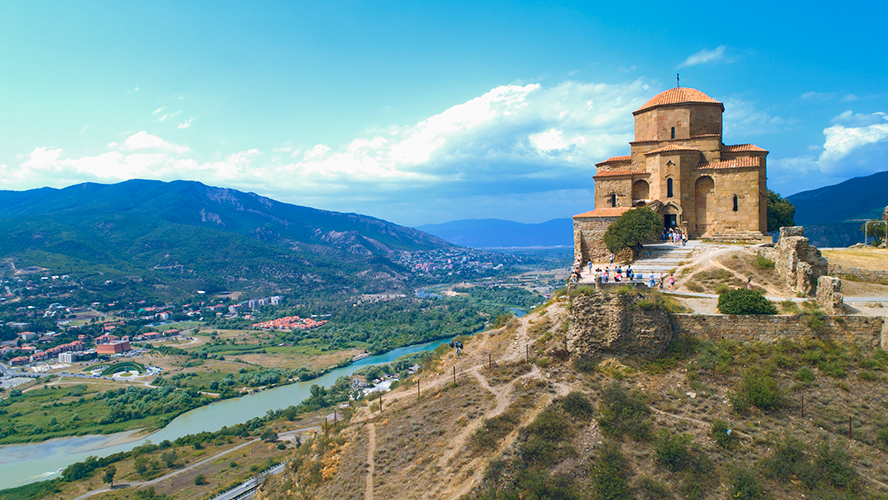
Jvari Monastery rises on top of a hill facing the city, dominating the confluence of the Aragvi and the Kura. Built in the 6th century, it’s one of the oldest and purest examples of central-plan architecture in Georgia. Its name means “cross” and refers to the symbol that, according to tradition, Saint Nino erected on that very spot after the king’s conversion.
Its esplanade offers one of the country’s most iconic views: the contrast between the river with lighter waters and the one with a darker tone, winding before merging into a single course. Inside, austere and almost bare, the exposed stone and filtered light create a sober atmosphere that invites reflection. The structural simplicity is deceptive, as every proportion is designed to create balance and harmony.
Svetitskhoveli Cathedral: the “living column” and Christ’s tunic
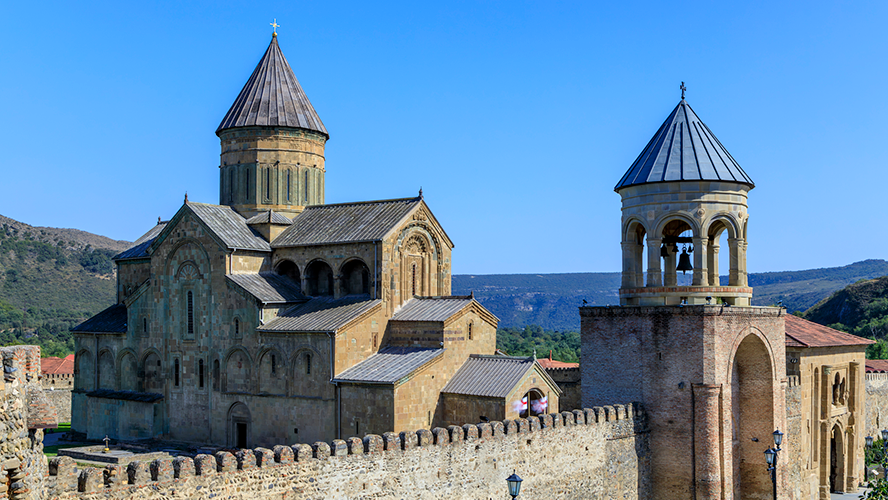
In the heart of Mtskheta stands Svetitskhoveli Cathedral, built in the 11th century on the site of earlier churches. Its name can be translated as “the living column” and is linked to the legend of Christ’s tunic buried on the site. According to tradition, a miraculous column exuded holy oil, which consolidated the site’s spiritual importance.
The current building, which is quite large, stands out for its carefully carved stone façade and balanced proportions. Inside, frescoes from different periods and the tombs of Georgian kings are preserved, which reinforce its religious and political significance. Unlike the isolation of Jvari, here life flows with visitors, worshippers and liturgical celebrations.
Samtavro Convent: monastic seclusion among cypresses
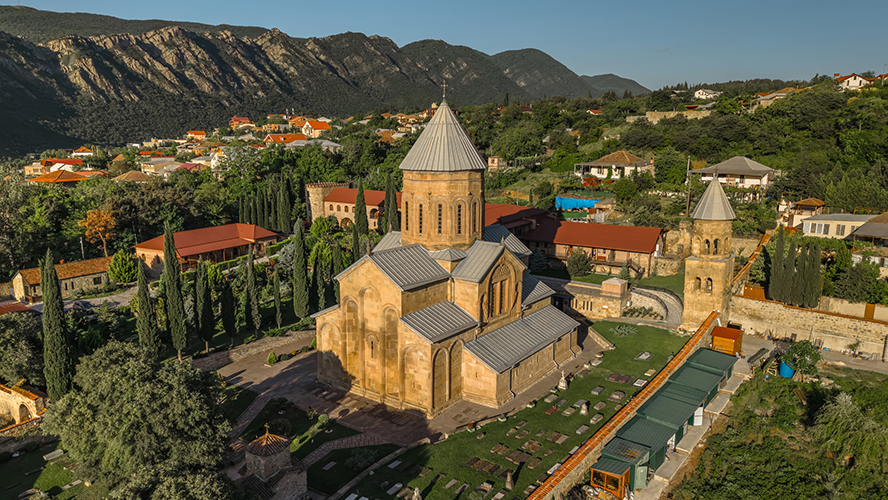
Samtavro Convent, located a short distance from the centre, consists of a church and an active monastic complex. Its origins also date back to the early centuries of Christianity in Georgia, and the site houses the tombs of King Mirian III and Queen Nana, key figures in the country’s conversion.
The complex, surrounded by gardens and tall trees, conveys a sense of serenity distinct from the grandeur of Svetitskhoveli. The nuns who live in the convent keep the spiritual tradition of the place alive, and visitors can explore the main church and the small adjoining chapels while respecting the atmosphere of contemplation.
Where to eat: traditional restaurants between Svetitskhoveli Cathedral and the Aragvi River
Although Mtskheta is a small city, its proximity to Tbilisi has encouraged the emergence of several restaurants where you can try Georgian cuisine in a particularly evocative setting. One of the best known is Salobie, located a few minutes from the historic centre. This restaurant takes its name from lobio, the traditional Georgian bean stew served in a clay pot, and prepares it according to local recipes accompanied by mchadi (cornbread). Its menu also includes freshly made khinkali, badrijani nigvzit, aubergines stuffed with walnut paste, and wines from the Kakheti region served in clay jugs.
Right in the historic centre, near Svetitskhoveli Cathedral, is Check-In Garden, a restaurant with a shaded terrace from which you can see the walls of the cathedral complex. Here, they usually prepare very refined versions of classics such as khachapuri imeruli (bread stuffed with cheese) or chakapuli, a spring lamb stew with tarragon and green plums. The outdoor tables, surrounded by greenery, make it a lovely place for lunch after visiting the monuments in the centre.
Another very popular option among travellers and hikers is Old Armazi Restaurant, located near the Aragvi River, at a point where the landscape opens out towards the surrounding hills. This restaurant is known for its Georgian grilled meats (mtsvadi), skewers of pork or beef slowly roasted over embers, and for serving Georgian wine made using the traditional qvevri method, in large amphorae buried underground. Eating here at sunset, with the mountains of inland Georgia appearing on the horizon, adds a scenic dimension to the dining experience.
What to see in the surrounding area: from medieval fortresses to the Georgian Military Road
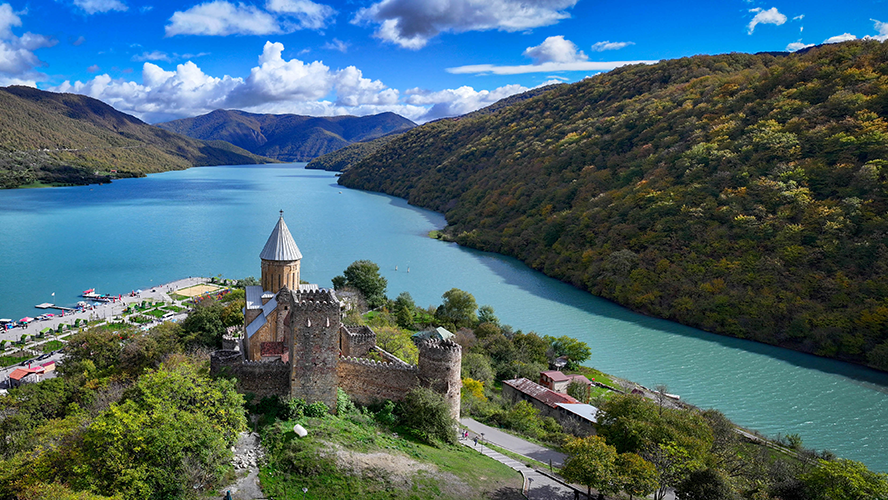
The area around Mtskheta is home to some of the most interesting historical landscapes in central Georgia. About 12 kilometres to the north lies Ananuri Fortress, one of the country’s most photogenic defensive complexes. Its crenellated walls and watchtowers rise beside the Zhinvali Reservoir, whose bluish waters contrast with the golden stone of the churches within the complex. Built between the 16th and 17th centuries by the Dukes of Aragvi, the fortress controlled the passage towards the mountains and protected the trade route that crossed the valley.
From Ananuri begins one of the most spectacular stretches of the Georgian Military Road, the historic route that links Tbilisi with the North Caucasus. This road winds through gorges and mountain meadows, passing through small villages and natural viewpoints. For many travellers, following this route offers a first glimpse of the alpine landscapes that dominate the north of the country.
It’s also worth making the trip to Zedazeni Monastery, located on top of a wooded hill about 20 kilometres from Mtskheta. Founded in the 6th century by one of the so-called Thirteen Assyrian Fathers who spread Christianity in Georgia, the monastery offers a wide panoramic view over the Aragvi River valley and the plains surrounding the ancient capital. The tranquillity of the place and the absence of large tourist crowds make it a particularly captivating stop.
For those with more time, Mtskheta can serve as a starting point for more ambitious routes through the north of the country, following the road towards Kazbegi and the high mountains of the Greater Caucasus. In this sense, the ancient Georgian capital not only summarises the country’s medieval history, but also marks the symbolic gateway to its most spectacular landscapes.