









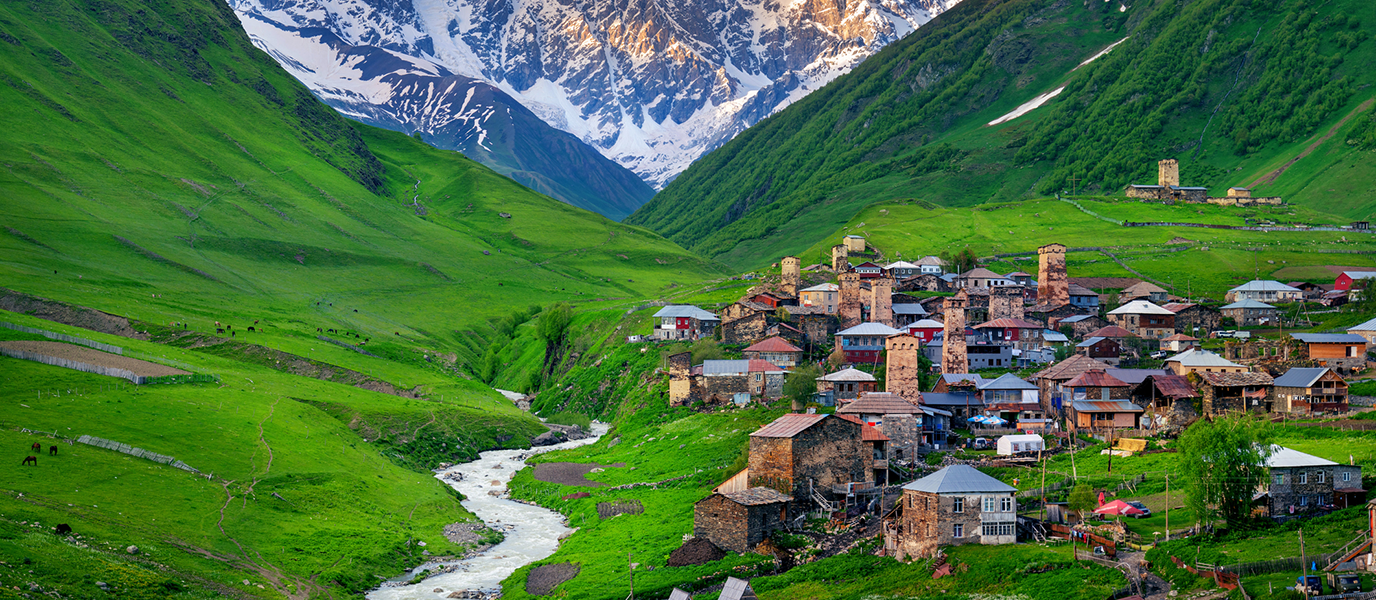
Travelling to Svaneti means venturing into one of Georgia’s most remote and breathtaking regions, a territory nestled on the southern flank of the Greater Caucasus, where the villages seem to be sheltered by a ring of snow-capped peaks. There, the landscape is not merely a backdrop: it shapes the architecture, the customs and even the character of its inhabitants, the Svans, an ethnic group with their own language and an identity forged amidst long winters and mountain passes that remain closed for months on end. The region is divided into Upper and Lower Svaneti, although for travellers the main hub is usually Mestia, a small administrative capital located at an altitude of 1,500 metres. Roads and trails lead out of this valley to communities such as Ushguli, one of the highest continuously inhabited settlements in Europe. Svaneti’s historical isolation has allowed it to preserve an exceptional architectural and cultural heritage that is visible in the distinctive medieval defensive towers standing next to every family home.
- Svaneti, Georgia’s most spectacular region between the Ushba and the Shkhara
- History and culture: the towers that survived empires and avalanches
- Things to see in Svaneti: from Mestia to Ushguli, among museums and stone villages
- Landscapes and nature: alpine routes and ice horizons
Svaneti, Georgia’s most spectacular region between the Ushba and the Shkhara
Svaneti stretches across north-western Georgia, near the border with Russia, in a strip dominated by some of the most imposing peaks in the Caucasus. Among them are Mount Shkhara, at 5,193 meters, the highest peak in Georgia, and Ushba, famous among mountaineers for its double sharp peak and technical difficulty.
The Enguri river valley acts as the natural route in the region. Along the river, there are villages whose stone houses are grouped around square towers up to 25 meters high. Those constructions, built between the 9th and 13th centuries, served as a refuge from invasions and also as protection during disputes between family clans. The result is a unique architectural landscape which, in the case of Ushguli, has been recognised by UNESCO as a World Heritage Site.
The feeling when walking through Svaneti is that of being in a vertical territory. The slopes rise abruptly from the valley floor and, in summer, are covered with meadows dotted with alpine flowers. In winter, the snow transforms the region into an almost inaccessible area, which is why, for centuries, Svaneti developed autonomous social structures and a strong sense of community.
History and culture: the towers that survived empires and avalanches
The history of Svaneti is shaped by its geographical isolation. During the Middle Ages it was part of the Kingdom of Georgia, although its distance from the major urban centres allowed local communities to retain a remarkable degree of self-government. When Mongol and later Ottoman invasions shook other regions of the country, many religious treasures were moved to churches in Svaneti for protection.
The defensive towers, an undisputed symbol of the region, are a testament to a social system based on family clans. Each lineage built its own tower attached to the main house. In case of attack or revenge between families, a practice documented well into the 19th century, members of the clan could take refuge inside, entering through a high door and removing the ladder to hinder the assault.
With its annexation to the Russian Empire in the 19th century, Svaneti began to gradually integrate into broader administrative structures, although its difficult access kept it relatively isolated for decades. During the Soviet era, schooling was promoted and basic infrastructure was built, but many local traditions survived, including the Svan language, different from standard Georgian.
The Svan culture is also expressed in its polyphonic music, recognised as one of the oldest forms of choral singing in Georgia. The rural churches preserve medieval frescoes and ancient icons, some of which were hidden for centuries to prevent looting. This combination of defensive architecture, sacred art and oral tradition makes Svaneti a region where history is not displayed in glass cases, but is part of the everyday landscape.
Things to see in Svaneti: from Mestia to Ushguli, among museums and stone villages
Mestia is the main entry point and base for exploring the region. In addition to featuring accommodations and restaurants, it houses the Svaneti History and Ethnography Museum, where illuminated manuscripts, medieval crosses and liturgical objects that were preserved in mountain churches for centuries are exhibited. From the centre of the village, several restored towers can be visited to understand their internal structure.
About 45 kilometres away by car, Ushguli provides one of the most striking sights in Georgia: dozens of medieval towers clustered in a valley at an altitude of 2,100 meters, with Mount Shkhara rising in the background. When walking along its dirt paths, between stone houses and stables, you will see how rural life continues despite the growing arrival of visitors.
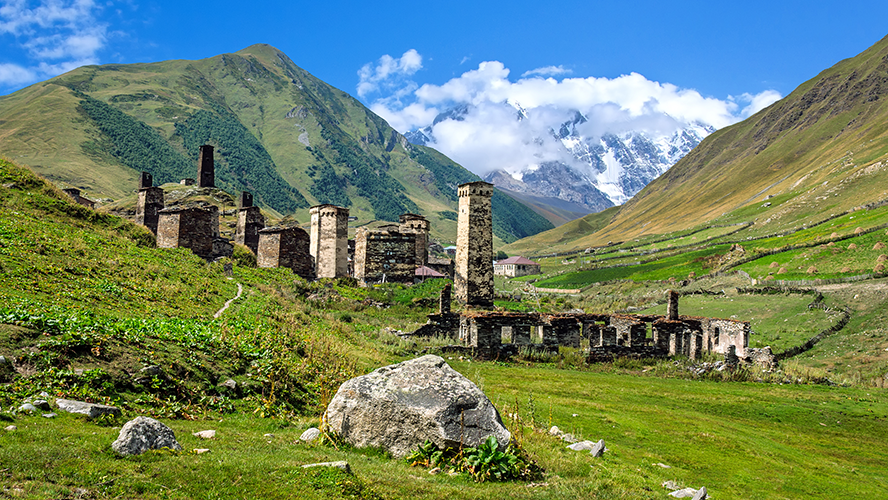
Another interesting stop is the Chalaadi glacier, accessible via a relatively easy hike from Mestia. The trail crosses a suspension bridge over the river and enters a forest before opening up to a landscape dominated by ice and moraines. You should also visit the Hatsvali viewpoint, which can be reached by cable car or on foot, for a wide panoramic view of the valley.
Landscapes and nature: alpine routes and ice horizons
Svaneti is one of the most highly rated destinations for hikers and mountain lovers in the Caucasus. The multi-day route between Mestia and Ushguli is one of the most well-known: it goes through mountain passes, remote villages and high-altitude meadows, providing a gradual glimpse into the region’s diverse landscapes.
The glaciers descending from peaks like Shkhara or Tetnuldi feed the rivers with cold and fast-flowing water. In summer, the alpine pastures are filled with cattle and wild flowers; in autumn, the forests take on reddish and golden hues. Winter, meanwhile, has boosted the development of small ski resorts such as Tetnuldi, which attract travellers in search of powder snow and smaller crowds than in other European destinations.
Its biodiversity is also remarkable: eagles and other birds of prey soar over the slopes, while in more remote areas there are species such as the Caucasian tur. The combination of altitude, isolation and variety of ecosystems makes Svaneti a territory of great natural value, where each season visibly modifies the landscape.