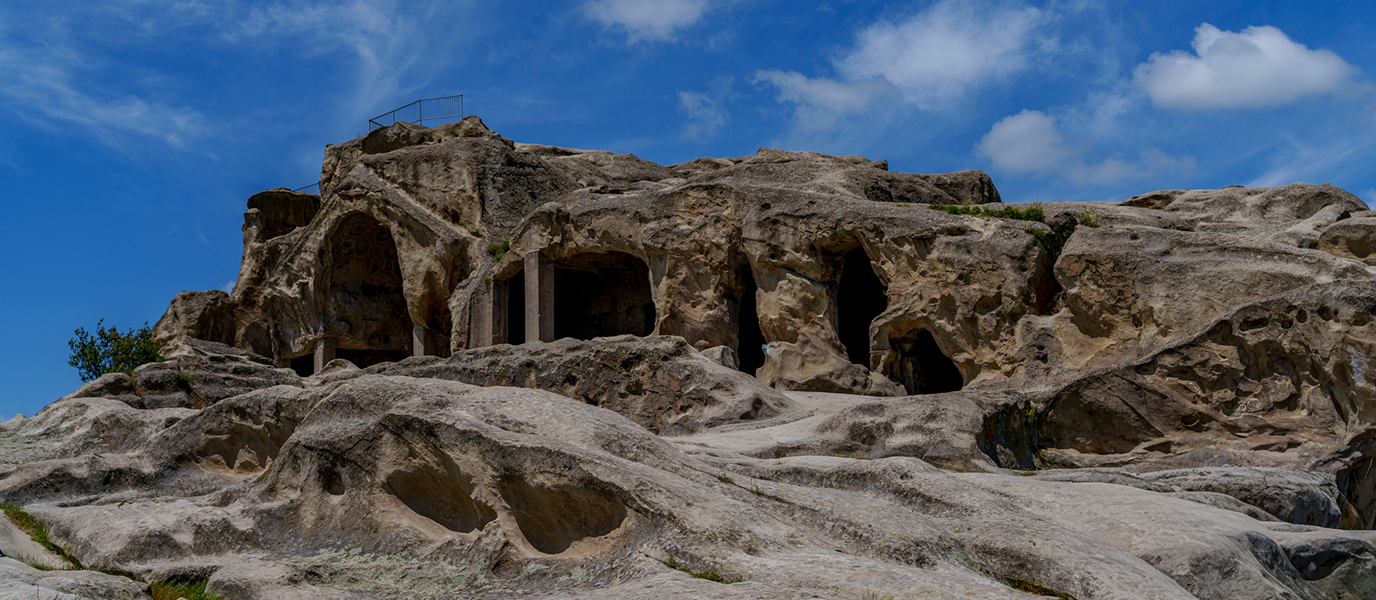












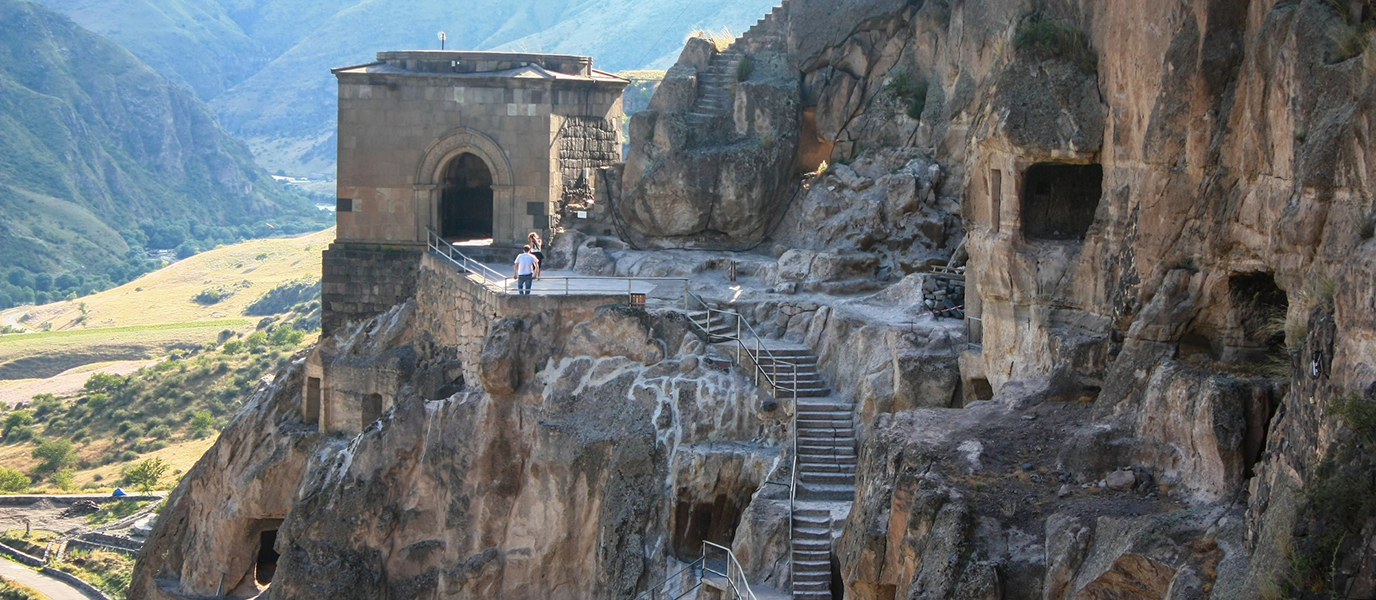
In the south of Georgia (near the border with Turkey and Armenia), the landscape opens up into a wide valley, where the river Mtkvari flows among weathered mountains and ochre-coloured hillsides. On one of these escarpments appears Vardzia, as if the rock had been carefully hollowed out by invisible hands. It is a monastic complex excavated directly into the cliff face, which was for centuries a fortress, a religious centre and a strategic refuge. The first glimpse of Vardzia is disconcerting. From a distance, you can make out even rows of hollows, balconies carved into the rock, and openings that seem like windows in a fantasy building. It is only from close up that one can appreciate the enormous scale of the project: ten or more excavated levels, linked by tunnels, hidden stairways, and rooms that were once chapels, monastic cells, cellars and storerooms. Vardzia was not merely a prehistoric monastery, but a true vertical city designed to resist and last.
- The history of Vardzia, the city excavated into the rock: Queen Tamar’s dream defensive project
- How to get there and advice for visitors: mountain roads and passages dug into the rock
- What you can see: painted churches, secret tunnels, and balconies overlooking the river
- What to see in the surrounding area: the fortresses, monasteries and scenery of southern Georgia
The history of Vardzia, the city excavated into the rock: Queen Tamar’s dream defensive project
The construction of Vardzia began in the second half of the twelfth century under the reign of George III, and underwent significant expansion during the rule of his daughter, Queen Tamar, one of the most powerful figures in the history of Georgia. At that time, the kingdom was enjoying a period of territorial expansion and cultural prosperity known as the Georgian Golden Age. Building a complex of such grand scale in a strategic spot was not just a religious gesture, but also a political and military measure.
The site was clearly chosen with the aim of protecting the Samtskhe-Javakheti region from incursions, particularly from the south. Excavated within the cliff face itself, the city was both camouflaged and sheltered. From the outside, the entrances were barely visible. In the case of attack, the inhabitants could take refuge in interior levels connected by secret tunnels that led down to the river, thus ensuring a supply of water.
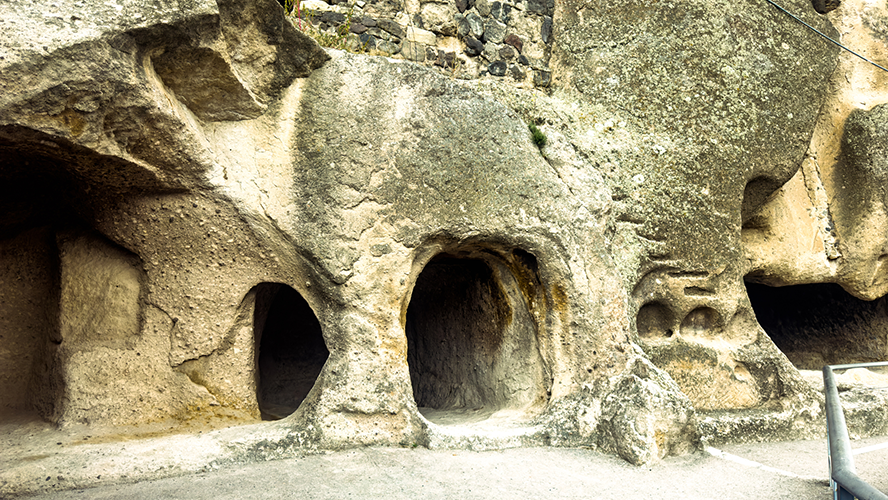
It is estimated that the complex was home to thousands of people, including monks, soldiers — and a civil population in times of danger. In its heyday, Vardzia boasted 600 rooms spread over several levels, including secondary chapels, refectories, libraries, and cellars. The main church, dedicated to the Dormition of the Virgin, was the spiritual heart of the complex, and still retains its artistically accomplished twelfth-century frescoes.
In 1283, the region was shaken by an earthquake, which caused part of the rocky façade that concealed the city to become detached. Paradoxically, this natural disaster revealed the vast scale of the project, making it visible from the valley. In time, invasions by the Mongolians and Ottomans weakened the enclave, and Vardzia began to lose its strategic importance. However, the monastery was never completely abandoned, and even today it remains home to a small religious community.
How to get there and advice for visitors: mountain roads and passages dug into the rock
Vardzia is about 270 kilometres south-east of Tbilisi. By car, the journey takes between four and five hours, depending on the conditions and stops along the way. Lots of travellers choose to divide the trip into two phases, by combining their visit with other points of interest in the south of the country. The route crosses changing landscapes: from agricultural plains to mountain passes where the asphalt winds around arid hills.
The final stretch leading to the complex is a minor road that runs down towards the Mtkvari valley. At the entrance, a visitor centre organises admission to the complex, and there is a charge. It is advisable to wear comfortable, non-slip footwear, as the tour involves going up and down stairways dug into the rock, and walking along narrow tunnels with limited lighting. In summer, the heat can be intense outside, but inside the caves it remains cooler.
The tour demands time and attention. It is not a matter of just looking at the façade: you need to go in and explore the network of passages and rooms. Some stairways are steep and you have to crouch down, something that adds a physical dimension to the experience. We recommend that you spend at least two hours to make a leisurely tour of the complex and to spend time at the key points of interest.
What you can see: painted churches, secret tunnels, and balconies overlooking the river
The central highlight of the tour is the main church of the Dormition, which is excavated into the rock and decorated with frescoes dating from the late twelfth century. One portrays Queen Tamar along with her father, George III, an exceptional portrait that emphasises the link between political and religious power. The colours, though somewhat faded by the passage of time, are nevertheless sufficiently intense to allow visitors to appreciate details in the clothing and faces.
Away from the church, visitors can explore small monastic cells, refectories with benches carved into the stone, and cellars where food was stored. On some levels, you can look out from open balconies in the cliff face and appreciate the strategic position of the enclave. The river Mtkvari flows several metres below, and the silence is broken only by the wind.
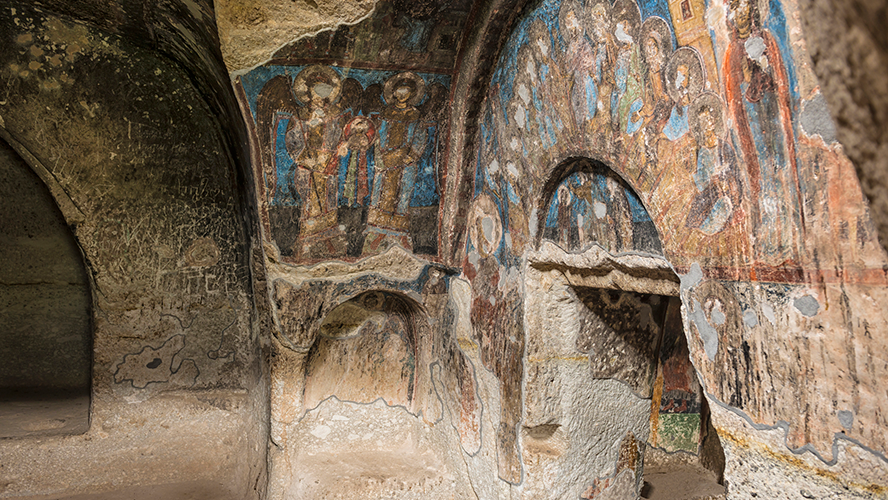
One of the most remarkable elements is the system of internal tunnels. Narrow passages connect the various levels and lead to hidden stairways that, according to tradition, enabled the city to receive supplies or be evacuated without being seen. Walking along them offers a new perspective on the place, so that one sees it as a complex, functional defensive infrastructure, rather than as a simple monument.
Around the complex, you can see the remains of walls and other external structures that contributed to its defence. Although they are less spectacular than the caves, they help to complete the picture of the complex at the height of its activity.
What to see in the surrounding area: the fortresses, monasteries and scenery of southern Georgia
The trip to Vardzia can be combined with visits to other attractions in the Samtskhe-Javakheti region. A short distance away is the Khertvisi fortress, a medieval construction that overlooks a crossroads, offering a complementary perspective on Georgian defensive architecture.
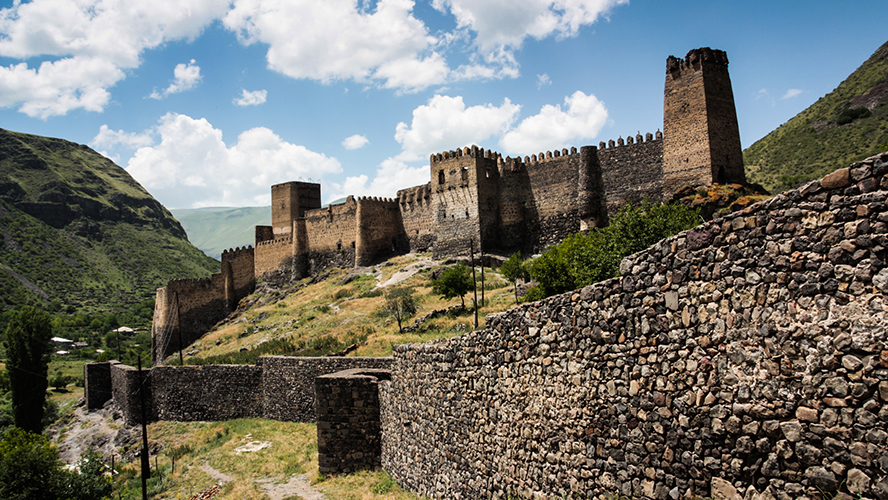
Tourist itineraries normally include a visit to the Sapara monastery, hidden among tree-clothed hills and famous for its churches decorated with medieval frescoes. These enclaves allow us to contextualise Vardzia within the wider network of religious and military centres that existed in the south of the kingdom.
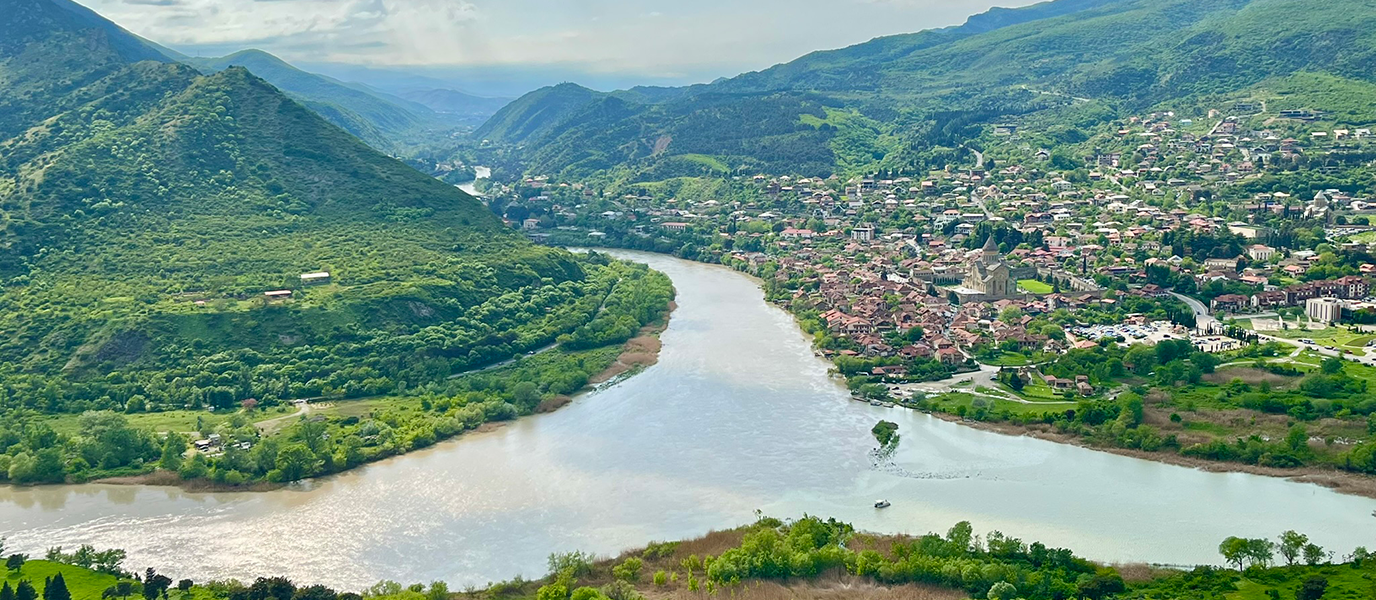
The Mtkvari valley itself, with its ochre shades and its scattered vegetation, is part of the attraction of the trip. This is not a lush landscape: it is open and austere, and human intervention — in the form of excavated monasteries or stone fortresses — takes on a special significance.