











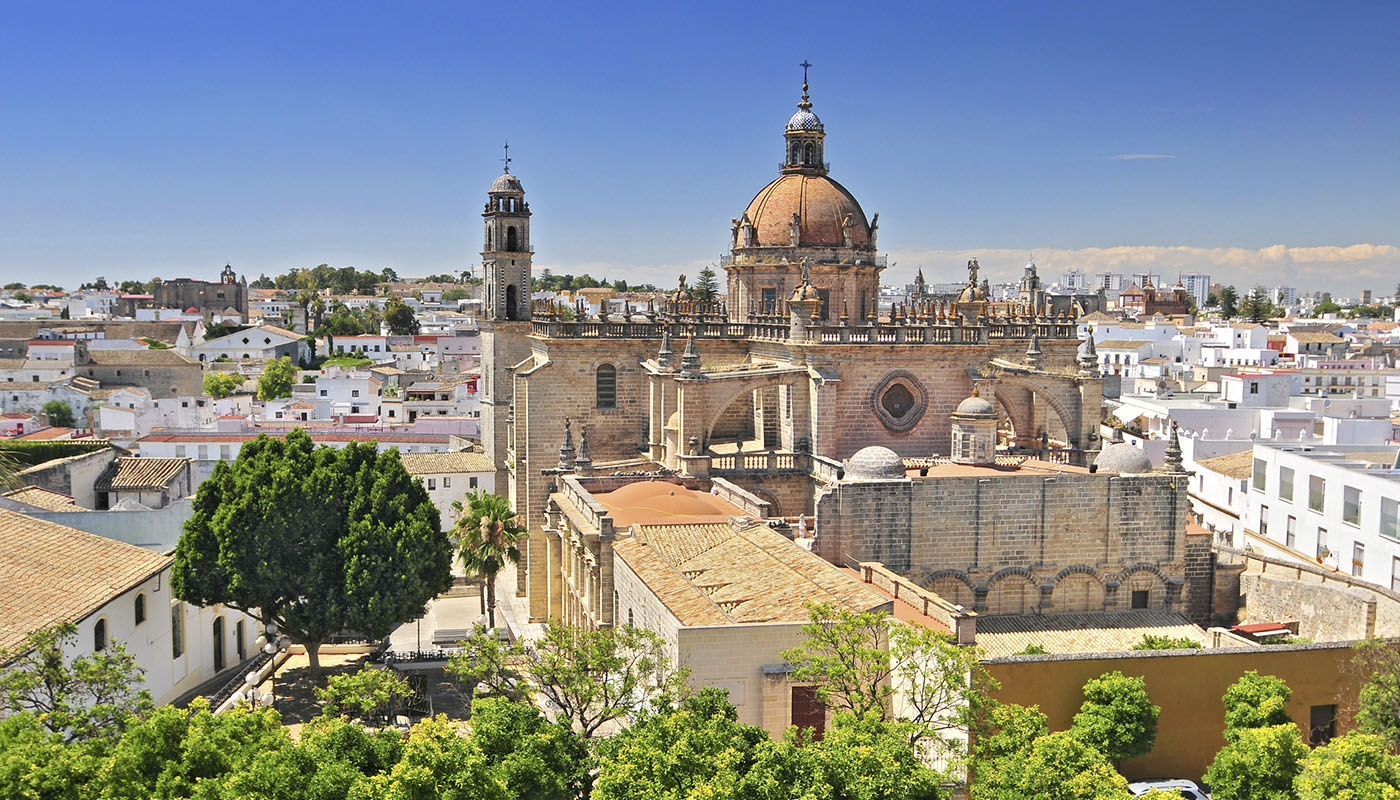







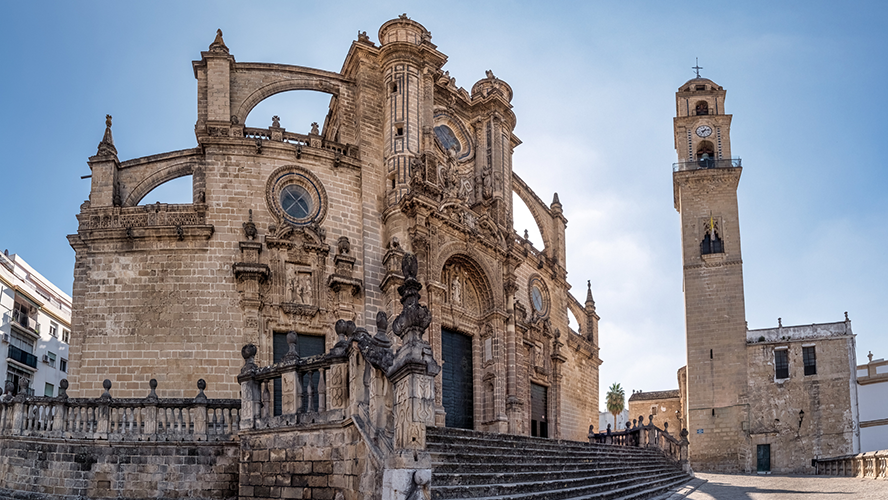
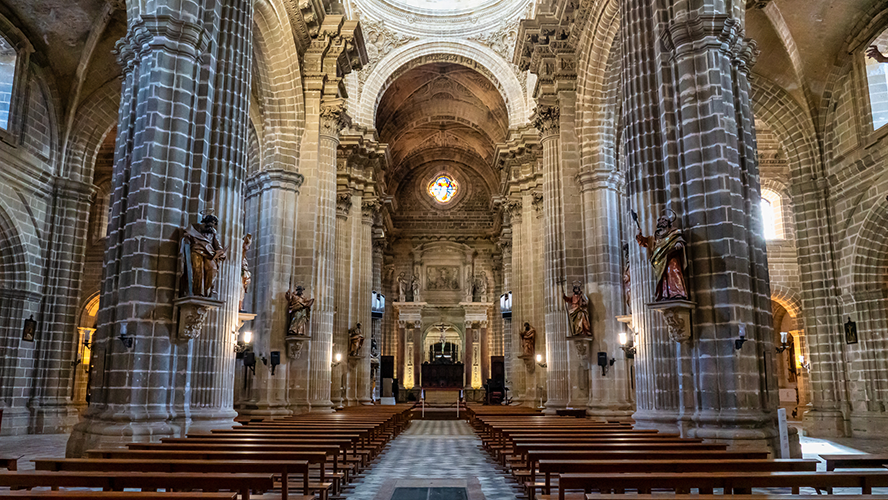
Occupying a building constructed during the seventeenth century, Jerez Cathedral is very young, given that until 1980 it was a collegiate church which was raised to the status of cathedral by a papal bull issued by Pope John Paul II. It is worth glancing back to the year 1695 to learn that in that year the Collegiate Council decided to commission the building of a church. The work was entrusted to the master builder Jerez Diego Moreno Menéndez, but as the project took over 80 years, he did not live to see its completion. The church was finally blessed in 1778. The cost of the work was borne by Cardinal Arias, with contributions from the Spanish monarchy (Carlos II, Luis I and Carlos III) and by Popes Innocent XIII and Benedict XIII. Inside, the cathedral has five naves that combine different architectural styles, creating a sense of harmony and balance.
- About Jerez’s Great Mosque
- Architecture, art, and seeing inside the building
- Jerez Cathedral: opening hours, admission, worship…
About Jerez’s Great Mosque
Jerez Cathedral as we see it today was built on the remains of the former Jerez Great Mosque and of the former twelfth-century Iglesia del Salvador. It is dedicated to Nuestro Señor San Salvador, and celebrates his festival on 6th August, the Transfiguration of the Lord.
The Collegiate Council came into being on 9th October 1264 with the Christian conquest of Jerez during the reign of Alfonso X El Sabio [The Wise], and was dissolved by a papal bull issued by Pope John Paul II to make way for the new Cathedral Council, made up of 12 canons.
Inside Jerez Cathedral, there is a permanent exhibition with extremely valuable works of art. One example is the painting of the ‘La Virgen Niña’, signed by Zurbarán, and ‘La Virgen de Guía’, an anonymous tablet dating from the fifteenth century. It is also worth looking at the processional monstrance of the Corpus, the old seating in the choir, and the various sacred ornaments dating from the eighteenth and nineteenth centuries.
Architecture, art, and seeing inside the building
Jerez Cathedral has a rectangular floor plan with thick pilasters dividing the naves. It was built using stone from the Sierra de San Cristóbal — apart from the domes over the naves, which are of threaded brick. All the façades have Corinthian columns and a wealth of bas-relief and Baroque decoration.
It is worth taking a look at the cathedral’s internal chapels, and particularly the most impressive ones, including the Ánimas, the Cristo de la Viga, the Inmaculada, and the Sagrario. And stopping to admire the altarpieces of San Pedro, the Virgen de Belén, Beato Diego José de Cádiz, Nuestra Señora del Socorro (joint patron of the city since 1610), San Caralampio, Santa Rita and Santa Teresa.
The cathedral building is also the seat of the Parish of the Saviour, the city’s first parish, according to the Distribution of Houses book of 1265.
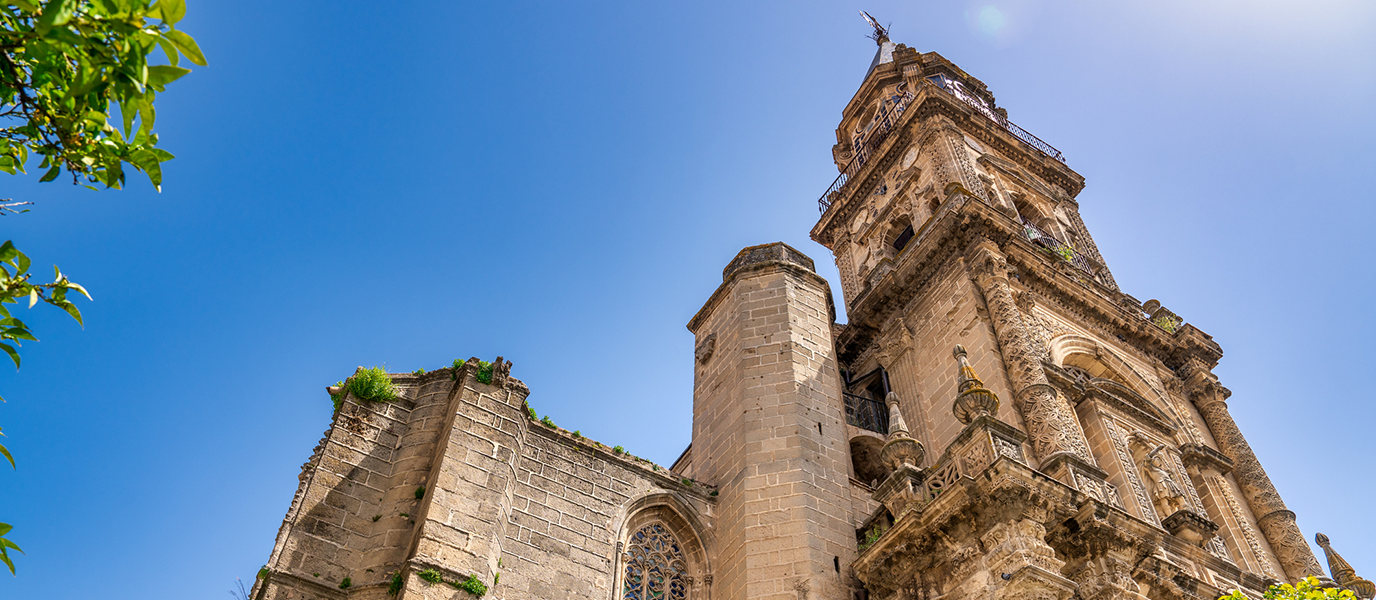
If you love architecture (and heights), you must go up to the bell-tower which rises above the former Church of the Saviour. The lower part of the tower appears to be of Gothic-Mudejar style, with the upper part being Baroque — some say the tower was built over the former minaret of the ancient great mosque. The tower has four fixed bells and four swinging bells, as well as two smaller communication bells and a rattle. Each has its own name: San Miguel, San Salvador, La Gorda, Salvadora, and so on. The views of the city and the Alcázar from the top of the tower are truly spectacular. The cupola that adorns the highest part of the tower is decorated with tiles of the colours of the city’s flag. To reach the first of the tower’s bell chambers, you need to climb a narrow stone staircase, and then a metal spiral stairway.
Jerez Cathedral: opening hours, admission, worship…
Cathedral opening hours are Monday – Saturday from 10.00 a.m. until 7.00 p.m., and Sunday from 1.00 p.m. until 7.00 p.m. The tower is open Monday – Saturday: from 11.00 a.m. until 1.00 p.m. and on Sundays from 3.00 p.m. until 6.00 p.m. In summer, opening hours are extended: from 11.00 a.m. until 2.00 p.m. and from 4.00 p.m. until 6.30 p.m.
The charge for general admission to the cathedral, with an audioguide, is 8 euros. There are reductions for certain groups, including those over 65 years (7 euros), students up to the age of 25 (6 euros), and groups (5 euros). Children under the age of 12 are admitted free of charge. A visit to the tower is 6 euros, but there is a combined ticket for the cathedral plus the tower, which works out cheaper. A special ticket is available for a visit to the cathedral and the Church of San Miguel at a cost of 13 euros. It is worth bearing in mind that you can visit Jerez Cathedral free of charge on Mondays from 1.30 p.m. until 2.30 p.m., and from 4.30 p.m. until 5.30 p.m. in summer.
The Eucharist is celebrated every Monday at 8.00 p.m. and every Sunday at 11.00 a.m.