
_435x320?&)
The most famous buildings in Spain and where to see them
The most famous buildings in Spain reveal the country’s layered history, Moorish, Gothic, modernist and boldly contemporary, best experienced in the cities that shaped them
Spain’s history is a potted one, spanning centuries and cultures. Yet, there is one thing that tells the story of this nation and its evolution into the country that it is today: architecture. Looking at the famous buildings in Spain, you can observe how they are living symbols of art, politics, faith and ambition. From Moorish palaces that give off a golden glow in the Spanish sun to contemporary masterpieces that resemble spacecraft, Spanish architecture is as varied as the land itself. Whether you are drawn to landmarks that dominate the skyline or those which are tucked away behind ancient city walls, all are worth the pilgrimage.
Famous Gaudí Buildings in Barcelona
When talking about all the famous buildings in Spain, it is impossible to gloss over the importance of Gaudí’s influence on Barcelona’s skyline.
Don’t forget about Casa Batlló in Barcelona
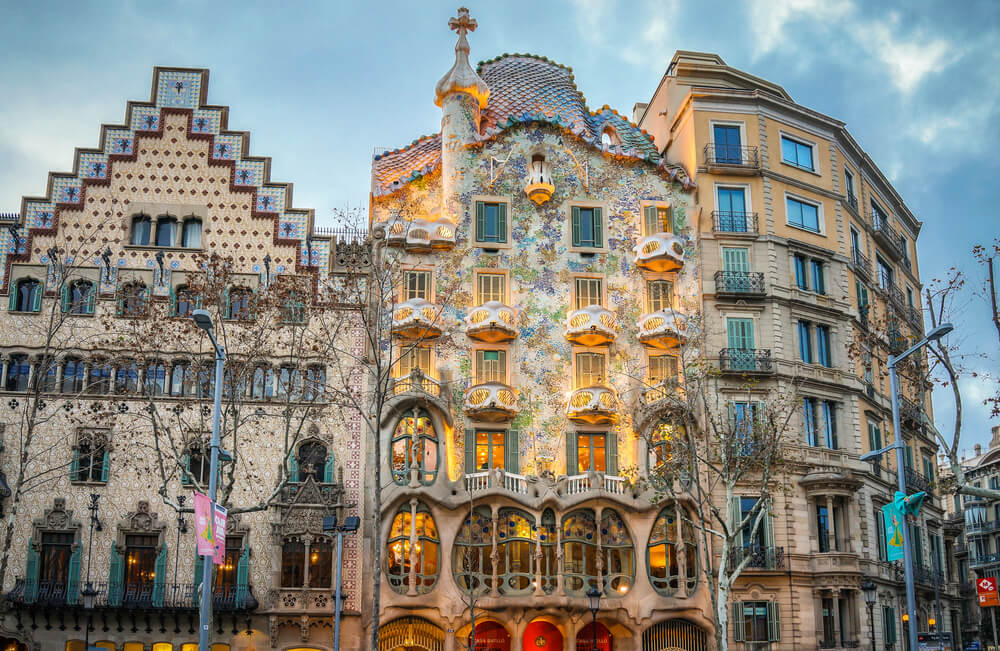
Continue exploring Barcelona’s Eixample neighbourhood and you will stumble across another Gaudí masterpiece, Casa Batlló. Originally constructed in 1877, the house was bought by Josep Batlló i Casanovas, a textile industrialist, in 1903, who turned to Gaudí to complete the necessary renovations on the property. Redesigned rather than built from scratch, the façade undulates like water, balconies resemble masks, and the roof arches like a dragon’s back.
Today, the house is an UNESCO World Heritage Site, open to the public with guided tours and events hosted within its walls. Be serenaded by the music of Dani Howard as you listen to the audioguide, marvel at Gaudí’s original inspiration and vision through virtual reality imaging and see what the house was like back in the day with rooms set up with all the original memorabilia from the Batlló family.
The Sagrada Familia, Barcelona
Sagrada Familia, one of the most famous landmarks in Spain
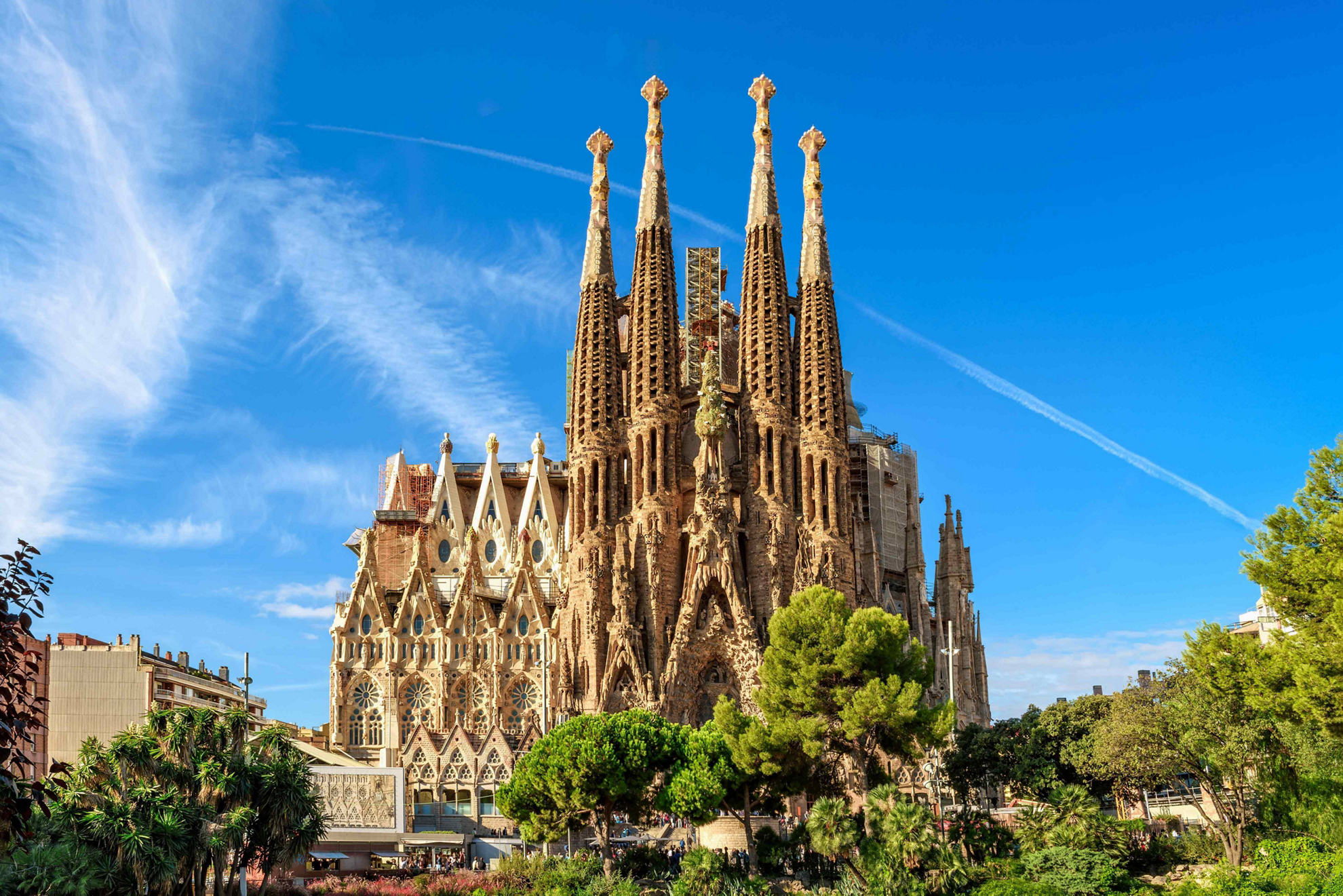
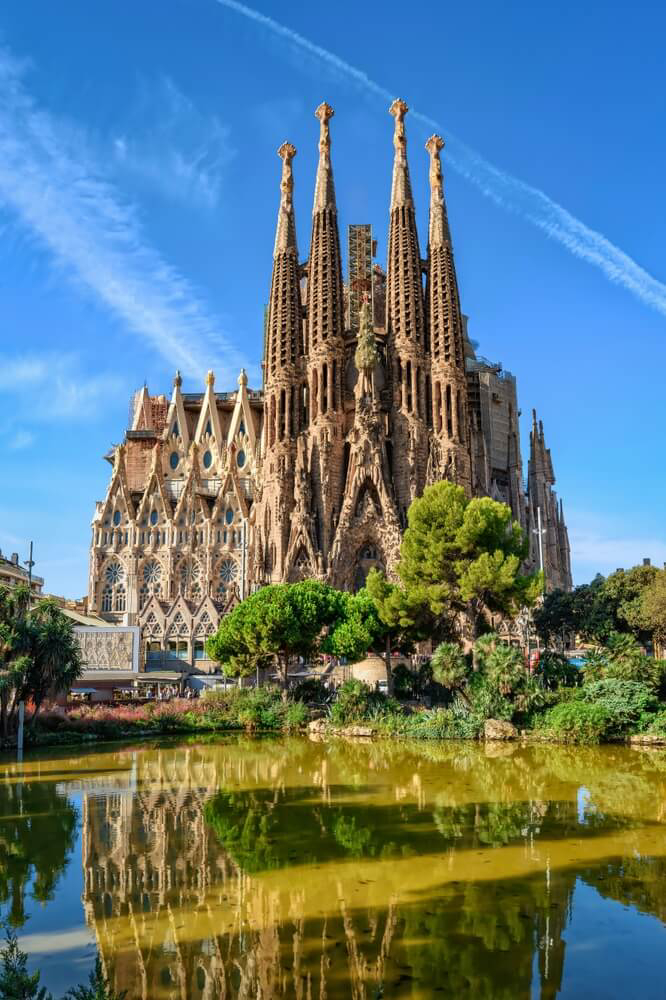
Perhaps the most iconic building in Spain is the Sagrada Familia, by the famous Spanish architect, Gaudí. Shrouded in a sense of awe, controversy and devotion, Antoni Gaudí's unfinished masterpiece is less a church than a riot of spires, symbolism and a creative vision rendered in stone. From the outside, the basilica dominates the Eixample district, mesmerising passers by with its Gothic and Art Nouveau forms that depict biblical stories. Today, it remains the largest unfinished Catholic Church as well as the tallest in the world. Step inside and admire the light pouring through the stained glass, transforming the morning light into slow-moving gradients of gold, blue and green and admire how the columns branch out like trees, holding up the ornate ceilings. If you are staying in Barcelona, this is a must-see.
Casa Batlló is a major landmark in Barcelona
Royal Palace of Madrid: One of the famous buildings in Spain
If you are visiting Madrid, it will be hard to miss the majestic and imposing facade of the Royal Palace of Madrid. By floor area, it is Western Europe’s largest royal palace and this unapologetically grand palace, built in the 18th century, definitely stands out as a symbol of monarchy among the famous architecture of Madrid. It is the official residence of the Spanish royal family, with over 3418 rooms and a floor plan that stretches across 135,000 m².
Step inside the palace and admire how the palace unfolds through a succession of lavish spaces: the opulent Throne Room beneath Tiepolo’s soaring frescoes; Sabatini’s monumental Grand Staircase; the Gasparini Room in all its Rococo extravagance; the Royal Chapel, home to a rare collection of Stradivarius instruments; and the vast Royal Armoury. Lesser-known highlights, including the Royal Pharmacy and the Hall of Columns, used for state receptions, offer further insight into the art, ceremony and daily rhythms of royal life.
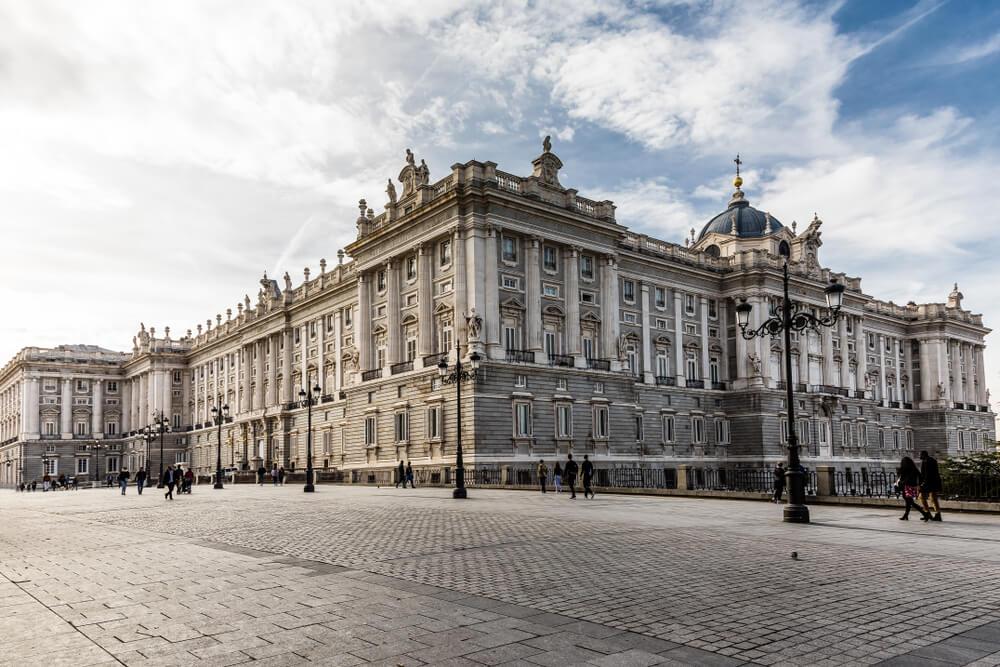
Royal Palace of Madrid
The Roman Theatre of Mérida, Mérida
In the heart of the Badajoz region, in the city of Mérida, lies the Roman Theatre of Emerita Augusta, built between 16 and 15 BC. This incredible ancient structure is partly carved into a hillside, to reduce construction costs, and was built to seat 6000 spectators according to a strict social hierarchy. Over time, it saw significant refurbishments, such as the addition of elaborate scaenae frons adorned with statues of emperors and gods and a richly decorated stage and orchestra renowned for its acoustics. Behind the stage lies a porticoed garden and a sacred space dedicated to the Divine Augustus.
However, before 1910, no one had discovered this now famous building in Spain, as it was in this year that excavations began
However, before 1910, no one had discovered this now famous building in Spain, as it was in this year that excavations began to reveal much of the structure, known locally as the Seven Chairs. Adjacent to the theatre, the so-called House-Basilica, once thought to be an early Christian meeting place, features mosaic floors, painted walls and apsed rooms, offering insight into the later reuse and evolution of the complex. To really bring Roman Spain to life, plan your visit in the summer during the International Classical Theatre Festival.
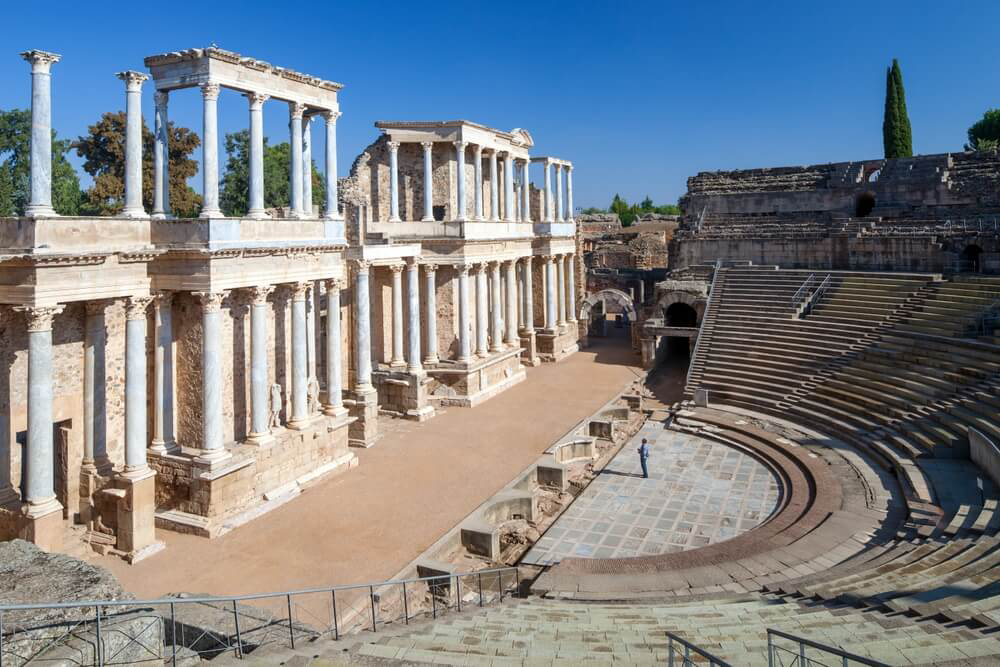
Roman Theatre of Mérida
Admire Galicia’s Cathedral of Santiago de Compostela
It is without a doubt that Santiago’s Cathedral of Santiago de Compostela, in the heart of Galicia, is a prime example of classic Spanish architecture. A pilgrimage site since the Early Middle Ages, the cathedral is the reputed burial place for Saint James the Great, one of the apostles of Jesus Christ. Aside from marking the spiritual culmination of the “Way of Saint James” pilgrimage, the cathedral is a renowned UNESCO World Heritage site and one of the most significant religious monuments in Europe today. Consecrated in 1211 and built primarily in the Romanesque style, the cathedral later absorbed Gothic, Renaissance and exuberant Baroque additions, most famously its 18th-century Obradoiro facade.
This later addition was designed to shelter the medieval core and project power and spectacle onto the great square below. At its heart lies the tomb of St James, turning the city of Santiago into one of Christendom’s three great pilgrimage destinations alongside Rome and Jerusalem. While the exterior takes your breath away with its beauty, the inside takes it up a notch. The gilded statue of the saint above the high altar draws pilgrims in, while the swinging botafumeiro, a giant incense burner introduced in the Middle Ages to purify the air after weeks of travel, adds a dramatic touch to the spiritual experience. Book onto a guided tour to learn about the history and cultural significance of the cathedral, or admire it as a general visitor. Be sure to look at mass times before your holiday to Galicia if you wish to attend, as they fill up fast.
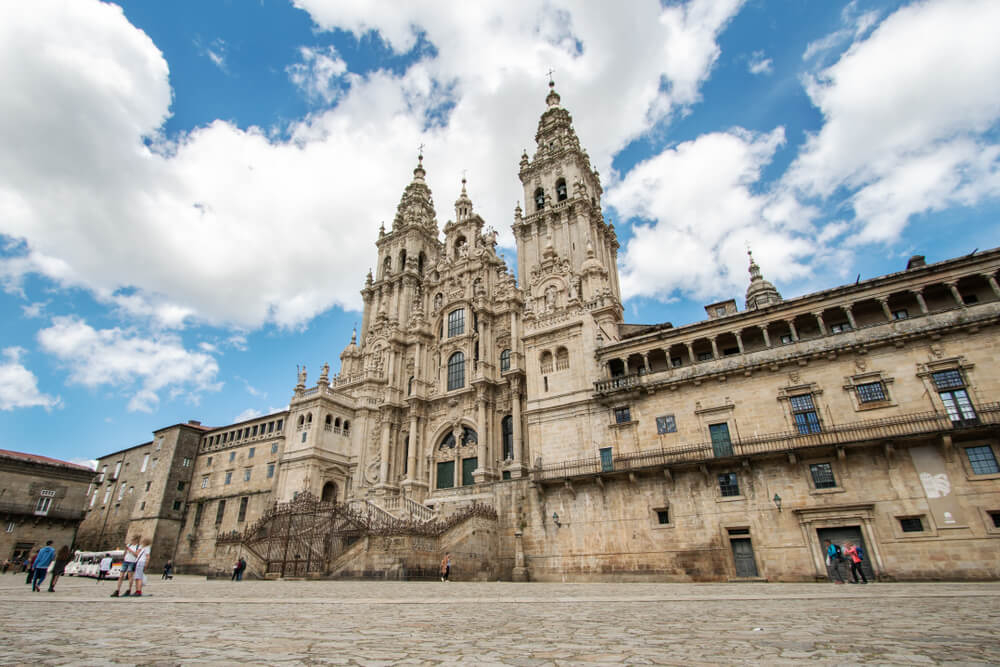
The Cathedral of Santiago de Compostela
Explore The Guggenheim, Bilbao
Swap the classical for the contemporary and hop over to the Basque Country to see a fresh take on famous buildings in Spain. Here, while visiting Bilbao, you cannot miss Frank Gehry’s masterpiece, the Guggenheim Museum Bilbao, which rises from the waterfront of the Nervion River like a sci-fi ship in dock constructed from glass, limestone and titanium. Part of the Solomon R. Guggenheim Foundation’s group of museums, this groundbreaking example of 20th-century design houses an exciting mix of temporary and permanent exhibitions of Spanish and international contemporary artists.
Its location on the Bilbao harbour, once a main source of income for the city, is a symbol of Bilbao’s transition into the modern era
Its location on the Bilbao harbour, once a main source of income for the city, is a symbol of Bilbao’s transition into the modern era and since its construction in 1997, this building has received critical praise among design connoisseurs. Visitors can explore works from Anish Kapoor, Mark Rothko and Andy Warhol, among many others, as they explore the luminous curved walkways joined by glass elevators and staircases that connect the museum’s three levels.
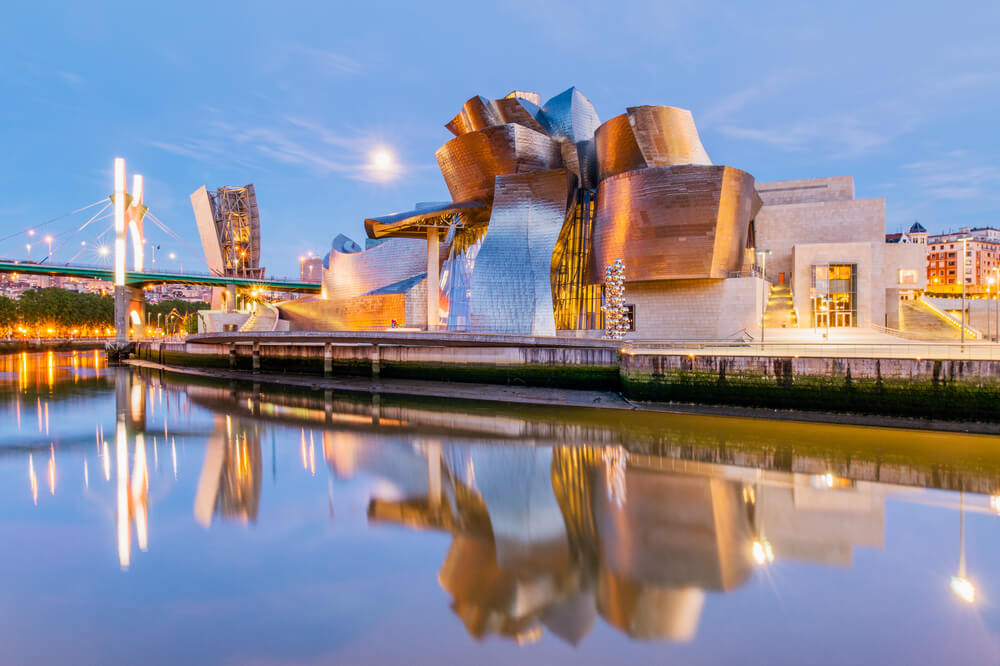
Guggenheim Bilbao
Walk around the City of Arts and Science, Valencia
There are many famous buildings in Valencia, but none quite like Santiago Calatrava’s cultural and architectural complex known as the City of Arts and Sciences. Valencia’s Ciudad de las Artes y las Ciencias opened in the late 1990s on the old riverbed of the Turia, its buildings riff on organic forms: ribs, shells, vertebrae, a great blinking eye. However, the real showstopper is L’Hemisfèric, a planetarium and IMAX cinema whose elliptical roof and reflective pool create the illusion of a giant eye opening to the sky.
Closeby, the Museo de las Ciencias Príncipe Felipe stretches out like a colossal whale skeleton. The Palau de les Arts Reina Sofía is equally dramatic, while L’Umbracle (a landscaped promenade under sweeping arches) is the best place to understand how the whole ensemble was conceived as a walkable city of culture. Fun fact: several areas have doubled as sci-fi filming locations. Have fun walking around a Hollywood film set while on holiday in Valencia.
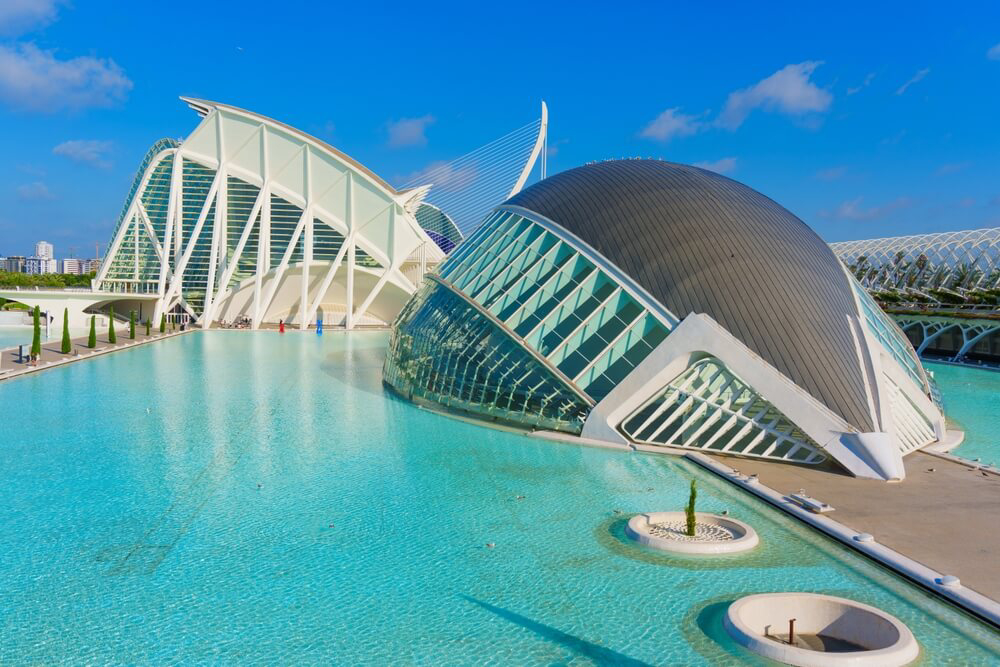
The City of Arts and Sciences in Valencia
Explore The Mosque-Cathedral in Córdoba
Interested in seeing one of the most famous cathedrals in Spain, with a twist? Head to Andalusia, where Córdoba’s famous mosque-cathedral marks a place where empires quite literally built on top of one another. Back in the 8th century, the site was home to the Great Mosque of Córdoba, built under the Umayyads, which expanded over the generations into an awe-inspiring forest of columns and double-tiered, red and white striped, horseshoe arches. After the Christian reconquest, a Renaissance cathedral nave was inserted into the heart of the mosque, creating a jarring and fascinating collision of sacred styles. Don’t miss the mihrab, an elaborate mosaic prayer niche and keep an eye out for the areas where the differing architectural styles melt into one another.
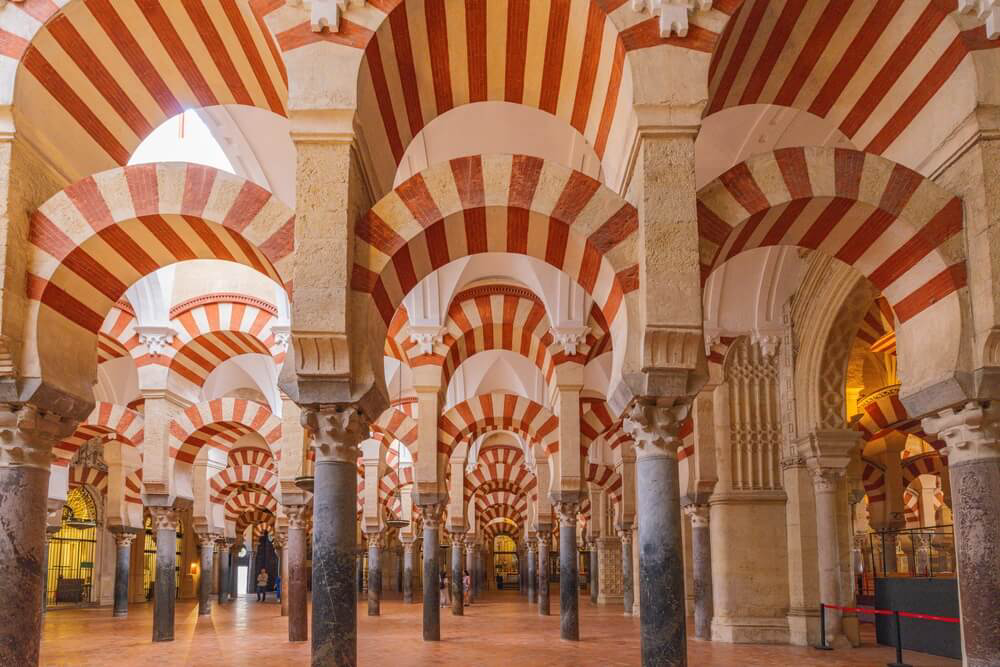
The iconic interiors of the Mezquita in Córdoba
Admire the beauty of The Alhambra in Granada
High above the city of Granada, sits one of the most famous buildings in Spain, the Andalusi-fortress known as the Alhambra. Here, geometry, poetry and water were treated as luxurious signifiers of status and power. Constructed largely under the Nasrid dynasty in the 13th and 14th centuries, it is famed for its exquisite courtyards, walls etched with calligraphy and elaborate mosaics. The iconic Court of the Lions, its fountain supported by twelve marble lions, is a must-see. Meanwhile, the Comares Palace and its reflective Pool of Myrtles emanate a sense of serenity. Outside, the Generalife gardens exhibit a marvellous engineered design which uses water to cool the air and create movement within the beautifully manicured gardens. When staying in Granada, a day out at the Alhambra is a must-do.
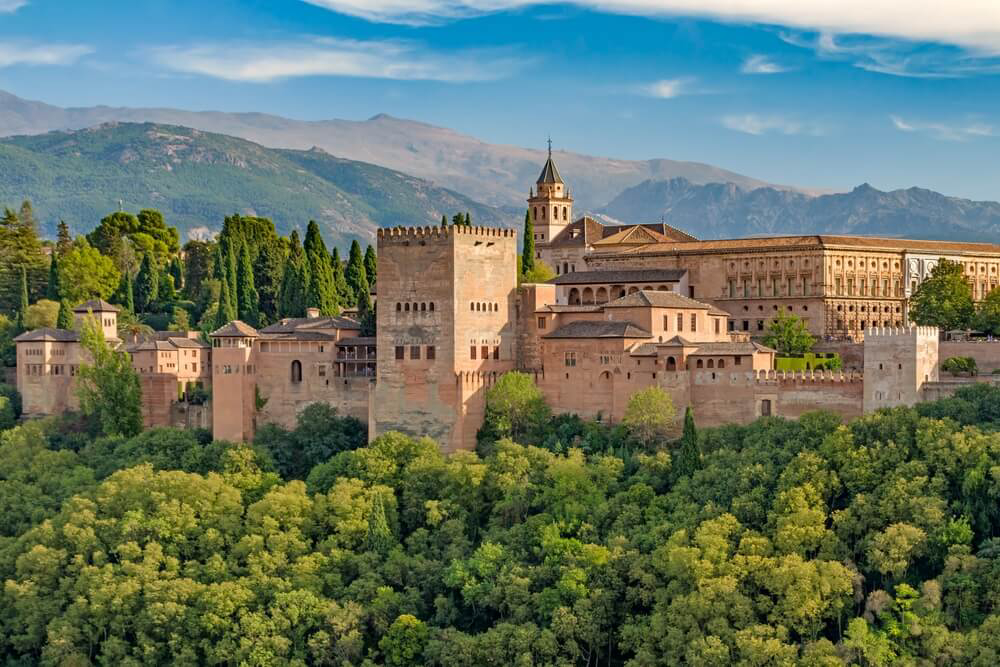
Alhambra, Granada
Discover La Giralda in Seville
Anyone on holiday in Seville cannot miss spotting La Giralda in the city’s skyline. This famous bell tower has lived a double life, constructed as a 12th-century minaret for the Almohad mosque and later transformed into the cathedral’s emblem. A famous landmark in Spain, Seville’s Giralda retains its decorative Islamic geometry in its lower sections, while the upper Renaissance belfry was added after Seville’s cathedral rose on the site of the former mosque.
It has many curiosities to discover, the main one being how you ascend the tower
It has many curiosities to discover, the main one being how you ascend the tower. To reach the top, you don’t climb a tight winding staircase but a series of ramps that were designed so guards could ride up the tower on horseback. The tower’s name comes from the Giraldillo weather vane, which turns like a gilded compass over the city. Visit in the late afternoon when the golden sunlight casts a glow over the terracotta rooftops, palm-dotted plazas full of tapas bars and the cathedral’s vast roofscape.
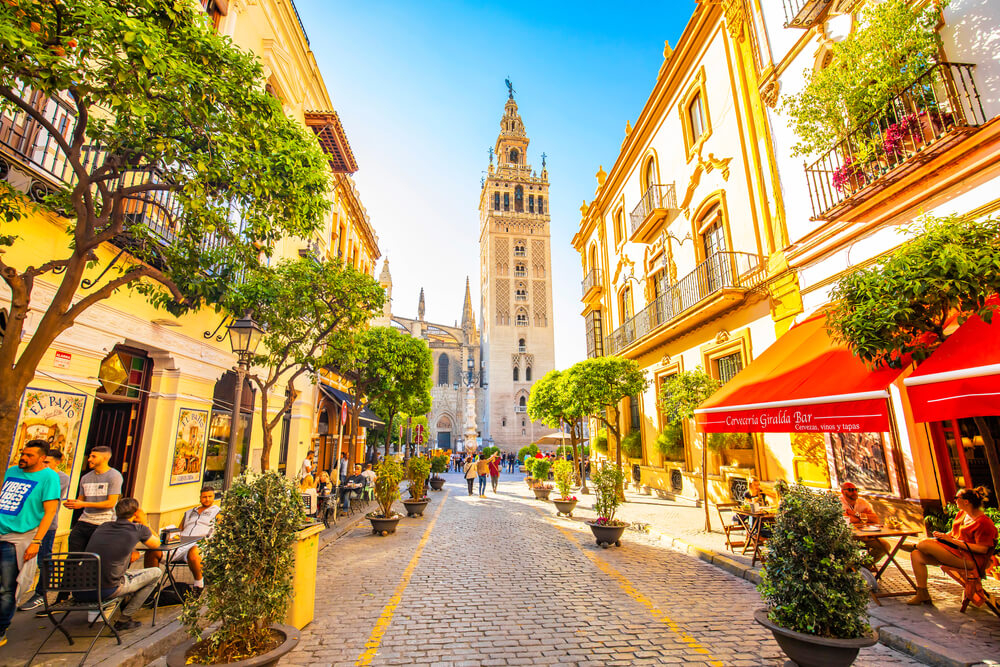
La Giralda, Seville
Tour the La Seu Cathedral in Palma de Mallorca
La Seu, also known as the Cathedral of Santa Maria, is possibly Palma de Mallorca’s most iconic building and one of the most important historical landmarks in Spain. Constructed in the 13th century, this Gothic cathedral is a symbol of the Christian conquest of Mallorca, soaring dramatically from its waterfront setting. Its picturesque rose window is one of the largest in the Gothic world, putting this cathedral on the map, with a kaleidoscope of colour the locals call the “Gothic eye”.
Inside, the light becomes part of the architecture. In the summer months, the morning light aligns with the rose window, its colours spilling out across the nave in a spectral display. Gaudí worked on the 20th-century renovations and Miquel Barceló later created a ceramic installation in the Chapel of the Blessed Sacrament. When on holiday in Mallorca, spend a day exploring Palma, making sure to arrive early at the Cathedral to avoid crowds and enjoy traditional Spanish architecture at its best.
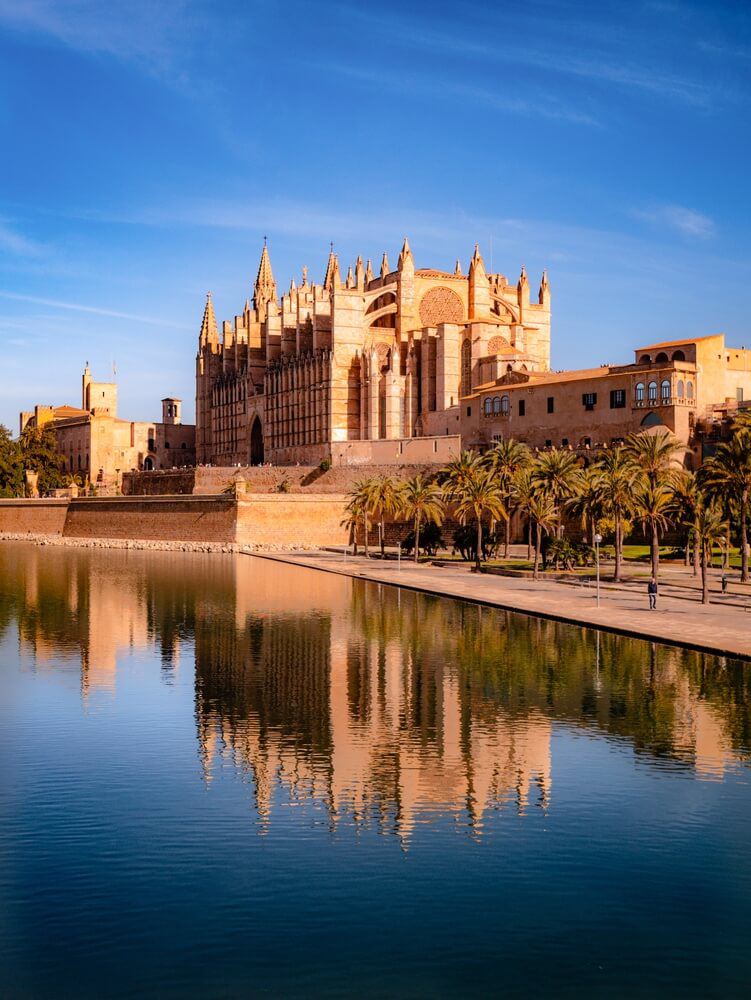
La Seu, Mallorca