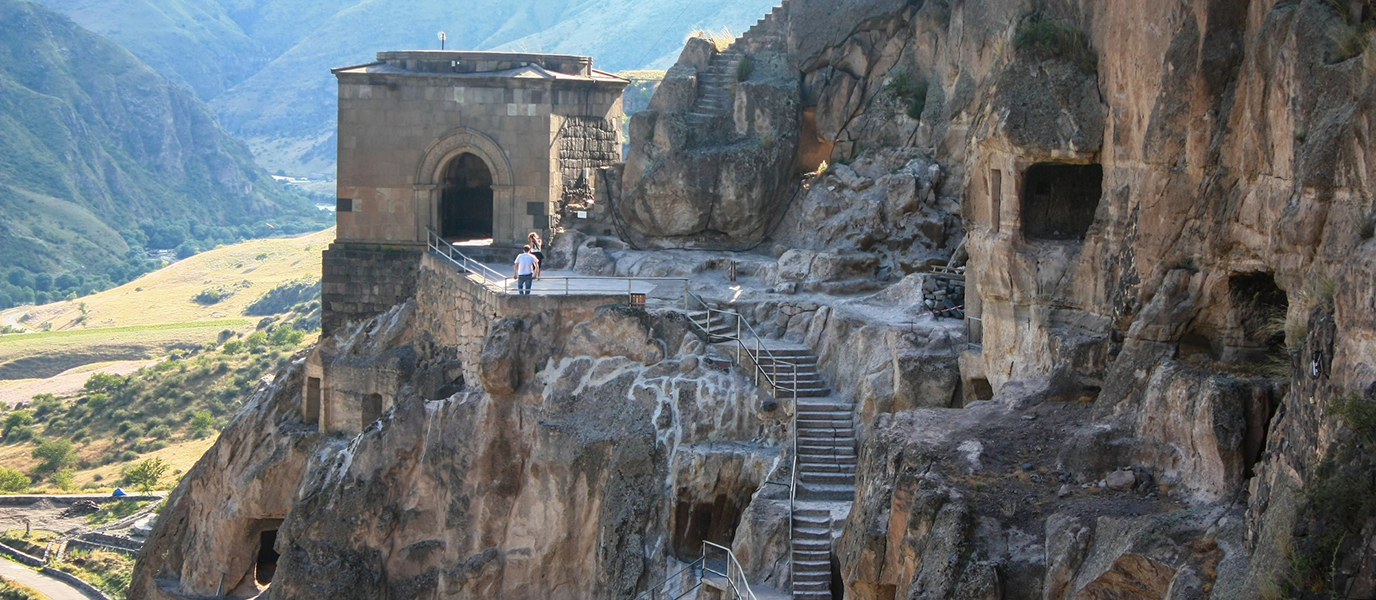














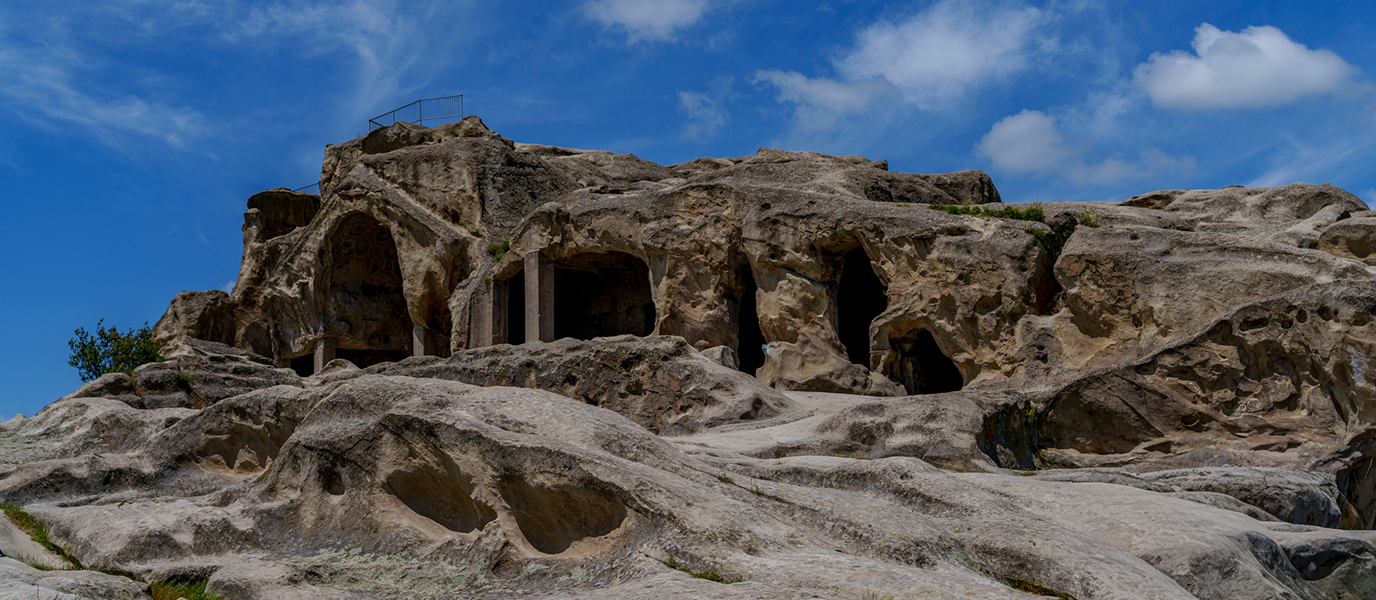
Long before Georgia adopted Christianity and built monasteries such as Jvari and cathedrals such as Svetitskhoveli, Uplistsikhe was already in existence. Excavated into a rocky plateau on the banks of the river Mtkvari in the Kartli region, this cave-town was for centuries a key religious, political and trading centre in the Caucasus. Its name translates as ‘the lord’s fortress’ or ‘the god’s city’, a clear indication of its original purpose. Unlike Vardzia, which was designed during the Christian Middle Ages, Uplistsikhe harks back to an earlier world, where the territory was dominated by pagan religions and the landscape was regarded as a sacred area. Nowadays, visitors can explore tunnels carved over two thousand years ago, walk across halls that were once temples, and look down on a wide valley that needs no further explanation of the strategic choice of the site.
- The history of Uplistsikhe, Georgia’s cave-town: from paganism to a strategic medieval enclave
- How to get there and and advice for visitors: between Gori and the Mtkvari valley
- What you can see: pagan temples, an excavated theatre, and tunnels leading down to the river
- What to see in the surrounding area: Gori, the birthplace of Stalin, and the historic routes from central Georgia
The history of Uplistsikhe, Georgia’s cave-town: from paganism to a strategic medieval enclave
The origins of Uplistsikhe date back to the late Bronze Age, although its most intense period of development was between the sixth century B.C. and the first century A.D. During this period, the town established itself as one of the main urban centres of the ancient kingdom of Iberia, at a time when the the main trading routes between Anatolia, Persia and the Black Sea all crossed Georgian territory.
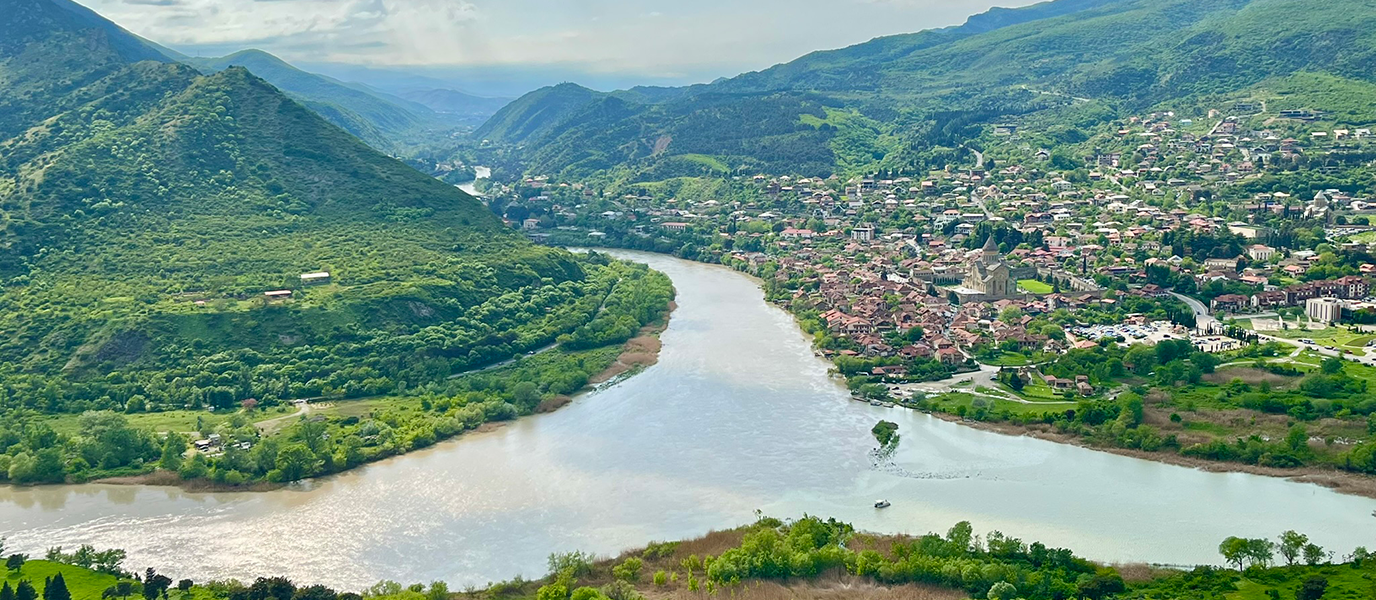
The town’s location was no accident. The rocky plateau upon which it was built overlooked the Mtkvari valley, and thus allowed the inhabitants to control the transit of caravans. In addition, the sandstone rock was relatively easy to excavate, making it possible to create a complex network of rooms, passages and ceremonial spaces. Unlike simple natural caves adapted for human occupation, Uplistsikhe was planned as a town, with squares, streets, residential areas, and places dedicated to religious worship.
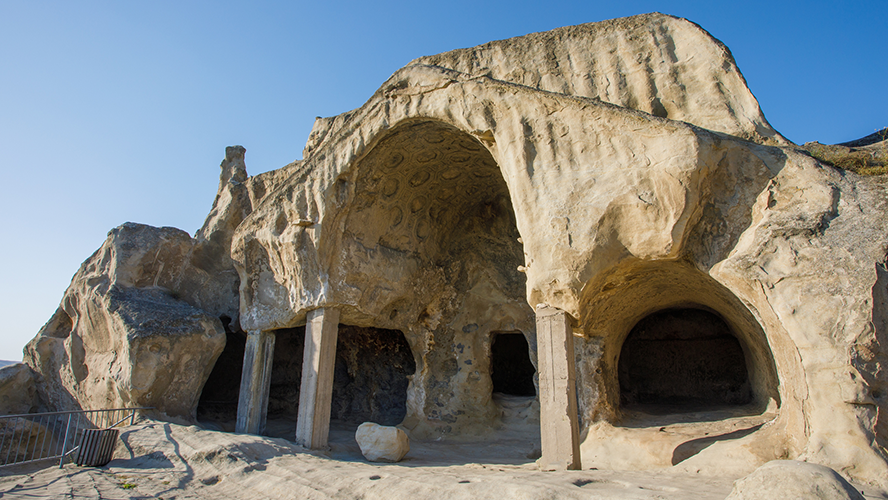
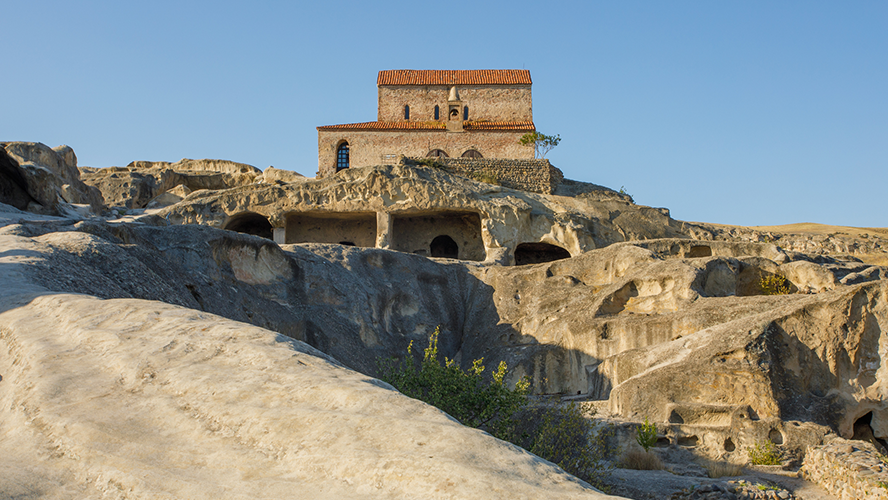
During its pagan period, the enclave had temples dedicated to divinities linked with the sun and fertility. Archaeological remains indicate the presence of altars and ritual spaces carved with geometric precision. When Christianity was adopted as the official religion in the fourth century, the town began a progressive transformation. Some temples were abandoned or reused, and a Christian basilica was built in the upper part of the complex.
During the Middle Ages, Uplistsikhe retained a certain strategic importance, although it was losing status in comparison with other urban centres. The thirteenth-century invasions by the Mongolians and the displacement of the major trading routes contributed to its decline. In time, the town was left partly abandoned, and its caves were used sporadically as refuges or as rural housing.
It was during the twentieth century that systematic archaeological excavations began; these contributed towards a better understanding of the town’s urban and religious structure. Nowadays, Uplistsikhe provides an extraordinary record of the transition from Caucasian paganism to Georgian Christianity — a process that can be traced directly in the rock.
How to get there and and advice for visitors: between Gori and the Mtkvari valley
Uplistsikhe is about 10 kilometres to the east of Gori, and approximately 85 kilometres from Tbilisi. The journey from the capital takes around an hour and a half by road, making it a feasible day trip. Many travellers combine a visit here with a stop-off in Gori or in one of the region’s other historic enclaves.
From the official car park, a path leads gently uphill to the complex entrance and its visitor centre. Admission costs 15 laris (or about €4.80) and the tour is signposted, although you do need to take care with the surface underfoot, which can be slippery, especially after rain. It is advisable to wear shoes with good soles, and sun protection in summer, as there is no shade for a good part of the tour.
The tour takes between one and two hours, depending on the pace and the degree of interest in the archaeological details. Unlike other prehistoric complexes with a more vertical construction, the layout here is relatively open, so you can find your way easily and understand how the town was organised from several elevated vantage points.
What you can see: pagan temples, an excavated theatre, and tunnels leading down to the river
- One of the most impressive spaces is the so-called ‘great hall’, a spacious cavity with a domed ceiling carved directly into the rock; this would have been used as a temple or ceremonial space. The iron frameworks are still visible on some surfaces, reminding us of the technical endeavour that lay behind the excavation.
- Another highlight is the small theatre, with its rows of seats carved into the rock. Although its dimensions are modest, it proves that there were public activities and, probably, collective rituals. The combination of functional and symbolic architecture reveals the Uplistsikhe was not merely a refuge, but a living town.
- In the upper part of the complex, there are the remains of a brick-built Christian basilica, which contrasts with the excavated surroundings. This spot affords a panoramic view of the Mtkvari valley, with the river winding among fields and hills. This perspective helps us to appreciate the strategic function performed by the enclave.
- One of the most fascinating elements is the tunnel that leads down to the river. Excavated as an escape route or as an access route for supplies, it allowed the inhabitants to reach the water without being seen in a siege situation. Nowadays, visitors have to negotiate a narrow, downward-sloping and rather uneven passage, but it helps us to gain an understanding of the place’s defensive scope.
- Along the route can be seen cellars, domestic dwelling spaces, and small niches that probably contained idols or ritual elements. Although there is an absence of striking or lush ornamentation, the complex impresses with its spatial logic and the way it fits harmoniously into the landscape.
What to see in the surrounding area: Gori, the birthplace of Stalin, and the historic routes from central Georgia
The proximity of Uplistsikhe to Gori means that you can conveniently visit both in one day.
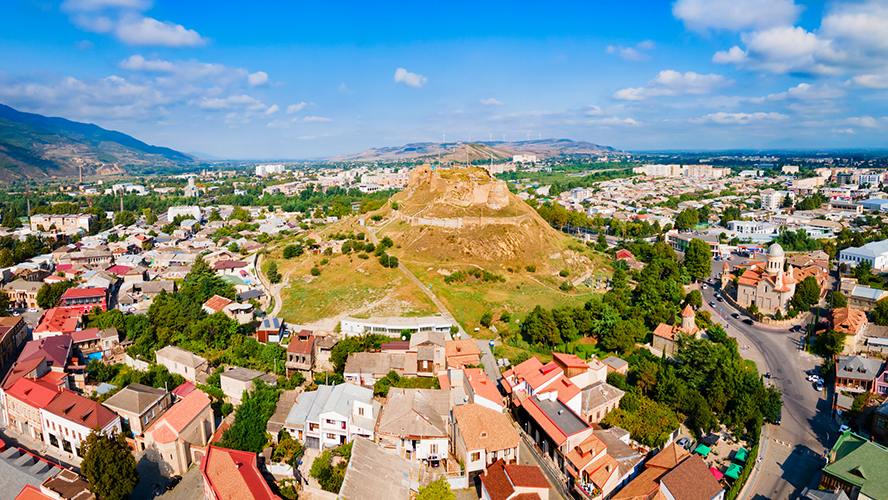
- Gori, located just a few kilometres away, has traditionally been an important communications hub in the centre of the country. Gori’s main claim to fame is as the birthplace of the Soviet dictator Stalin, and the Joseph Stalin State Museum is open to the public.
- It includes the little cabin where Stalin was born and spent his childhood. It is also worth stopping off at Goristsikhe Castle, a medieval fortress dating from the thirteenth century, perched on a hill from which visitors can gain another perspective over the Kartli region.
- The road that connects Tbilisi with western Georgia also crosses agricultural areas and little towns where the pace of life is decidedly rural. For travellers who can spare the time, this area acts as a gateway to more extensive itineraries towards Kutaisi or the mountains of the Greater Caucasus.
- The Mtkvari valley, with its combination of cultivated farmland and weathered hillsides, acts as a connecting thread between these destinations. Uplistsikhe occupies its place in the landscape not as an isolated element, but as one more piece in a long, complex story.