










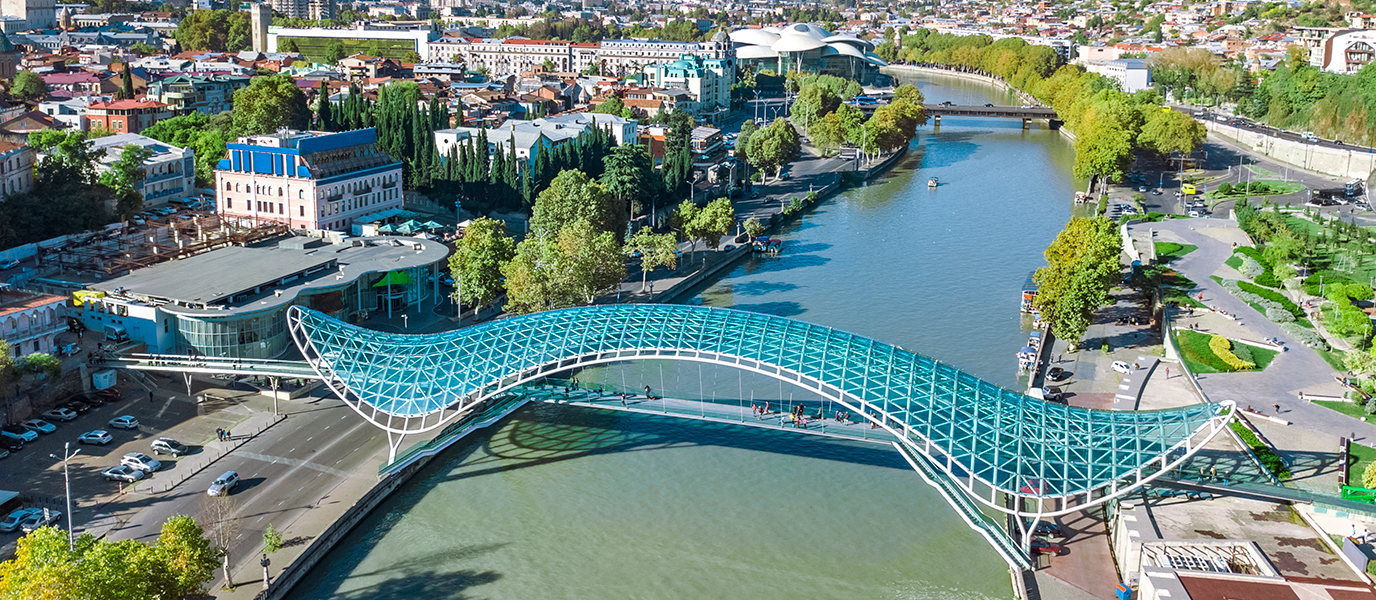
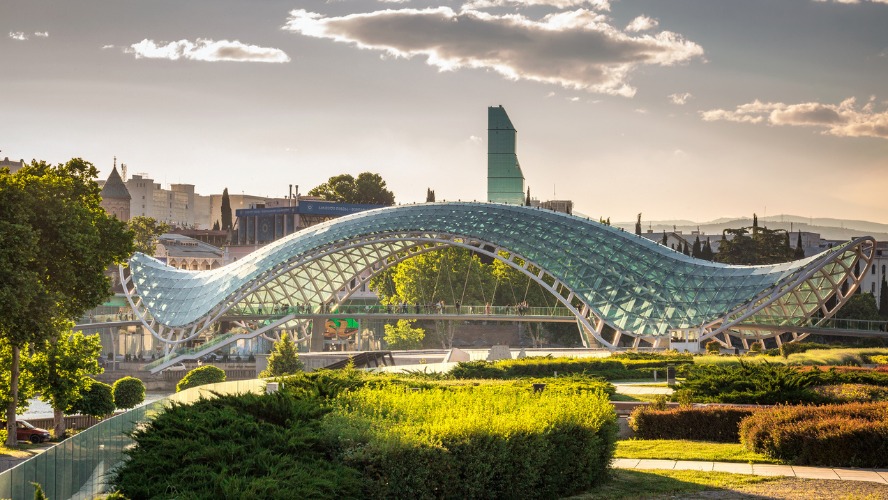
Some cities are best understood through their bridges. Tbilisi is one of them. Along the banks of the river Kura (Mtkvari in Georgian), among houses with carved balconies, Orthodox domes and narrow streets that still smell of freshly baked bread, a steel and glass structure emerges that seems to have come straight from the future. The Bridge of Peace does not merely connect two banks: it links two ways of understanding Georgia, i.e. one that clings to its thousand-year-old past and the other that looks towards Europe with a contemporary outlook. Opened in 2010, this pedestrian bridge has become one of the most recognisable landmarks in the Georgian capital. Its undulating silhouette, clad in a translucent skin comprising thousands of glass panels, is illuminated every night by a complex LED system that transforms the bridge into a constellation suspended over the water.
- The history and symbolism of Tbilisi’s Bridge of Peace
- Architecture and design
- Where is the bridge and how to get there
- Things to see nearby
The history and symbolism of Tbilisi’s Bridge of Peace: a contemporary symbol of the Saakashvili era
The Bridge of Peace was built at a pivotal moment for Georgia. Following the Rose Revolution in 2003, the country embarked on an ambitious programme of political and urban reforms under the leadership of President Mikheil Saakashvili. Tbilisi thus became an architectural laboratory where restoration work in the historic centre coexisted with avant-garde projects designed to convey a modern image open to the world.
The bridge began to be built in 2009 and was funded by Tbilisi Town Council with a budget of approximately 12 million dollars. From the outset, it was the subject of debate: for some, the futuristic structure clashed with the city’s historic nature; for others, it was a bold move that symbolised the country’s European orientation. The name chosen, Bridge of Peace, was no accident. Georgia had recently experienced conflicts, particularly the war with Russia in 2008, and the word ‘peace’ took on a clear political connotation.
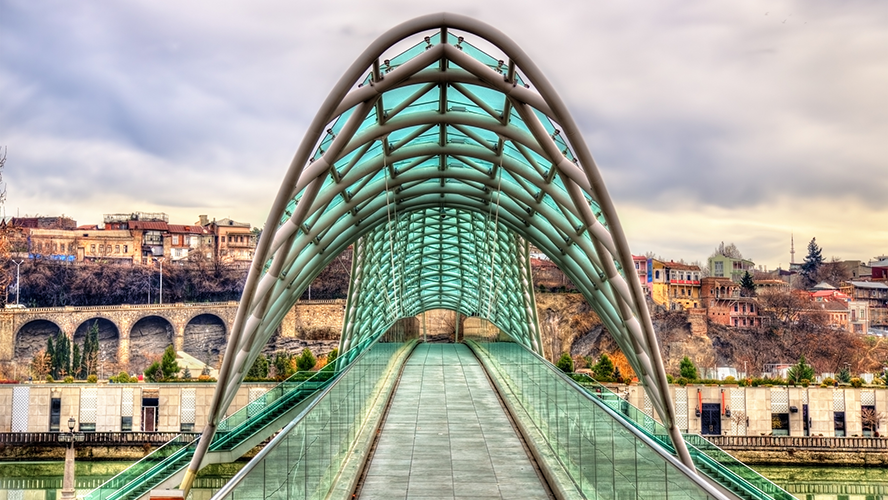
The location was not chosen at random either. It links Rike Park, which was also developed during those years as a large contemporary green space, with the old quarter, dominated by Metekhi Church and Narikala Fortress. In other words, it physically connects the new Tbilisi, with its wide avenues and institutional buildings, to the old town, with its narrow streets and wooden houses featuring cantilevered balconies. The bridge thus serves as an urban metaphor: a bridge between past and future.
Over time, the initial controversies have died down. Today, the Bridge of Peace is one of the most photographed spots in Georgia and a regular feature on any tour of the capital. Its presence has redefined the landscape of the old town, introducing a contemporary feature which, far from erasing the past, sets it in a different light.
Architecture and design: curved steel, 6,000 square metres of glass and an LED roof spanning the Kura
The bridge was designed by the Italian architect Michele De Lucchi, who is known for his work on institutional and cultural projects in Eastern Europe. The structure was prefabricated in Italy and transported to Tbilisi in sections, which were then assembled over the river Kura. The result is a footbridge approximately 150 metres long, supported by a system of steel arches that rest on just one of the banks, creating a sense of lightness and fluidity.
The roof consists of over 6,000 square metres of curved glass panels that provide shelter from the rain without visually isolating it from its surroundings. During the day, sunlight filters through the structure, casting geometric shadows on the floor; at night, the focus shifts to the lighting system created by French designer Philippe Martinaud. Thousands of LED bulbs embedded in the roof create light patterns which, according to their creators, spell out words related to peace and life in Morse code.
The bridge deck combines wood and weather-resistant synthetic materials, and its gentle slope ensures universal access. Walking along it provides a different experience depending on the time of day: at dawn, the glass reflects the pink hues of the Caucasian sky; at dusk, the silhouette of Narikala Fortress stands out against the backdrop; and once night has fallen, the structure resembles a luminous serpent suspended above the river.
Where is the bridge and how to get there: between Rike Park and Metekhi Church, in the old town
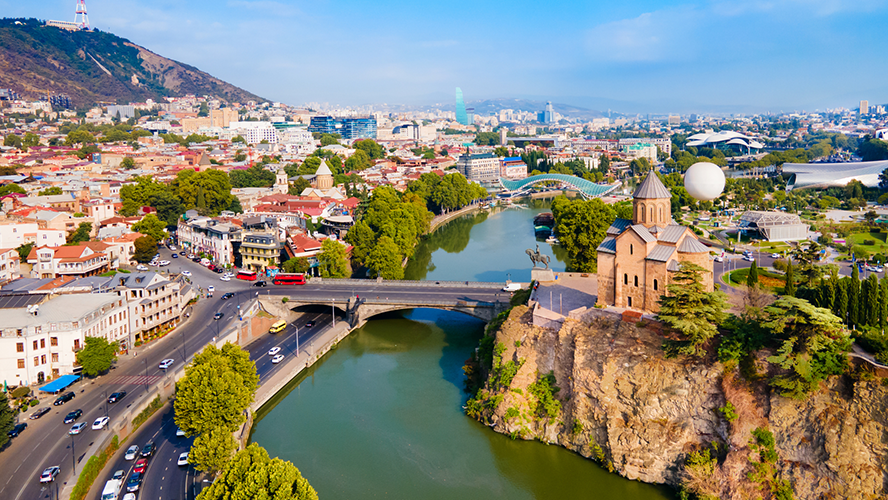
The Bridge of Peace is situated in the heart of Tbilisi, spanning the river Kura and linking the eastern bank where Rike Park is located with the western bank in the old quarter. At one end stands the 13th-century Metekhi Church, perched on a rocky outcrop overlooking the river. On the other side, the park’s extensive green space provides rest areas and access to the cable car that goes up to Narikala Fortress.
Getting to the bridge is easy. The nearest underground station is Avlabari, just a few minutes’ walk away. From Freedom Square, another of the city’s key hubs, you can walk down the streets that wind through the historic centre in about fifteen minutes. Many travellers include the bridge in a tour that starts at the sulphur baths in the Abanotubani district and continues on to Sioni Cathedral and Anchiskhati Basilica.
The best way to appreciate it is to stroll along the bridge at a leisurely pace and stop halfway to take in the river’s course and the layout of the old façades. From there, you can enjoy some of the most picturesque views of Tbilisi, where traditional wooden architecture stands alongside the domes of Orthodox churches, with the hills that surround the city in the background.
Things to see nearby: from Narikala Fortress to the sulphur baths in Abanotubani
The area immediately surrounding the Bridge of Peace is home to several of Tbilisi’s must-see attractions. As you cross into the old town, Metekhi Church provides one of the best views of the river and the bridge itself. Its sober and intimate interior contrasts with the modern glass structure just a few metres away.
The cable car departs from Rike Park and goes up to the Narikala Fortress, which dates back to the 4th century. Seen from above, the bridge reveals how it blends into the urban landscape: a curved line linking the park with the medieval streets. Nearby stands the statue of Kartlis Deda, the Mother of Georgia, who holds a sword in one hand and a wine glass in the other, symbolising hospitality and defence.
A short walk away lies the Abanotubani district, famous for its brick-domed sulphur baths. There, visitors can soak in the hot springs, following in the footsteps of Silk Road traders and writers such as Pushkin. The contrast between the oriental atmosphere of the baths and the contemporary aesthetic of the Bridge of Peace perfectly encapsulates Tbilisi’s cultural diversity.
The tour is rounded off by a visit to Sioni Cathedral, which is home to the cross of Saint Nino, and Anchiskhati Basilica, considered to be the oldest church in the city. All these sights can easily be visited in a single day, with the bridge serving as the visual and geographical focal point of the tour.