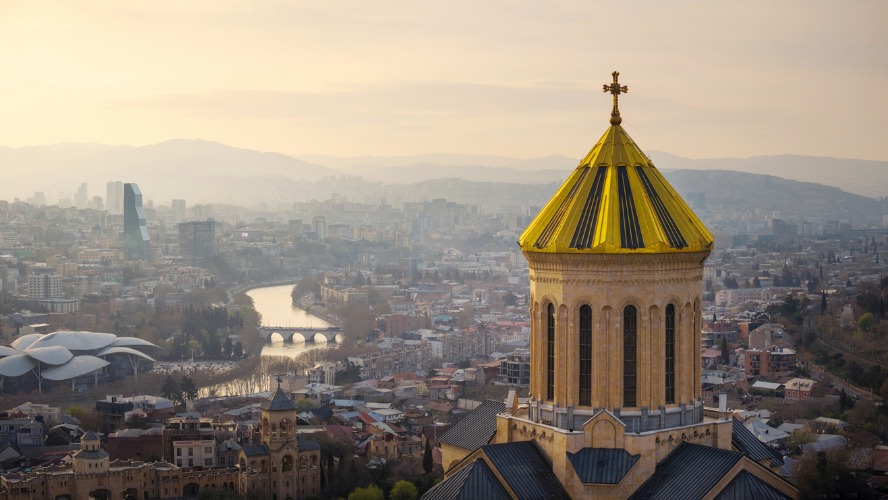













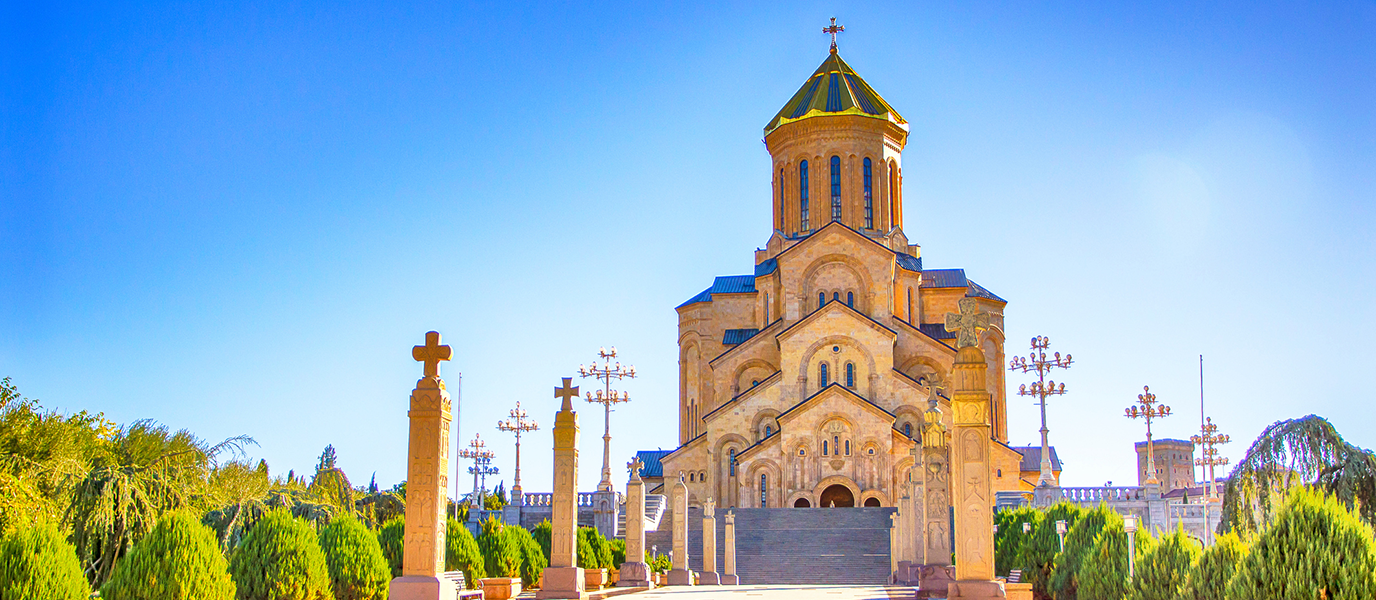
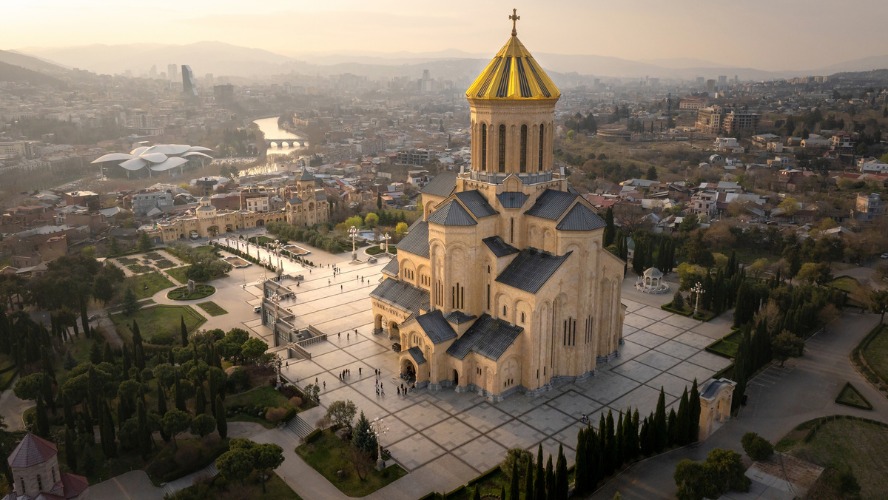
The scale of Tbilisi’s Cathedral of the Holy Trinity is surprisingly impressive. It is Georgia’s largest cathedral, and the third tallest Eastern Orthodox cathedral in the whole world. Popularly known by its sobriquet of ‘Sameba’, it was built relatively recently — between 1995 and 2004. It combines architectural styles traditionally found in Georgian religious buildings, although certain Byzantine touches are prominent.
It is the symbol of the new Georgia, and its beauty is genuinely impressive. It stands on the hill of Saint Ilia, on the bank of the river Kura, in the heart of the Avlabari district in Tbilisi’s historic quarter. The edifice is 101 metres tall and, when it was built, it exceeded the height of the tallest cathedral at that time, the 50-metre-tall Alaverdi cathedral in Kakheti.
Its golden cupola, crowned by a 7.5-metre gilded cross, can be seen from practically any point in Tbilisi, and offers dramatic, panoramic views of the city and surrounding hills. Inside the cathedral, visitors will also find the residence of the Patriarch and a monastery — along with the school of Theology and the Academy, a hotel and a total of nine chapels, five of which are below ground.
- A cathedral born with the twenty-first century
- An architecture that combines various elements
- Five underground chapels
- Advice and information for visitors
A cathedral born with the twenty-first century
The Cathedral of Tbilisi is possibly Georgia’s most visited monument. Its construction coincided with the 2,000th anniversary of Christianity and the 1,500th anniversary of the independence of the Georgian Church. Building was actually supposed to have begun in 1989, but did not commence until November 1995. The first religious service was held on 25th December 2002, while construction was still ongoing. The cathedral was consecrated by none other than Ilia II, the patriarch of the Georgian Orthodox Church, and by senior representatives of Orthodox churches throughout the world.
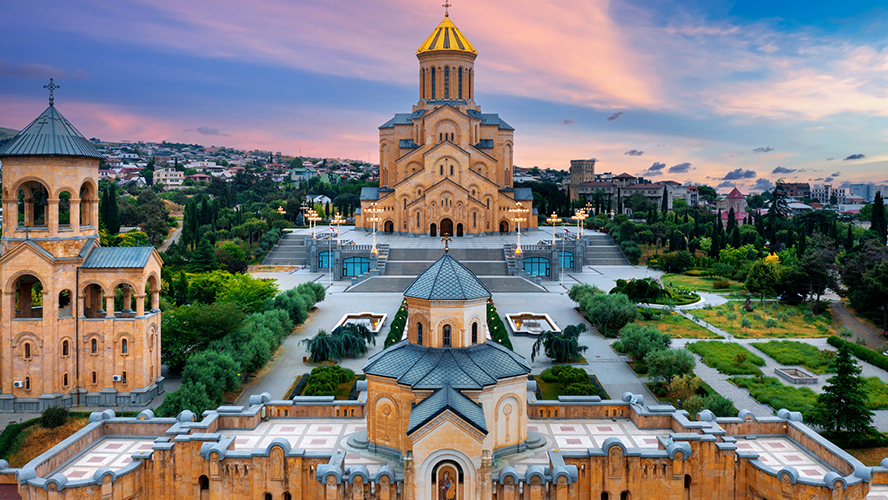
Construction of the cathedral was paid for by the city’s wealthiest inhabitants, and was completed in 2004. It is worth noting that Sameba’s cathedral square measures no less than 5,000 m2, and can hold up to 15,000 people.
An architecture that combines various elements
Tbilisi Cathedral was designed in the spirit of Modernism, and its architecture combines elements of traditional medieval Georgian elements with aspects of modern style. If you are lucky, you may hear a choir singing inside the church.
On the building’s façades, you can see very strange-looking arches and openwork. And on the interior walls there are curious frescoes made under the supervision of the icon painter Amiran Goglidze. Also involved in the cathedral’s pictorial works was the Catholic Patriarch of Georgia, Ilia II: he designed several icons and an image of the Holy Virgin that can be seen in the entrance. The cathedral has two underground floors, one of which is a museum and the other a conference hall.
Five underground chapels
It is worth noting that this cathedral, or at least part of it, was built on the site of a former cemetery known as ‘Khojavank’. This was a graveyard linked to an Armenian church that had been demolished along with the cemetery’s tombstones and monuments during the Soviet period. However, when construction of the new church began, pieces of tombstones and human remains began to emerge, and this sparked a huge debate.
Inside the cathedral there is a total of nine chapels, dedicated to the Archangels, John the Baptist, St. Nino, St. George, St. Nicholas, the twelve Apostles and All Saints, among others. Of these nine chapels, five are in an underground section. The church covers an area of over 5,000 m2, and the interior surface area is 2,380 m2.
It is worth taking a good look at the icons and frescoes to appreciate their beauty.
Advice and information for visitors
It is relatively easy to find the Cathedral of the Holy Trinity because its elevated golden cupola is a veritable lighthouse. It can be reached by car, on foot (30 minutes from the historic quarter), or on the metro, using the red line until Avlabari station, about 15 minutes away from the cathedral. You could make your way there by bus (routes 91, 122 or 391) as far as the ‘Cathedral of Sameba’ stop, which is five minutes’ walk from the cathedral’s main entrance. Minibus routes 434, 440, 479, 522 and 576 will also take you to the Cathedral.
As this is one of Tbilisi’s main tourist attractions, we recommend you visit early in the morning, or in the evening, when there are fewer guided tour groups. If you would prefer to join a guided tour, you need to remember that they last for 90 minutes.
The cathedral is open to visitors throughout the day, from 8.00 a.m. until 10.00 p.m., from Monday to Sunday. Photography is not permitted inside the building.