










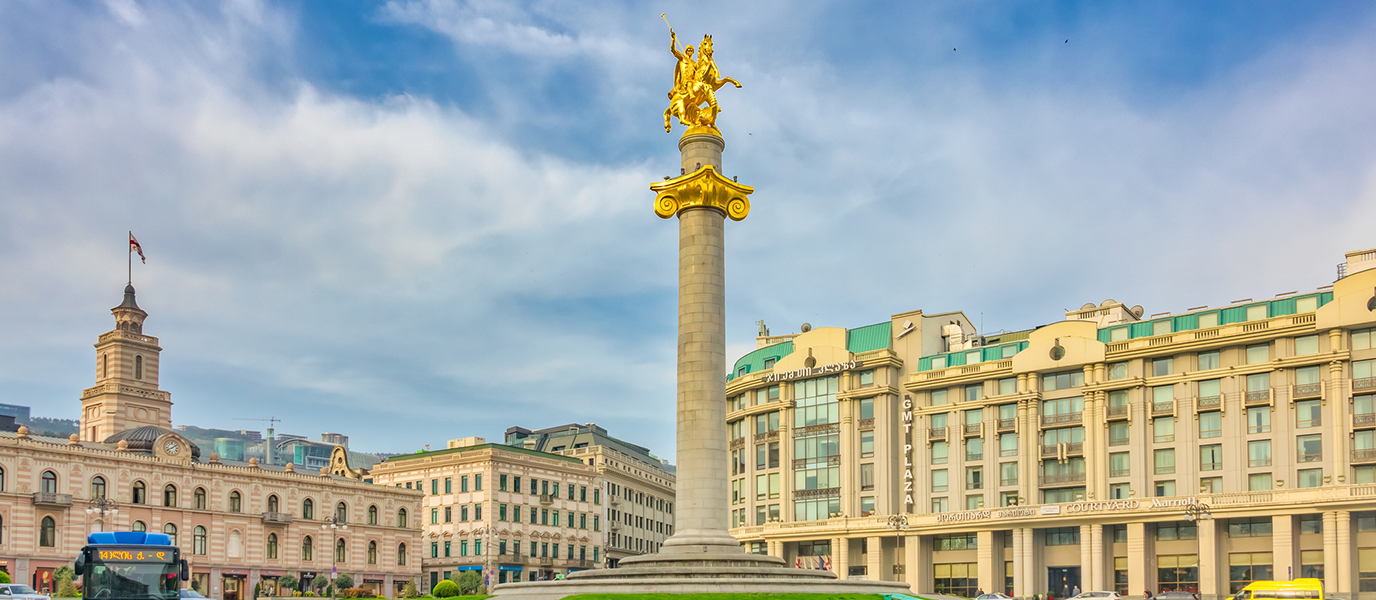
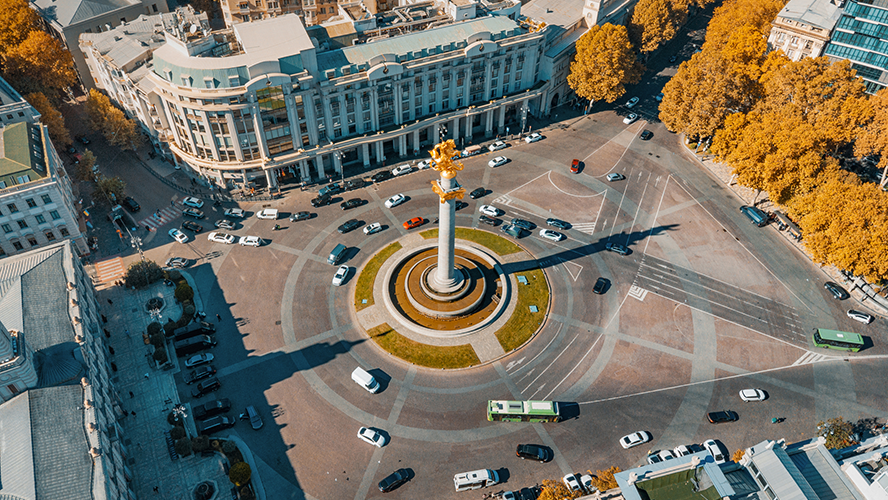
With its unusual, skewed trapezium shape, Tbilisi’s monumental Freedom Square is Georgia’s great symbol of unity, equality and independence. It has been the stage for many crucial events in the country’s history over the last two centuries, and is one of those places that every traveller must visit.
One interesting fact is that its name has been changed many times. In 1829, it was called Yerebanskaya Square in honour of General Paskevich-Yerevansky on account of his exploits during the Russo-Turkish war of 1828-29. Later, when this emblematic site had acquired a theatre and a caravanserai, it came to be called Theatre Square. The first time the title Freedom Square was used was in 1918, when Georgia declared independence from tsarist Russia. However, the Soviets changed the square’s name again in 1940, in honour of the politician and Bolshevik activist Lavrenty Beria. That lasted until 1956, when a monument to Lenin was erected in the centre, and the space was renamed Lenin Square. And finally, in 1991, when Georgia declared independence from the USSR, its name changed again, to Freedom Square. That was when the statue of Lenin was permanently replaced by a golden monument dedicated to St. George, designed by local artist Zurab Tsereteli in 2006.
- The history and political significance of Freedom Square
- Freedom Square: the nerve centre of Tbilisi
- Monuments and outstanding buildings
- What to see and do in the square and around
The history and political significance of Freedom Square
Freedom Square lies just behind Tbilisi’s defensive city wall. Before the nineteenth century, this space was known as Garetubani (outer district). The area began to develop with the arrival of important edifices, such as the General Trans-Caucasian Military Barracks (1824), located in one corner of the square, and the residence of the Georgian entrepreneur Jacob Zubalashvili, which now houses Georgia’s Museum of Art. In 1851, a theatre was added, but it was destroyed by a fire in 1874. It should be remembered that it was in this square that the 1991 Declaration of Independence was composed and the Massacre of Tbilisi occurred; it was also the scene of the 2003 Rose Revolution.
After the 1991-2 Georgian Civil War, several of the square’s buildings were destroyed, including in 2002 the twentieth-century Caucasus and International Hotel, later replaced by the Courtyard Marriott Hotel.
Freedom Square: the nerve centre of Tbilisi
In addition to being the nerve centre of Tbilisi, Freedom Square is the great pride and joy of the Georgian people, and a favourite haunt of visitors to the city. Almost all major celebrations and events (New Year, concerts, festivals, political demonstrations, and so on) begin in this square before spreading out into neighbouring (and similarly famous) Rustaveli Avenue.
The square is also surrounded by a host of restaurants of all types, where you can find everything from street food to traditional Georgian dishes, as well as European and Asian cuisine. The Georgian Machakhela chain of restaurants is very popular. And Tabidze Street is a gastronomic destination par excellence, and home to a plethora of establishments.
Next to the Square, you will find the attractive Alexander Pushkin Park, a relaxing space that is highly recommended for a few minutes’ peace away from the crowds of tourists. Inside the park, visitors can see a bust of the author of Eugene Onegin, call into the tourist information office or buy a book at the second-hand book stalls.
Monuments and outstanding buildings
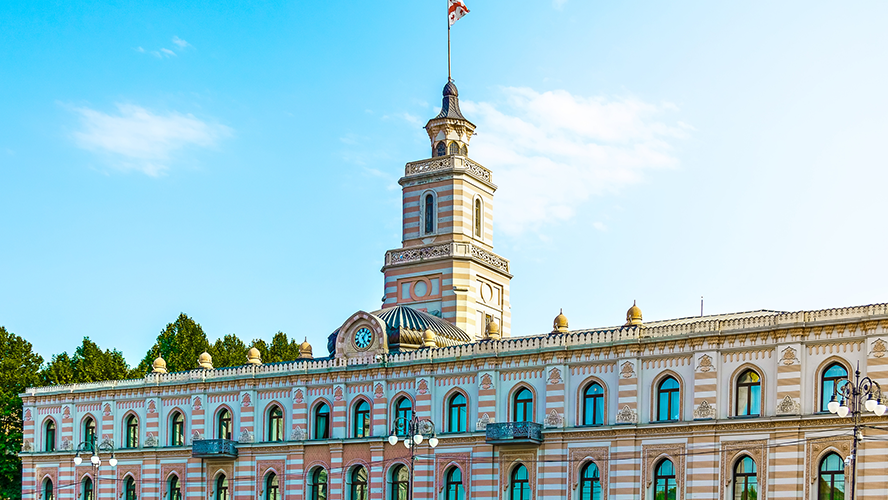
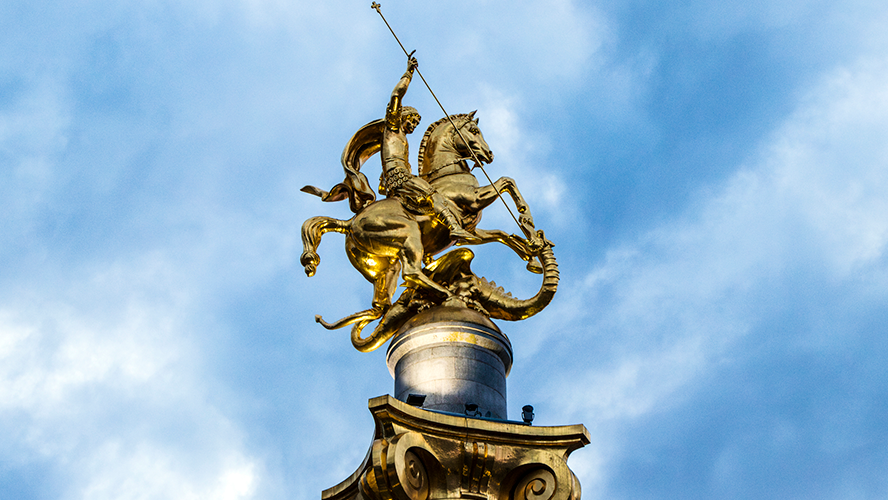
Nowadays Freedom Square is probably the city’s main tourist attraction, an essential visit for any traveller. The southern perimeter of the square is occupied by Tbilisi Town Hall, with its clock tower in the centre — built in the 1940s as the general Police barracks, and now the office of the Mayor and Municipal Assembly. It is also important to stop in front of the white column dedicated to St. George, a figure revered throughout Georgia. This granite monument is 35 metres tall, although the statue itself, carved in gilded bronze, measures just under 5 metres. It is the work of the Georgian sculptor Zurab Tsereteli, and it stands at the heart of Freedom Square.
What to see and do in the square and around
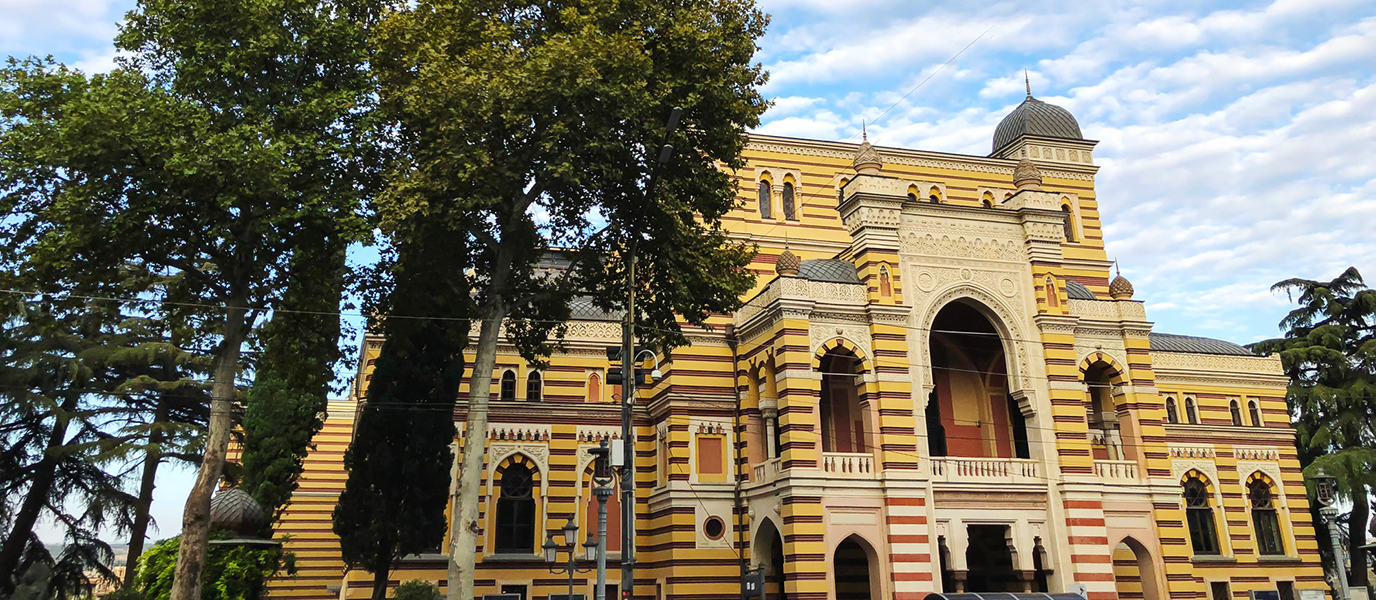
Without a doubt, this square is the perfect place to feel the pulse and the vibe of Tbilisi. You need to stop at each of its buildings, especially the most iconic ones, and to open your horizons from there to take in nearby areas of the city, such as vibrant Rustaveli Avenue, to discover the more modern face of Tbilisi. It is well worth taking a look at the old Narikala Fortress, and enjoying the Sololaki and Abanotubani neighbourhoods, with their many edifices with curved balconies and painted entrance halls. And if you follow the old city wall out of Freedom Square, you will come to Tbilisi’s historic quarter, and see a synagogue, a famous mosque and the Georgian, Georgian-Armenian and Catholic Orthodox churches. It is also worth visiting the National History Museum, the Opera House and the Griboedov Theatre, as well as shops and the Tbilisi Gallery’s food court. And, of course, there is the National Museum of Georgia — also known as the Shalva Amiranashvili Fine Art Museum, as it houses a major collection of around 140,000 pieces of Georgian, Eastern, Russian and European art.