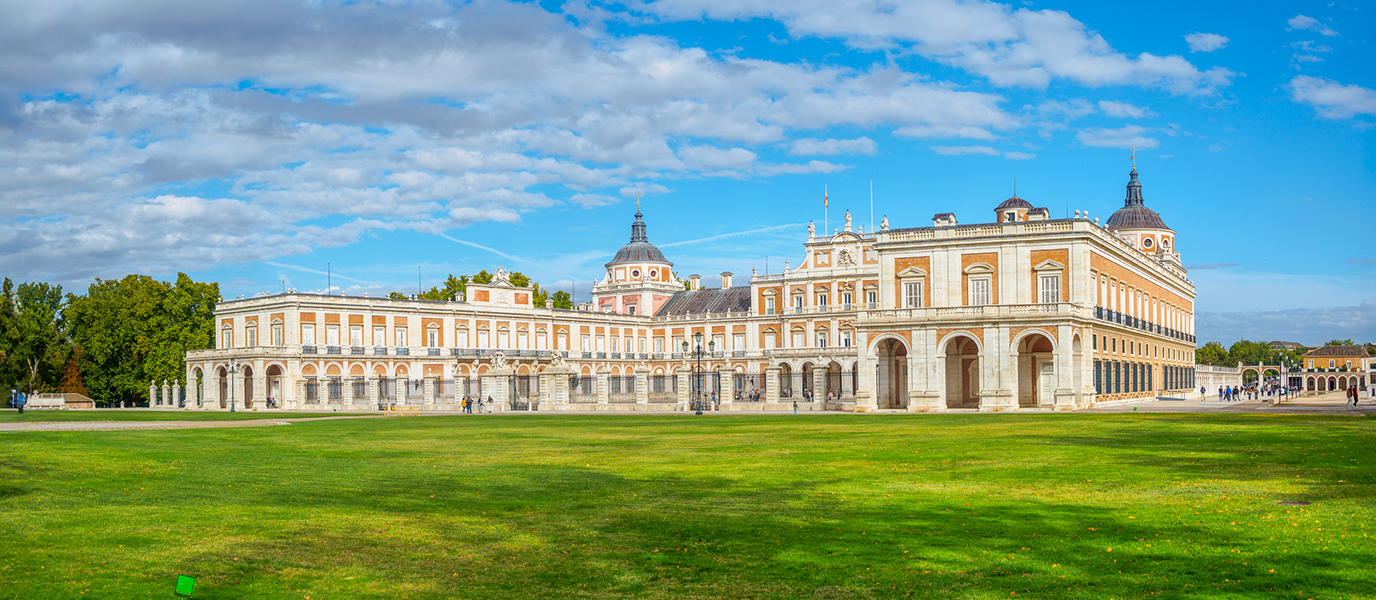


















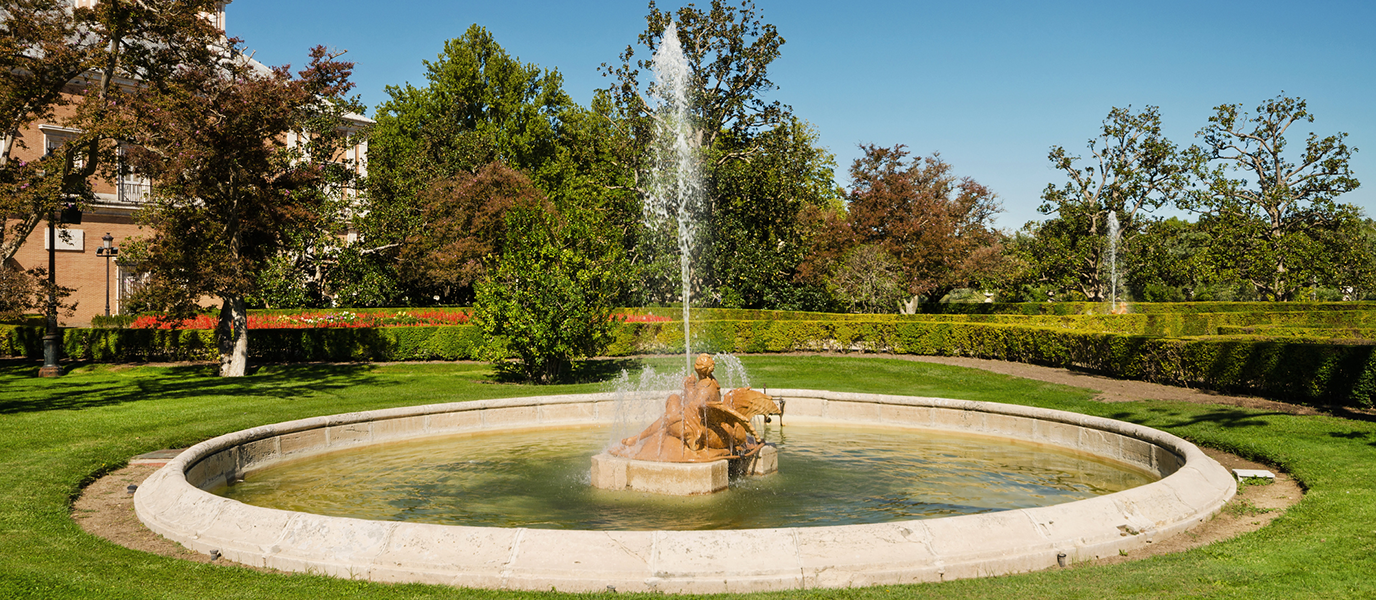
Aranjuez’s other historical gardens were designed for members of the court to enjoy strolling, hunting or leisure activities; the Jardín del Parterre however was created with a much more specific purpose — to be seen. It is no accident that the gardens lie directly opposite the main façade of the Royal Palace, as if they were an extension of its architecture beyond its walls with rows of plants, fountains, and perfectly calculated visual axes.
There is no spontaneity here. Every clipped hedge, every gravel path and every fountain is part of a logical, crafted design. The gardens acts as a green façade of royal power: anyone arriving in Aranjuez would see not just a palace, but a complete composition in which nature had been disciplined to reflect the political order of the eighteenth century.
- The history of Aranjuez’s Jardín del Parterre
- What to see in the Jardín del Parterre
- Interesting facts about the Jardín del Parterre
- What to see near the Jardín del Parterre
The history of Aranjuez’s Jardín del Parterre: from productive orchard to a Bourbon demonstration of French influence
The area of land now occupied by the Jardín del Parterre was originally an orchard linked to the agricultural system promoted in Aranjuez during the sixteenth century by Philip II. At that time, the Royal Site was not merely a place of leisure: it was also an agricultural laboratory where experiments were undertaken with crops, irrigation and spatial planning, thanks to the proximity of the rivers Tagus and Jarama.
During the seventeenth century and the early years of the eighteenth, this area retained most of its productive function, albeit with a few minor changes. However, the change of dynasty with the arrival of the Bourbons brought a drastic change for the whole concept of Aranjuez. Philip V, the new dynasty’s first king, introduced into Spain the model of the French garden he had seen in Versailles, where nature was subject to a strict geometry.
It was under Ferdinand VI that the first changes were made to transform this area into an ornamental garden. But it was during the reign of Charles III that the Jardín del Parterre would acquire its permanent configuration, within a broader programme of reforms in the town of Aranjuez and its surroundings.
Architects and gardeners linked to the court were involved in this process, figures such as Jaime Marquet and Pablo Boutelou (the latter being one of a series of royal gardeners of French origin who played a key role in the introduction of this French style into Spain). The result was a garden that did not merely imitate Versailles, but adapted its principles to the context of Aranjuez.
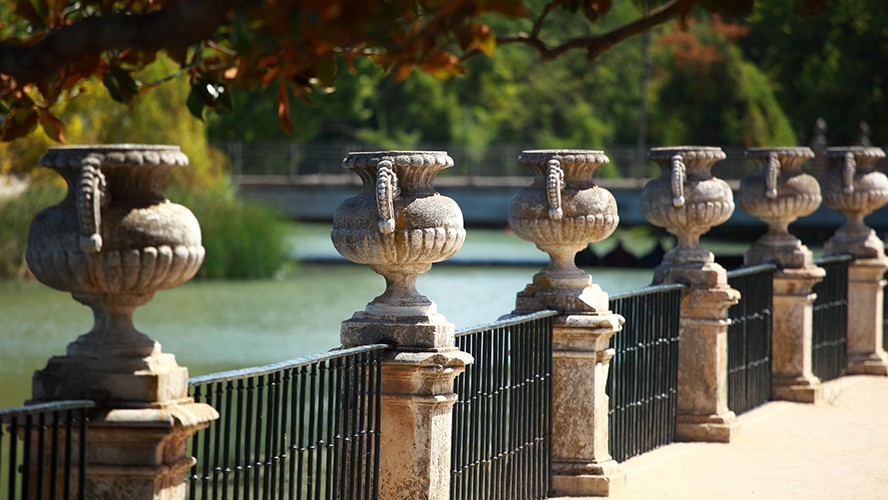
What to see in the Jardín del Parterre: mythological symbols, visual axes and geometrical precision
You do not walk around the Jardín del Parterre as you would a conventional garden: instead you read it. Each element forms part of a broader composition in which the central axis, aligned with the Royal Palace, organises the entire space. The experience is not so much one of walking, but more of seeing how the perspective is built.
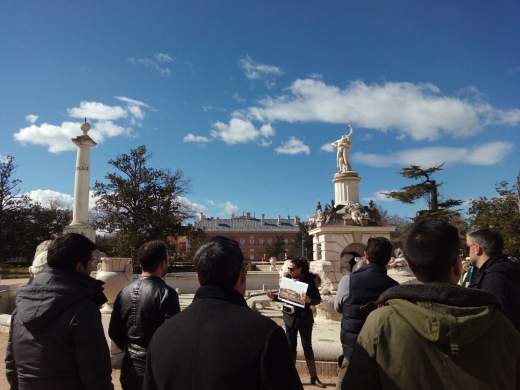
The fountain of Hercules and Antaeus: a political allegory carved in stone in front of the palace
The fountain of Hercules and Antaeus is one of the garden’s most heavily symbolic pieces. This sculptured composition depicts the moment when Hercules defeats the giant Antaeus by lifting him from the ground, depriving him of the strength he drew from it. In political terms, this mythological scene was interpreted as the victory of civilised power over brute force.
The fountain was not originally created for this site: it was brought here from another great Bourbon project, the gardens of La Granja de San Ildefonso. Its transfer to Aranjuez underlines the notion of continuity between the various Royal Sites. In addition, its position on the main visual axis makes this a kind of symbolic declaration for anyone approaching the palace.
The Fountain of the Nereidas: Baroque dynamism within a garden of rigid lines
In the face of the narrative tension of Hercules, the Fountain of the Nereidas introduces a more decorative and dynamic touch. The marine figures, inspired by classic mythology, generate a continuous movement that contrasts with the geometric rigidity of the parterres.
This type of fountain belongs to a Baroque tradition in which water is both a decorative element and an artistic resource. During the spring and summer months, when the fountains are in operation, the sound of the water adds a sensory dimension that completely transforms our perception of the space.
Ornamental flower beds: garden engineering at the service of perspective
The flower beds are the true heart of the garden. Designed with almost mathematical precision, they combine clipped box hedging, gravel and lawn to create geometrical drawings that can only be fully appreciated from an elevated position, and particularly from rooms in the Royal Palace.
This type of design, known as the French parterre style, involves constant maintenance. The gardeners need to cut the hedges several times a year to maintain their defined shapes. During the eighteenth century, this work was carried out by a court organisation in which even the care of the gardens was a matter for the State.
Interesting facts about the Jardín del Parterre: details that reveal a function beyond the purely decorative
One of the less obvious aspects of the Jardín del Parterre is its role as a space for diplomatic relations. Receptions and official promenades often began here, where the layout of the gardens acted as a visual introduction to the power of the monarchy.
Another point of interest is the gardens’ relationship with the seasons. Unlike more natural-style gardens, the changing seasons here mostly affect the colour and density of the flower beds, but they do not affect the structure. The garden was designed to keep its structure even in winter, when the vegetation loses some of its intensity.
In addition, the hydraulic system that supplies water to the fountains forms part of a historical network of channels and irrigation ditches that developed in Aranjuez from the sixteenth century onwards. This system enabled the gardens to be watered, but it also supplied the agricultural crops and regulated the use of water throughout the Royal Site.
What to see near the Jardín del Parterre: continuity between gardens, architecture and royal design
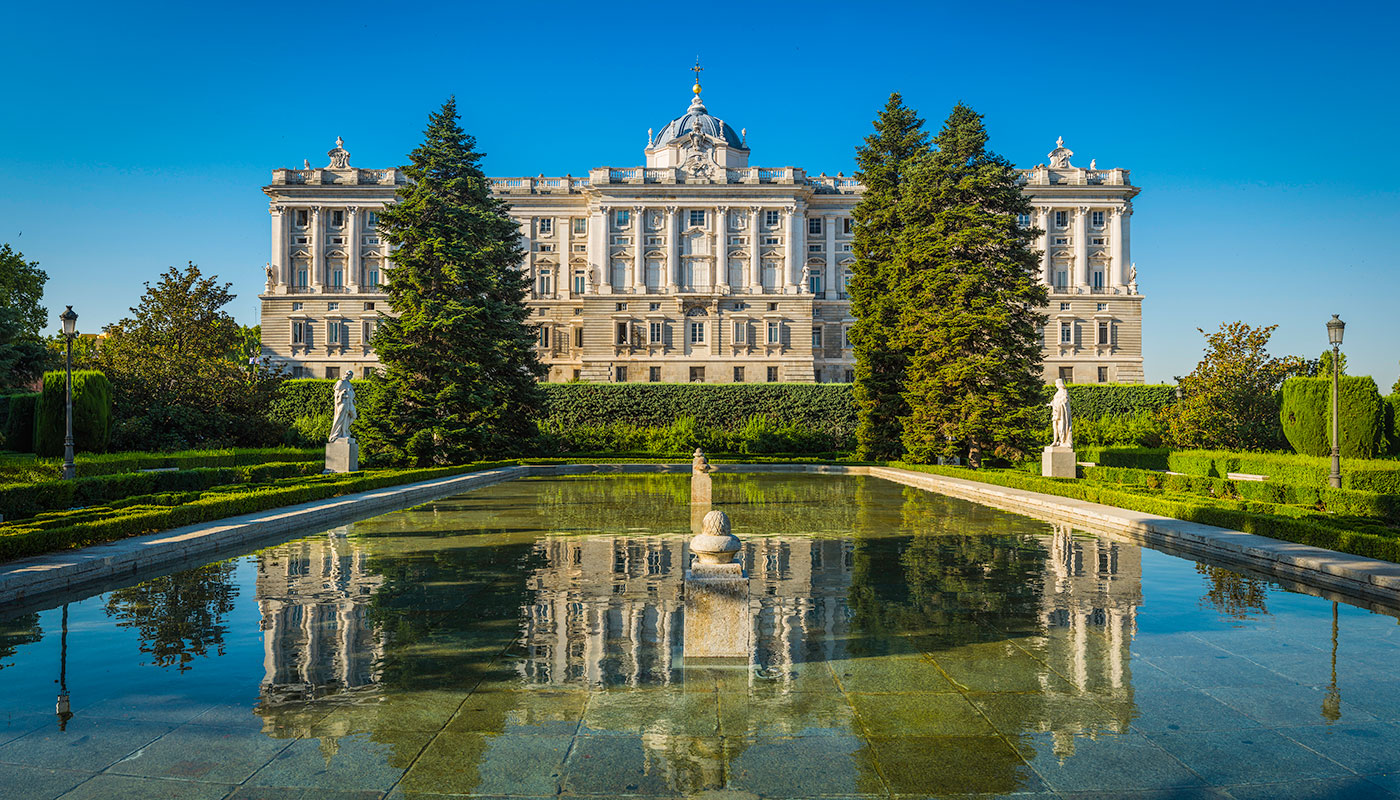
The Jardín del Parterre cannot be understood in isolation. Just behind it stands the Royal Palace of Aranjuez, whose main façade was conceived to maintain a direct dialogue with this space. From the palace windows, the monarchs and their guests would view the gardens as part of the court spectacle.
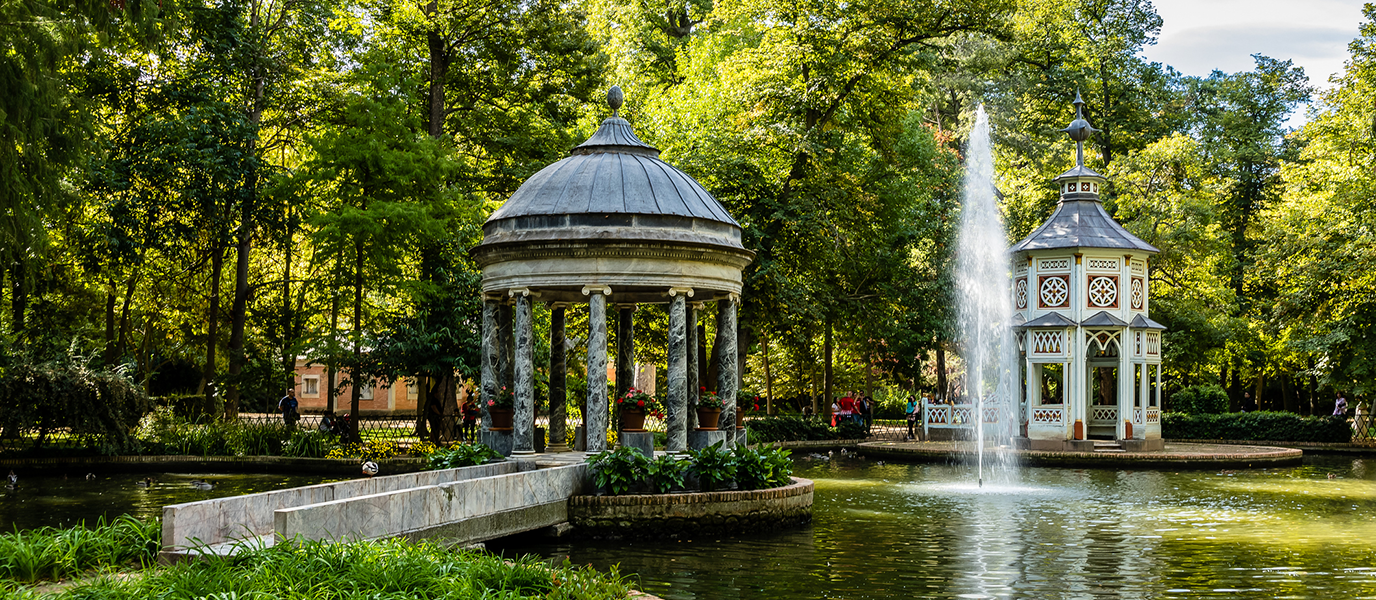
A stone’s throw away lies the Jardín de la Isla, of Renaissance origin, where the design changes radically in favour of a more intimate, enclosed model. This contrast enables us to understand the evolution of landscape design between the sixteenth and eighteenth centuries.
Also recommended is a visit to the Plaza de Parejas, a large open space where mock jousting games and court processions would be held. This site underlines the idea that Aranjuez was not simply a collection of gardens, but rather an authentic town designed to serve the court.