

















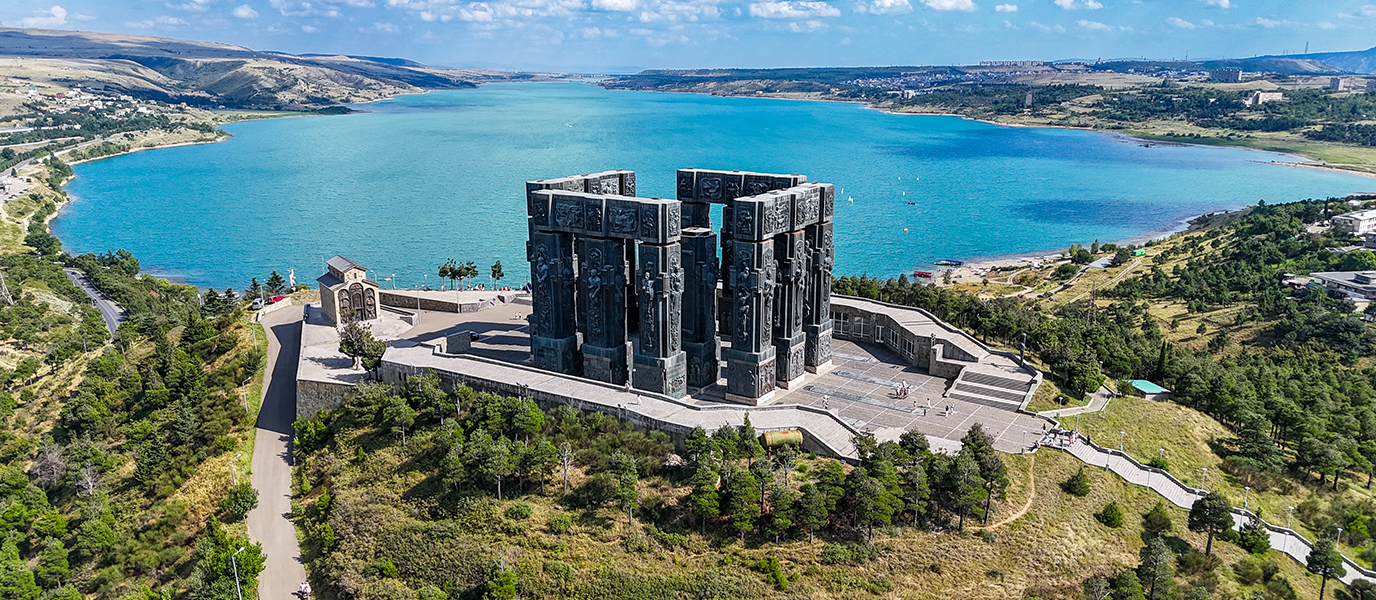
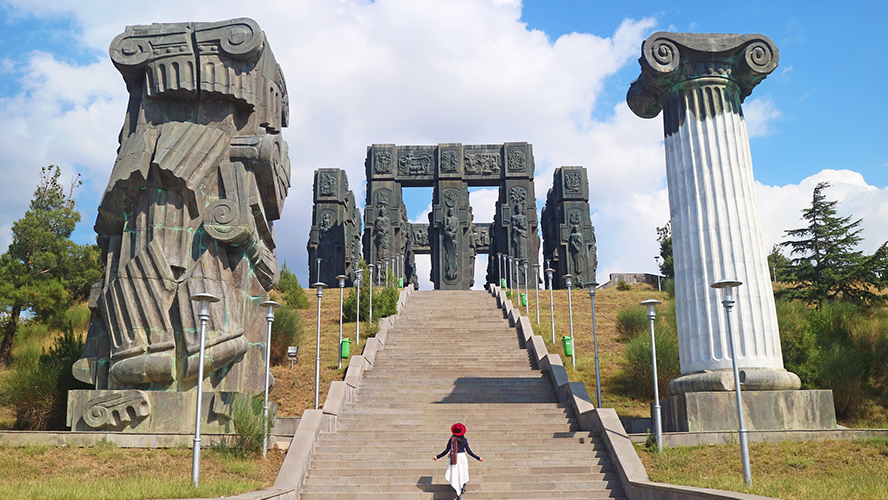
Some monuments are made to be gazed at, while others are made to be read. The Chronicle of Georgia belongs to the latter category. Standing on a hill to the north of Tbilisi near the reservoir known as the Sea of Tbilisi, this group of sculptures unfurls a visual narrative starting with the pre-Christian monarchs and continuing up to biblical scenes linked to the Georgian identity. Sixteen monumental columns, each around 30 metres tall, are positioned to form a kind of cloister open to the sky. From a distance, they look like abstract blocks, but close up, detailed reliefs can be seen to cover their surfaces: regal figures, religious scenes, episodes that have marked the country’s historical development. The wind that blows from the reservoir and the breadth of the horizon strengthen the impression of standing before a work designed not only to impress, but also to explain.
- The history and meaning of Tbilisi’s most impressive monument
- Sculptures and symbolism
- Advice and information for visitors
- What to see and do in the surrounding area: the ‘sea of Tbilisi’ and the expanding northern districts
The history and meaning of Tbilisi’s most impressive monument: a commemoration of the epic history of Georgia created in the late Soviet era
Construction of the Chronicle of Georgia began in 1985, during the final years of the Soviet Union. It is the work of the sculptor and internationally known Georgian artist Zurab Tsereteli, who would later design large-scale monuments in Moscow and other capitals. The choice of location was no accident: an imposing hill, visible from various points in the north of the city, that allowed the creation of a monumental complex far beyond the limitations that would have been imposed by a site within the historic quarter.
The project was conceived with the aim of synthesising the history of Georgia in a modern monumental language. At a time when the national identity was in the process of being redefined within the Soviet framework, this work of art acted as a cultural statement. In its carved reliefs, the monument reclaims Georgia’s medieval monarchs, the dynasties that established the territory, and the central role of Christian Orthodoxy in the formation of the country.
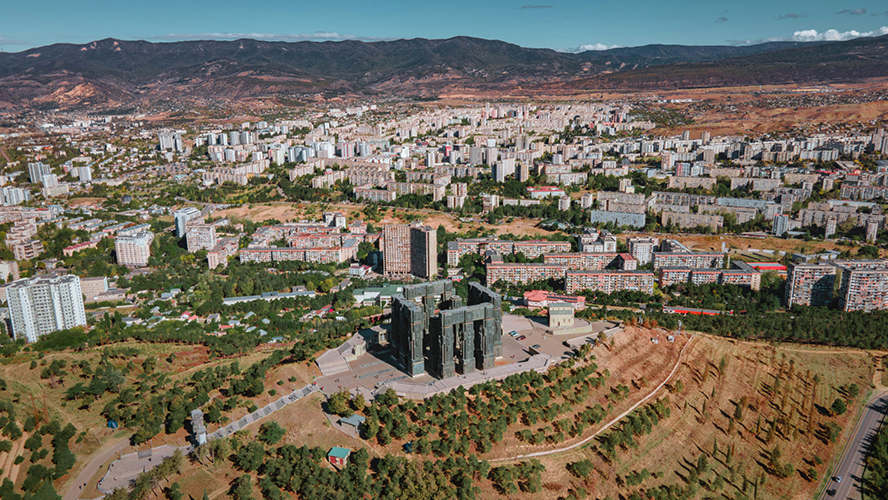
It construction, however, was never officially completed. Some parts of the complex remained unfinished, and it developed as time went on. This open condition adds an extra layer of meaning: rather than a closed monument, the Chronicle of Georgia seems to be a work in progress — as if the story it tells is still being written.
After Georgia gained its independence in 1991, the monument acquired a new significance. What could originally have been seen as a cultural statement within the Soviet system, came to be an explicit symbol of national sovereignty. The figures of the monarchs, the scenes of evangelisation and the historic passages carved in stone can today be read as an assertion of historical continuity in the face of the upheavals witnessed during the twentieth century.
Sculptures and symbolism: medieval monarchs, biblical passages, and the cross of Saint Nino in relief
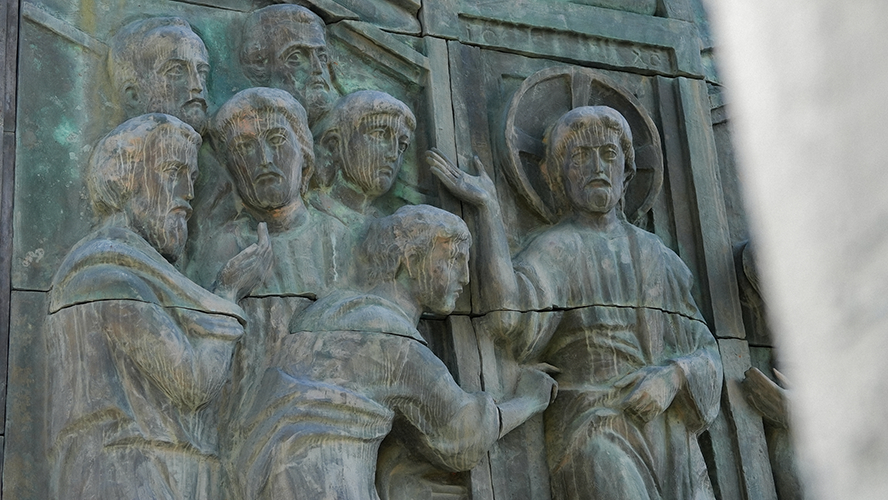
Each of the 16 columns is divided into sections. Monarchs and historic figures of Georgia are depicted on the top part, sculpted in high relief with vestments, crowns and attributes associated with different ages. They include King David IV, (known as David the Builder), and Queen Tamar, whose reign in the twelfth century marked one of the most splendid periods of the Georgian kingdom.
- On the lower part, there is a change of tone, with scenes from the New Testament and episodes related to the country’s conversion to Christianity. Georgia adopted Christianity as its official religion in the fourth century, and that historic decision underlies much of the monument’s iconography. The cross associated with Saint Nino, who brought Christianity to the region, appears as a recurring symbol, reinforcing the idea of a nation defined as much by its faith as by its political history.
- The sculpture combines a monumental vision along with fine detail. From a certain distance, the figures appear as imposing blocks, but as you get closer, you can see folds, gestures and highly detailed scenes that encourage the visitor to approach the monument in a calm frame of mind. It is not a matter of only looking upwards, but of walking among and around the columns and discovering how every surface offers a different fragment of the story.
- The elevated and open central area almost acts as a ceremonial square. It overlooks the reservoir and the building developments in the north of Tiflis. The combination of historical narrative and contemporary panorama generates an interesting contrast: while the stones tell the story of the county’s medieval past, the horizon shows the modern expansion of the capital city.
Advice and information for visitors: monumental staircases and views of the ‘Sea of Tbilisi’
How to get there
The Chronicle of Georgia stands at the top of a gentle slope. Having arrived by car or taxi, visitors then have to climb a wide staircase that leads to the main level of the monument. There is little shade in the upper part, so in summer, its is a good idea to bring water and sunscreen, particularly around the middle of the day.
Practical tips
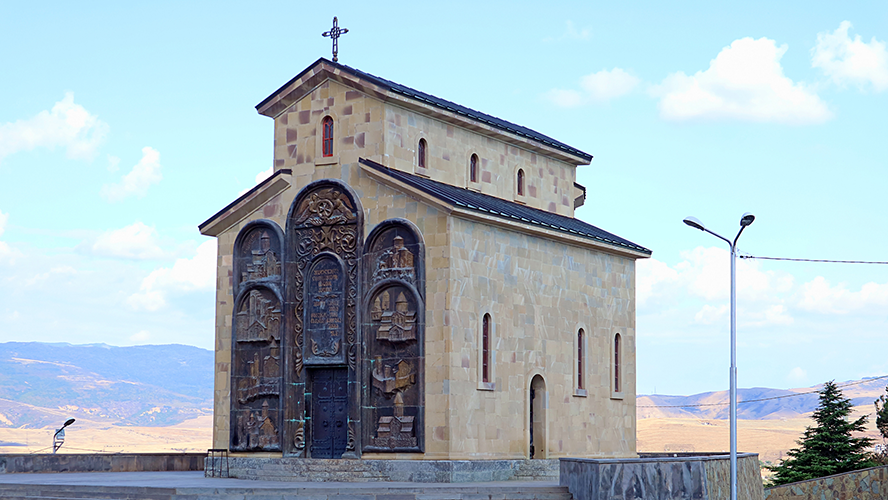
Admission is free, and the complex is always open, as it is an outdoor space. There is no formal interpretation centre or detailed explanatory displays, so to enjoy your visit to the full, it is worth finding out in advance something about the characters and scenes portrayed. However, the experience is free and there are no restrictions: you can explore the monument at your own pace and stop at the points that afford the best views of the reservoir.
Duration of the visit
The amount of time required for a visit depends on how much interest you have in the details of the sculptures. A quick tour could take between thirty and forty minutes, but if you want to have a close look at the reliefs and enjoy the picturesque setting, you could spend an hour or more here. You could combine the visit with a trip to other points of north Tbilisi on the same day.
What to see and do in the surrounding area: the ‘sea of Tbilisi’ and the expanding northern districts
Not far from the monument lies the Tbilisi reservoir, popularly known as the ‘sea of Tbilisi’. Built in the 1950s, the artificial lake provides the city’s water and has also become a leisure facility. In summer, there are areas adapted for bathing and water sports, offering a relaxed counterpoint to the monument’s intense symbolism.
On the nearby hills, new residential areas and recreational facilities have sprung up in recent years, evidence of the city’s expansion northwards. Although it attracts less traditional tourism, this area allows visitors to see another, more recent and evolving aspect of the Georgian capital.
If you have time, you could extend your visit to include other emblematic sites on a longer route through the city, before returning to the historic centre to see the churches, the cobbled streets and the viewing points over the river Kura. In this context, the Chronicle of Georgia acts as a monumental and panoramic counterpoint to the more intimate scale of the historic quarter.