














This public edifice, one of the most typical in Aranjuez, was built in the nineteenth century with a practical aim: to improve the hygiene of the products that were sold in the square. Soon, however, it became an exemplar for other towns and cities, as it is one of the first examples of ironwork architecture in Spain, a style that was already beginning to sweep across Europe.
- The history of the Market Hall: a quest for improved hygiene
- The building’s architecture: iron and white stone
- Stall and products in the Market Hall that come from the farmland around Aranjuez
- Opening times and information for visitors to this traditional market
The history of the Market Hall: a quest for improved hygiene
- The origins of the market date back to the eighteenth century. It is in 1775 that the name Plaza de Abastos [Market Square] first appears on a plan drawn up by Domingo de Aguirre to indicate a fair that was held outdoors, and where the traders arranged their goods on wooden tables and in drawers, with no great concern for hygiene.
- What has now become one of the town’s most important public buildings was built in the late nineteenth century, and was designed by the architect Enrique Sánchez Sedeño.
- Work on the building was not begun until 1891, and then three years later, on 30th December 1894, the market officially opened.
- By the beginning of 1895, the Market Hall, the first building in the town to have been sponsored by the Town Hall, was functioning normally.
- We need to bear in mind that over the course of the twentieth century, the building underwent several changes. The most important changes occurred during its restoration in 1985, directed by the architect Enrique de Teresa, and in 1997, when it was modernised with the addition of glazed enclosures and interior improvements.
The building’s architecture: iron and white stone
The Market Hall is one of the first examples of the famous ironwork architecture to be built in Spain. This type of industrial, late nineteenth-century, public architecture was already beginning to appear in Europe, but in this case it was being used in civil architecture, for a market.
The Market Hall building combined exposed brick with the famous white stone from Colmenar (a neighbouring town), along with iron and glass. It was planned that the building would be consistent with the scale and volumetrics of Aranjuez’s historic quarter, so that it would blend in in perfect harmony.
In fact, we can see that the building displays similarities with nineteenth-century residential and palace architecture, along with certain neo-Mudejar details; it therefore fits in perfectly with the other riverside buildings, and especially with the Plaza de la Constitución, which has been presided over by the statue of Alfonso XII since 1897.
The stalls around the perimeter delineate a vast, light and airy central space which continues to provide storage and display for the products sold almost every day in this market.
Stall and products in the Market Hall that come from the farmland around Aranjuez
This space has become a unique scenario from which to appreciate the riverside agricultural land that has contributed so much to Aranjuez’s fame; its vegetables are at the top of the list, but there is also the tradition of locally produced offal and its most popular recipes.
The market boasts classic stalls selling fruit, bread, meat, offal, poultry, fish, delicatessen and groceries, with familiar brand names such as Frutería Tinín and Panaderías Pan Yepes.
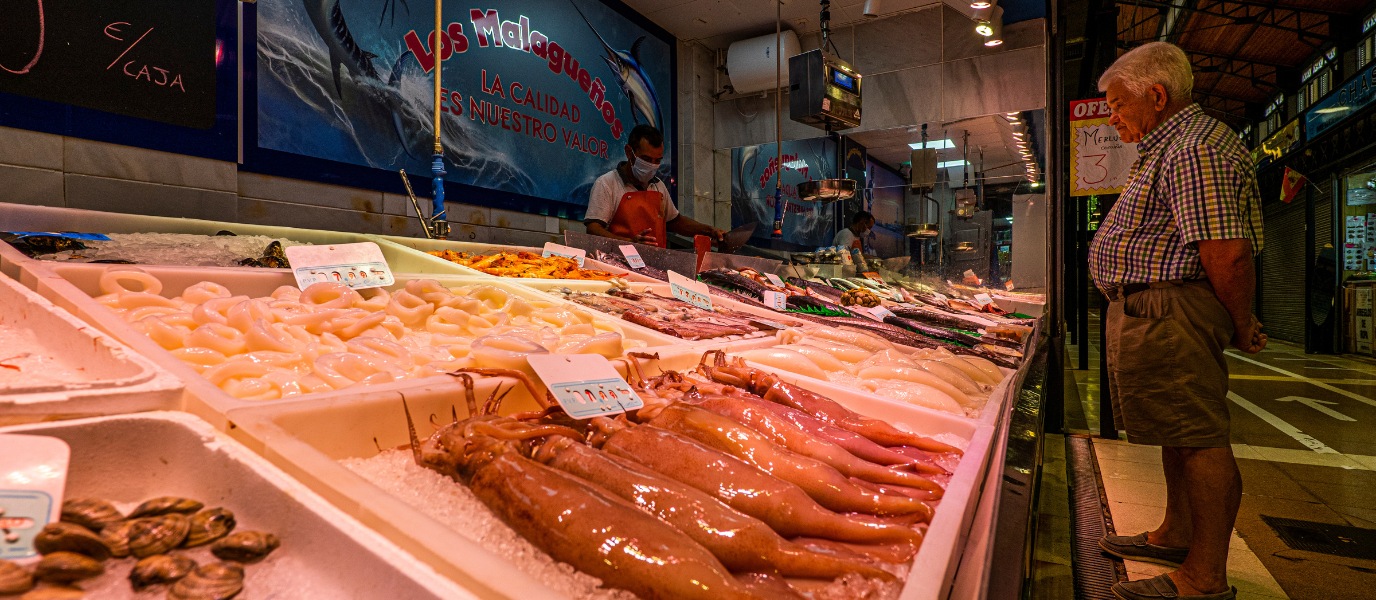
Most of the stalls sell fresh produce, such as seasonal fruit and vegetables, but you will also find fish, seafood, meat and offal. The market also has stalls selling miscellaneous goods, tinned foods and nuts that complete the picture of everyday gastronomy in Aranjuez.
Opening times and information for visitors to this traditional market
The address of Aranjuez’s Market Hall is the Plaza de la Constitución (no number); in other words, it is in the very heart of the town, and close to the main tourist attractions, such as the Royal Palace and the gardens.
Normal opening hours are Mondays and Saturdays, mornings only, until 2.00 p.m., then from Tuesday to Friday, from 9.00 a.m. until 2.00 p.m., and from 5.30 p.m. until 8.30 p.m. The market is closed on Sundays.
Before your visit, it is a good idea to consult the Market Hall website, because the opening hours can change on public holidays, and also because the market puts on special campaigns and activities that may be of interest.